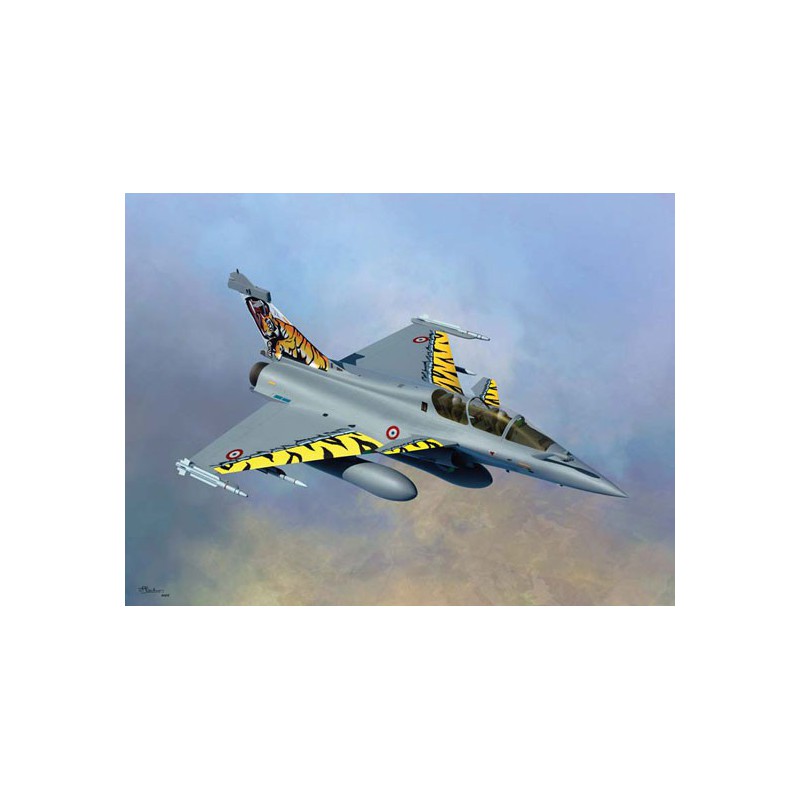
Proposed decorations
-
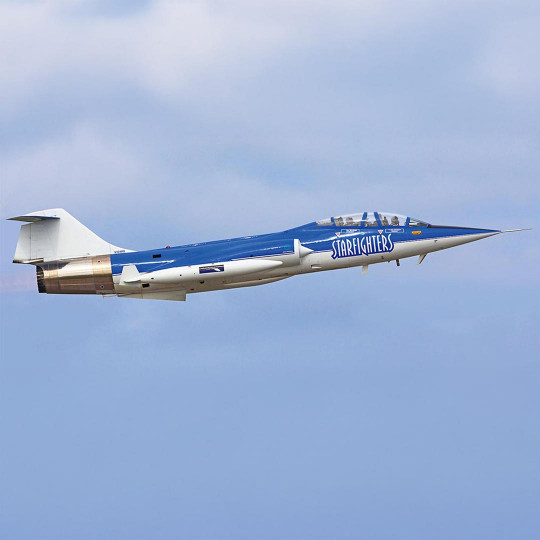
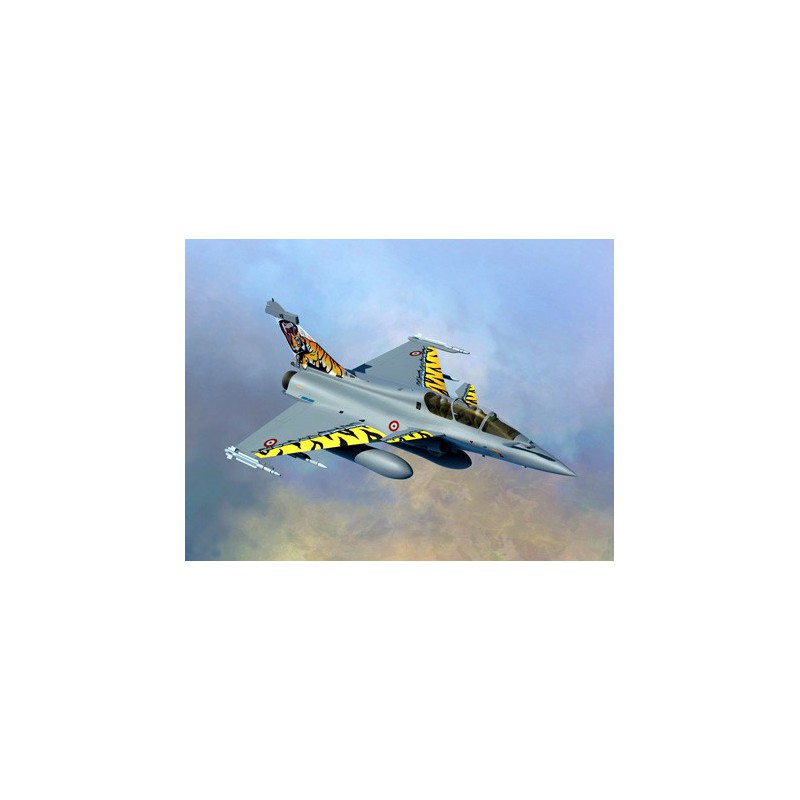
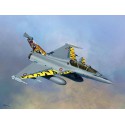
French Air Force, 330-EE, NATO Tiger Meet 2006
-
French Evaluation and Testing Unit, 330-EC "Eye of the Tiger", NATO Tiger Meet 2006
Additional features
The model consists of approximately 120 light gray plastic parts as well as 5 transparent parts.
The fuselage and wings feature finely engraved structural lines, providing a realistic level of detail for this 1/72 scale Rafale B model.
Model
When I discover a Rafale B model to assemble, I immediately understand that it is not just a variant of the classic Rafale. This two-seater version of the famous French fighter jet has a unique configuration that makes it very interesting to reproduce in a Rafale plastic airplane model.
The Rafale, developed by the French aircraft manufacturer Dassault Aviation, was designed to modernize the French military aviation and replace several older aircraft used by the French Air Force and Navy. Among the aircraft to be replaced were notably the SEPECAT Jaguar and the F-8 Crusader used by the French naval aviation.
The first prototype of the Rafale made its maiden flight on July 4, 1986, marking the beginning of an ambitious aeronautical program. The first production version of the Rafale then took to the skies on December 4, 1998, before being delivered to the French air forces.
For aviation and modeling enthusiasts, these dates represent an important milestone in the history of modern military aviation. Assembling a plastic model of the Rafale B allows rediscovering this technological evolution through a detailed scale model.
A family of Rafale aircraft consisting of several versions
The Rafale platform was designed to be extremely versatile. To meet the needs of different military missions, the aircraft exists in three main versions.
First, there is the Rafale C, a single-seater version intended for operations from air bases. The Rafale M, on the other hand, is adapted for operations aboard aircraft carriers.
Finally, the Rafale B is the two-seater version of the aircraft. This configuration allows for two crew members to be on board, seated in tandem in the cockpit. This feature is particularly useful for certain complex missions, including penetration operations or missions requiring advanced weapon system management.
For modelers, this difference in configuration is immediately visible. The longer canopy and the presence of two cockpits give the Rafale B model a slightly different silhouette from the single-seater model.
A versatile and technologically advanced combat aircraft
The Rafale was designed as an aircraft capable of performing various missions. Thanks to the full integration of its weapon and navigation systems, it can intervene in both air combat missions and ground attack operations.
This versatility is one of the main strengths of the Rafale. The aircraft can engage multiple aerial targets while being able to carry out air-to-ground missions sometimes far behind enemy lines.
For fans of Rafale model airplanes to build, this versatility often translates into the presence of numerous equipment in the kits: missiles, additional fuel tanks, or equipment pods.
Assembling a plastic model of the Rafale B allows reproducing an aircraft capable of fulfilling multiple operational roles.
The Rafale B01 Air prototype
Among the prototypes developed during the Rafale program, the Rafale B01 holds an important place. This aircraft, recognizable by its camouflage livery, has a very similar architecture to that of the Rafale C01.
In reality, the two aircraft share about 90% of their common elements. However, the addition of a second cockpit leads to several technical modifications.
The Rafale B is about 700 kilograms heavier than the single-seater version. Additionally, the space taken up by the second cockpit reduces the fuel capacity by about 500 liters.
To accommodate this second cockpit, certain parts of the aircraft have also been modified. The air intake for the cooling system has been redesigned to allow for the installation of the second cockpit.
Both cockpits are designed to be identical and interchangeable, which facilitates crew training and the execution of the most complex missions.
A detailed Rafale B model for enthusiasts
In the world of modeling, several manufacturers offer Rafale B model kits to assemble, some of which faithfully reproduce the proportions and characteristics of this aircraft.
For example, some models offered in 1/72 scale allow for a compact yet detailed model, ideal for collectors or military aviation enthusiasts.
In this scale, the dimensions of the model are generally as follows:
-
Length: 213.02 mm
-
Wingspan: 142.61 mm
Some kits contain numerous parts to assemble in order to replicate the fuselage, delta wings, landing gear, and the characteristic two-seater cockpit of the Rafale B.
Among the manufacturers offering this type of model is notably Hobby Boss, a well-known brand in the field of aeronautical modeling for its detailed and accessible kits.
A miniature reproduction of a modern combat aircraft
When I take the time to assemble a Rafale B model kit, I often feel like I'm recreating a miniature version of an extremely modern combat aircraft.
Each assembly step helps to better understand the design of this aircraft, from the fuselage structure to the two-seater cockpit configuration.
For military aviation and modeling enthusiasts, the plastic Rafale B model kits to assemble offer an excellent opportunity to explore in detail one of the most advanced fighter jets designed by the French aerospace industry.








 4.6/5
4.6/5