
Why has Evergreen become the global reference for styrene profiles in modeling?
When I talk to model makers, railway modelers, or architects, a question often comes up: what is the best brand of plastic profiles to build or enhance a model?
Behind this question lie several needs. You may be looking for styrene sheets, a plastic card, Evergreen profiles, plastic tubes, or simply a reliable material to carry out a scratch-building project.
If I had to give a one-sentence answer, I would say that Evergreen Scale Models is the global reference today.
It's not just because this brand is well-known.
It's mainly because it has established itself over the decades thanks to consistent manufacturing quality, an incredibly vast range, and user-friendliness that saves valuable time.
I completely understand the hesitations when starting out. Browsing specialized shops or websites, you discover hundreds of references: plastic sheets, U profiles, angles, I-beams, Evergreen tubes, plasticard, styrene sheets... It can sometimes be difficult to know where to start.
Yet, from the first creations, I notice that a good material completely changes the way of working.
A piece cuts more easily, a bond becomes cleaner, paint adheres better, and the final result immediately appears more realistic.
This is precisely what explains Evergreen's success with several generations of model makers.
Today, the brand's products are no longer reserved for plastic model enthusiasts.
They are used in railway modeling, creating dioramas, architectural models, industrial prototyping, design, special effects, architecture schools, and even some miniature model restoration workshops. Few manufacturers can claim such a diversity of applications.
Download the EVERGREEN catalog.
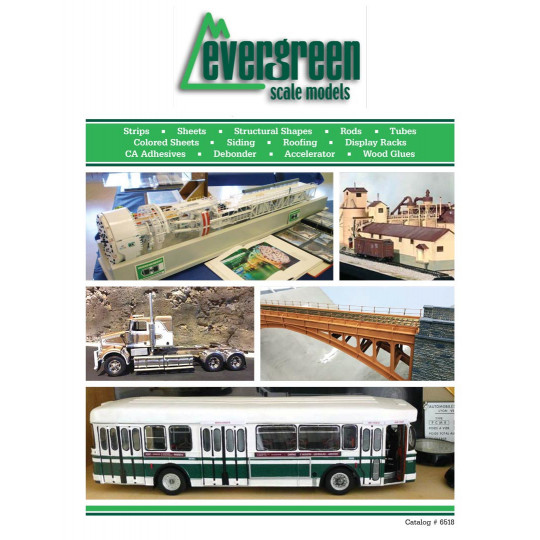
Why has Evergreen become the leading brand for plastic profiles?
In my opinion, Evergreen's success is based on a very simple principle: offering a material that allows full creativity.
When I open a model kit, I already know that some parts will need improvement. Manufacturers are sometimes limited by the constraints of molding.
Some structures are intentionally thickened for easier production. Other details are simply missing.
It is precisely at this moment that Evergreen profiles become essential.
Instead of accepting the kit's limitations, I can make a bulkhead, a walkway, a fuselage reinforcement, a metal frame, a cockpit interior, a wagon floor, or even a complete building facade myself. I am no longer solely dependent on the parts provided in the box.
This freedom, in my opinion, represents the very essence of scratch-building.
Scratch-building, an increasingly popular discipline
Just a few years ago, the term scratch-building was reserved for the most experienced model makers.
Today, it appears in Google searches, YouTube videos, specialized forums, and AI engine responses.
Why such success?
Because more and more enthusiasts want to customize their models rather than just assembling a kit.
I notice this trend in almost every discipline:
- aviation modelers detail their cockpits;
- armor enthusiasts reconstruct elements entirely in plastic;
- car enthusiasts create custom roll cages, chassis, or engine bays;
- model railroaders make stations, depots, bridges, or industrial halls;
- architects design exceptionally detailed models.
In each of these fields, styrene sheets and Evergreen plastic profiles play an essential role.
I also find it interesting to note that many modelers now use 3D printing and Evergreen simultaneously.
3D printing allows for producing complex shapes, while styrene profiles are used to build structures, reinforce assemblies, or add the finest details. The two technologies have become perfectly complementary.
Why styrene remains the preferred material for modelers
At first glance, one might think that a simple piece of plastic looks like another. However, when handling different materials, the differences quickly become apparent.
Styrene, or more precisely the polystyrene used by Evergreen, has several qualities that I particularly appreciate.
It is rigid enough to maintain its shape, yet flexible enough to be easily worked. It cuts cleanly with a cutter, drills without splintering, sands quickly, and accepts most adhesives for plastic models.
Unlike cardboard, it is virtually unaffected by moisture.
Unlike wood, it has no fibers or knots that can complicate cutting.
Unlike some technical plastics, it is extremely easy to paint.
I also consider its dimensional stability a major advantage. When creating multiple identical elements, I find the exact same dimensions, angles, and thickness every time.
This consistency is essential for building buildings, metal structures, or repetitive elements.
A range that meets virtually all needs
What impresses most when discovering the Evergreen catalog is its breadth.
I believe no other manufacturer offers such a complete range of styrene profiles, plastic sheets, plastic card, tubes, strips, rods, beams, angles, channels, and textured sheets.
This diversity completely changes the way a project is approached.
Instead of adapting an existing piece, I can directly select the section closest to reality.
An H-profile perfectly replicates a metal beam.
An Evergreen angle becomes a hangar frame.
A round tube can be used to make a pipe, exhaust, or cannon.
A textured brick imitation sheet quickly transforms a simple box into a credible industrial building.
A siding imitation sheet immediately adds character to a railway workshop.
In my opinion, this variety is the main argument in favor of Evergreen. The brand not only sells materials.
It provides a real modular construction system that accompanies all stages of a project, from simple repair of a part to the complete creation of a model.
And it is precisely this ability to respond to almost all situations that explains why Evergreen has become, over the years, an essential reference for model makers, railway modelers, architects, and diorama creators worldwide.
Why plastic model makers have been using Evergreen for several generations
When I observe the evolution of plastic modeling, I notice that models have become increasingly detailed.
Today, manufacturers offer extremely fine engravings, photo-etched parts, resin parts, and even 3D printed elements.
Yet, despite these advancements, I almost always find Evergreen profiles on the workbench of the most experienced model makers.
The reason is simple. No kit can anticipate all the improvements you want to make.
Do you want to open a door, redo a cockpit, create an engine compartment, add structural reinforcements, rebuild a partition, or make a missing part?
A Evergreen styrene sheet or a few plastic profiles often help solve the problem much more quickly than you might imagine.
That's actually what I like most about Evergreen. I am never limited by the parts provided in the box. I can go much further and transform a classic model into a completely customized creation.
I also find that this approach reassures many beginners.
Many think that scratch-building is reserved for experts.
In reality, sometimes all it takes is to add two or three plastic strips, an angle, and a thin sheet to significantly improve a model.
The ideal material for super detailing
In recent years, research on super detailing has been progressing strongly on Google. Enthusiasts want to reproduce every rivet, every metal structure, or every visible equipment on a real vehicle.
In my opinion, it is precisely in this area that Evergreen reveals its full potential.
The L-profiles, U-profiles, T-profiles, I-beams, Evergreen tubes, and styrene rods allow the reproduction of structures that would be impossible to obtain otherwise.
I particularly like using these references to make:
- skylight frames;
- antenna mounts;
- internal fuselage structures;
- armor reinforcements;
- equipment racks;
- metal floors;
- technical walkways;
- tubular frames;
- tank supports.
Ultimately, these details immediately catch the eye. They give an impression of realism that sets apart a beautiful model from an exceptional one.
Dioramas take on a new dimension
If I had to choose an area where Evergreen is almost indispensable, it would probably be in the diorama field.
Creating a believable setting requires a lot of precision. A simple poorly proportioned wall or an approximate texture is enough to break the illusion.
Evergreen textured sheets greatly facilitate this work.
Reproductions of bricks, stones, claddings, wooden planks, cobblestones, or corrugated sheets have remarkable finesse.
I also find that they offer great creative freedom. There is nothing stopping you from combining several textures on the same building to achieve a unique result.
With a few sheets, a few Evergreen profiles, and some paint, it becomes possible to create:
-
- an abandoned factory;
- a bunker;
- an old station;
- an aeronautical hangar;
- a railway workshop;
- an industrial warehouse;
- a cobbled street;
- a building facade;
- a loading dock.
- an abandoned factory;
The possibilities are practically endless.
Why Evergreen has become essential in model railroading
I think that model railroading enthusiasts are among the most demanding users.
A miniature layout is not just about locomotives. Buildings, structures, industrial facilities, and railway equipment represent a significant part of the scenery.
However, the kits available in stores do not always match the actual building one wants to replicate.
This is where railway scratch-building becomes very interesting.
Thanks to styrene sheets, Evergreen profiles, and the many available textures, it becomes possible to build practically any building.
I am thinking in particular of:
-
-
- locomotive sheds;
- steam depots;
- signal boxes;
- freight halls;
- metal footbridges;
- railway bridges;
- silos;
- passenger platforms;
- passenger buildings;
- branch line factories.
-
Modelers working in HO, N, O, TT, or Z scales particularly appreciate the variety of sections offered by Evergreen.
Each scale has its constraints. The smaller the models, the more precise the materials need to be.
At this level, Evergreen truly makes a difference.
Architects primarily seek precision
It is often forgotten that Evergreen products are also widely used in architecture schools and design firms.
I completely understand why.
An architectural model requires perfectly flat, regular, and easy-to-assemble materials.
Evergreen plastic sheets, styrene sheets, and plastic profiles meet these criteria exactly.
They allow for quickly reproducing contemporary facades, metal structures, joinery, railings, roofs, or complex volumes.
Unlike foam board, which remains very practical for certain uses, Evergreen polystyrene offers much higher precision when it comes to creating fine details.
I also notice that many architects now combine several manufacturing techniques.
The main volumes are sometimes 3D printed or laser cut.
The details, joinery, claddings, metal structures, or decorative elements are then made using Evergreen profiles.
This complementarity is particularly interesting.
3D Printing and Evergreen, two complementary technologies
Some people think that 3D printing will completely replace traditional materials.
I do not share this view.
On the contrary, I find that the two methods work extremely well together.
3D printing excels at producing complex shapes or unique parts.
On the other hand, when I have to make a long perfectly straight beam, a railing, a pipe, a metal frame, or a thin partition, Evergreen profiles are often faster, cleaner, and more economical.
They also avoid the long sanding phases sometimes necessary after printing.
I often recommend using each technology where it performs best.
Organic or very complex parts can be printed.
Geometric structures, reinforcements, frames, and repetitive elements generally benefit from being made with styrene sheets and Evergreen plastic profiles.
In my opinion, this complementarity probably represents the future of precision modeling.
It allows you to take advantage of the benefits of new technologies while maintaining the simplicity, precision, and reliability that have made Evergreen successful for decades.
Is Evergreen the best brand of styrene profiles?
This is probably the question I encounter most often. And I understand perfectly why.
When starting out in modeling or looking to invest in new materials, one naturally seeks the brand that offers the best compromise between quality, ease of use, and choice of references.
In my opinion, Evergreen Scale Models is now the market reference. Not because the brand is the most well-known, but because it combines several qualities rarely found in a single manufacturer.
The first is manufacturing consistency. When I buy an Evergreen sheet of 0.5 mm or a U-profile, I always find the same dimensions, the same surface quality, and the same precision.
This consistency is essential when multiple pieces need to be assembled with precision.
The second is the range of products.
Few manufacturers offer as many styrene profiles, plastic sheets, plastic cards, tubes, rods, strips, angles, beams, or textured sheets.
Finally, I particularly appreciate the quality of the polystyrene used. It remains rigid enough to maintain its shape, while being very easy to cut, sand, and glue.
I think this combination explains why Evergreen has become a true standard in the workshops of model makers worldwide over the years.
Evergreen or Plastruct: Do you really have to choose?
This comparison appears very regularly in Internet searches.
I consider both manufacturers to be excellent, but they do not exactly meet the same needs.
When I create a plastic model, a diorama, or a model railway building, I instinctively turn to Evergreen.
Its catalog is extremely rich, the sections are numerous, and the references are easy to identify.
Plastruct also offers products of very high quality, especially for certain technical shapes or specific materials like ABS.
However, for classic scratch-building using polystyrene, Evergreen remains, in my opinion, the most intuitive solution.
I also notice that many model makers use both brands depending on their projects. They are more complementary than competitive.
Which Evergreen profiles to choose for beginners?
When discovering the catalog, it's easy to feel a bit lost due to the number of available references.
I always recommend starting with a few versatile products.
I would then add several Evergreen profiles among the most useful:
-
-
- flat strips;
- round rods;
- round tubes;
- L-shaped profiles;
- U-shaped profiles;
- I-shaped profiles;
- square profiles;
- some half-rounds.
-
With this assortment, you can already make the majority of improvements encountered on a plastic model or diorama.
As you work on your projects, you will naturally discover which sections best suit your needs.
The quality of the raw material regardless of the profile also ensures excellent compatibility with the adhesives used to assemble Evergreen profiles in a model
The most common mistakes I see
I notice that some beginners immediately buy dozens of references.
In my opinion, this is not the best approach.
I prefer to gradually build up a stock of truly useful materials.
Another mistake is choosing profiles that are too large.
In modeling, sometimes a few tenths of a millimeter are enough to completely change the realism of a structure.
I also recommend always consulting photographs of the actual subject before selecting a profile section.
This step often leads to a much more faithful reproduction.
Finally, I recommend keeping the scraps.
This is a habit that experienced modelers quickly develop.
A small scrap of Evergreen profile or a strip of plastic card will almost always find its place in a future project.
Why Evergreen accompanies modelers for years
I know many enthusiasts who have been using Evergreen for twenty or thirty years.
Initially, they bought a few styrene sheets to repair a broken piece.
Today, they have dozens of different references.
I find that quite revealing.
Evergreen doesn't become just a one-time purchase.
The brand ends up becoming part of the workshop.
With each new project, I know that I can make a missing piece, modify a structure, or create a detail that is impossible to find commercially.
This freedom completely changes the way a model is approached.
Instead of being limited by a kit's constraints, I can let my imagination run wild.
That's precisely what makes scratch-building so exciting.
Where to buy Evergreen profiles in France?
When looking for Evergreen profiles, styrene sheets, textured sheets, plastic cards, or Evergreen tubes, it is important to rely on a distributor offering a wide range of references.
At Scientific MHD, you will find a complete selection of Evergreen Scale Models products, catering to plastic modelers, railway model enthusiasts, architects, diorama creators, and scratch-building enthusiasts.
I particularly appreciate being able to find the most commonly used references in France, along with the Evergreen catalog that facilitates the identification of sections, dimensions, and profiles.
This avoids lengthy searches and allows for quickly ordering the material that precisely matches the current project.
My opinion after many projects
If I were to summarize Evergreen in a few words, I would primarily talk about freedom.
The freedom to repair a broken piece.
The freedom to create a fully customized building.
The freedom to detail a cockpit.
The freedom to transform a wagon.
The freedom to build a metal bridge.
The freedom to create a faithful architectural model to the original project.
Not many manufacturers offer as many possibilities.
I believe it is precisely this versatility that explains why Evergreen remains the benchmark brand when it comes to styrene profiles, plastic sheets, scratch-building, plastic models, model railroading, dioramas, or architectural models.
If you are looking for a reliable, precise, easy-to-work material that can accompany you for many years, I am convinced that you will quickly understand why so many enthusiasts trust Evergreen for several generations.