
Book Nook and DIY Miniature Houses: The Ultimate Guide
Book Nooks and DIY miniature houses are gaining popularity among book lovers, craft enthusiasts, and home decorators.
In just a few years, these miniature worlds have evolved from simple wooden models to much more.
They allow you to create lifelike scenes, detailed dioramas, that can be placed among books on a bookshelf or on a shelf to add a unique touch to your interior.
Personally, I completely understand this enthusiasm.
Building a Book Nook kit or a DIY miniature house involves taking the time to construct a unique setting, piece by piece, while enjoying a relaxing moment.
Each precisely cut piece of wood, each LED light, each miniature accessory contributes to creating a warm and immersive atmosphere.
The result goes beyond being just a simple decoration item: you end up with a true miniature masterpiece that you can be proud of.
If you are new to this world, you may be wondering which model to choose, what level of difficulty to prioritize, how much time to allocate for assembly, or what the differences are between a Book Nook, a DIY miniature house, or a decorative diorama.
You may also be looking for an original gift for a loved one who is passionate about reading, DIY, or modeling.
Therefore, I offer you a comprehensive guide to help you make your choice.
I will present the different types of Book Nook kits, the DIY miniature houses offered by Rolife, Robotime, and CUTEBEE, their levels of difficulty, their themes, their advantages, as well as my advice on selecting the model that truly matches your desires.
Why do Book Nooks appeal to DIY enthusiasts?
Just observe a bookshelf equipped with a Book Nook to understand its success.
Unlike a simple bookend, a Book Nook creates the illusion of a secret passage, an old alley, a bookstore, a Japanese station, or even a fantastical world hidden between two novels.
Each Book Nook kit is designed as a true miniature diorama.
Once assembled, the numerous details immediately catch the eye: lighted signs, cobblestones, miniature books, plants, stairs, windows, shops, and characters.
The addition of LED lighting enhances this sense of depth and completely transforms your bookshelf when the light dims.
I particularly appreciate the ability of Book Nooks to tell a story.
Each model conceals a different ambiance. Some evoke travel with European alleyways or Japanese neighborhoods, while others delve into a fantastical world inspired by ancient libraries, magic, or fairy tales.
Beyond their decorative aspect, these kits also offer an excellent creative outlet.
Assembling the various pieces requires patience, precision, and a bit of dexterity, without requiring any particular modeling skills.
It is precisely this balance between accessibility and richness of details that explains their popularity among a diverse audience.
DIY Miniature Houses: Another Way to Create a Miniature World
DIY miniature houses share many similarities with Book Nooks, but they offer a different experience.
Here, the goal is not only to adorn a bookshelf, but to build a complete scene to display on a piece of furniture, in a showcase, or on a desk.
Manufacturers like Rolife, Robotime, and CUTEBEE now offer dozens of different themes.
You can find old bookstores, florists, cafes, artist studios, traditional Japanese houses, charming shops, or fantasy-inspired worlds.
What I particularly like about DIY miniature houses is their level of customization.
Each accessory contributes to bringing the scene to life: miniature furniture, plants, books, paintings, lights, decorative objects... The assembly gradually becomes a true immersion in a miniature world where every detail matters.
These kits appeal to DIY enthusiasts as well as interior decoration enthusiasts.
Once completed, they become refined decorative objects that immediately capture attention.
Book Nook or DIY Miniature House: What are the Differences?
Although these two worlds are often associated, they do not exactly meet the same need.
Before choosing your first kit, I find it useful to understand their main differences.
| Criterion | Book Nook | DIY Miniature House |
|---|---|---|
| Usage | Among books in a library | To display on a shelf, desk, or showcase |
| Format | Vertical and compact | Wider and more open |
| Intended Effect | Create an illusion of depth in a library | Reproduce a complete miniature life scene |
| LED Lighting | Very common | Very common |
| Assembly Time | Approximately 3 to 8 hours depending on the models | Approximately 5 to over 15 hours depending on complexity |
| Level of Detail | Very high | Very high, with more accessories |
| Customization | Possible | Very important |
| Target Audience | Readers, decoration and DIY enthusiasts | Miniature, model, and decoration enthusiasts |
In reality, these two product families are perfectly complementary.
Many enthusiasts start with a Book Nook before being tempted by a DIY Miniature House, or vice versa.
Both offer the same construction pleasure, quality of finish, and satisfaction once assembly is complete.
How to choose the Book Nook or DIY Miniature House that suits you?
Faced with the richness of collections from Rolife, Robotime, and CUTEBEE, it is completely normal to hesitate before choosing your first Book Nook or DIY Miniature House.
Some models prioritize quick and accessible assembly, while others offer a real challenge with hundreds of pieces, numerous miniature accessories, and a particularly elaborate LED lighting system.
In my opinion, the best choice is not necessarily the most spectacular model. I always prefer to select a kit that suits my experience and the time I have available.
Building a Book Nook should remain a pleasure. If the level of difficulty is too high from the start, the experience can quickly become frustrating.
Conversely, a DIY enthusiast who has already completed several miniature models will appreciate a more ambitious project.
Before placing an order, I advise you to consider several essential criteria.
The main criteria for choosing your kit
Level of Difficulty
The first criterion naturally concerns the level of difficulty.
Manufacturers like Rolife, Robotime, and CUTEBEE design their kits for very different profiles.
Some are perfectly suited for a first experience, while others require more patience, precision, and meticulousness.
I generally recommend:
- a simple model to discover the world of Book Nooks;
- an intermediate kit after one or two completions;
- a complex project only when you already master assembly techniques.
This progression allows you to gain confidence while fully enjoying each achievement.
Assembly Time
Assembly time varies greatly depending on the number of pieces and the richness of the decorations.
A small Book Nook can be completed in just a few hours, while a large, particularly detailed DIY Miniature House may require several evenings.
If you are looking for a relaxing project for a weekend, opt for a kit that takes about 4 to 6 hours.
On the other hand, if you enjoy gradually building a miniature diorama, the most comprehensive models will easily keep you occupied for several days.
Scientific-MHD's Advice
If you are making your first Book Nook, I recommend starting with a beginner-level model.
You will easily learn the different assembly techniques and quickly enjoy a beautiful result.
The universe that makes you dream
I find that this is probably the most important criterion.
You will spend several hours building your miniature library or your DIY miniature house.
So choose a theme that you truly enjoy.
At Scientific-MHD, the universes are particularly varied:
- old bookstores;
- Japanese streets;
- picturesque train stations;
- floral shops;
- cozy cafes;
- artists' studios;
- fantasy worlds;
- wizard houses;
- scenes inspired by Europe;
- poetic settings.
Each kit tells a real story.
LED lighting effects
Today, the majority of Book Nooks and DIY miniature houses come with LED lighting.
For me, this is an essential element.
Once night falls, the windows light up, the street lamps emit a warm light, and the depth of the diorama becomes even more impressive.
The result completely transforms your library or your decor space.
The richness of details
Not all kits offer the same level of finishing.
The simplest models prioritize quick assembly.
The more elaborate versions offer:
- hundreds of miniature accessories;
- books;
- plants;
- furniture;
- signs;
- display cases;
- stairs;
- frames;
- decorative objects.
It is this accumulation of small elements that gives so much charm to Rolife and CUTEBEE creations.
Buying guide: which level to choose?
The table below will help you quickly identify the type of Book Nook or DIY miniature house that best suits your experience.
| Level | Average assembly time | Difficulty | Recommended profile | Scientific-MHD Examples |
|---|---|---|---|---|
| Beginner | 3 to 5 hours | ★★☆☆☆ | First DIY experience | Sunshine Town, Sakura Densya, Secret Garden, small Rolife miniature houses |
| Intermediate | 5 to 8 hours | ★★★☆☆ | You have already completed one or two kits | Romantic Venice, Holiday Garden House, Gate of Wonderland, Alice, Champs Elysée Florist |
| Expert | 8 to 15 hours and more | ★★★★☆ to ★★★★★ | Miniature enthusiast looking for an ambitious project | Library of Wisdom, Journey Trace Bookshop, Green Life Bookshop, Mystic Theurge's Hut, Darkness Common Room, large CUTEBEE miniature houses |
Tip: the durations are indicative. They may vary depending on your experience, assembly pace, and attention to detail.
Which kit to choose according to your profile?
I'm completely new
If you have never made a Book Nook or DIY miniature house, I recommend starting with a simple model.
The goal is to discover:
- assembly techniques;
- how laser-cut pieces work;
- setting up LED lighting;
- the organization of assembly.
These first kits allow you to quickly achieve a beautiful result without excessive difficulty.
Our favorite
The Book Nook Grace of Forest
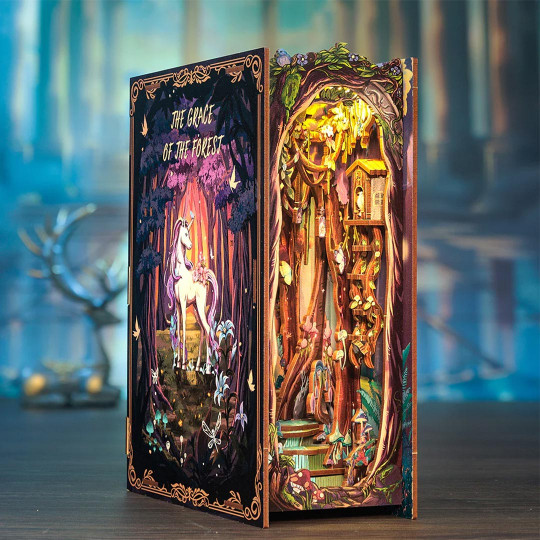
With its hundreds of details, LED lighting, and atmosphere of an old library, Grace of Forest is one of the most immersive models in the CUTEBEE range.
It is an excellent choice for fantasy and reading enthusiasts.
I have already assembled a few models
You can now choose a more ambitious project.
Intermediate models generally offer:
- more pieces;
- richer decors;
- more elaborate depth effects;
- multiple construction levels;
- more accessories.
This is often where one discovers the full decorative potential of Book Nooks.
I'm looking for a real challenge
Miniature enthusiasts will particularly appreciate the most complex models.
The large CUTEBEE creations offer extremely detailed universes:
- immense libraries;
- ancient bookstores;
- fantastic laboratories;
- charming shops;
- richly decorated houses.
These projects require more time but also offer the most spectacular results.
Which universe to choose?
The graphic universe plays an essential role in the construction pleasure.
For book lovers
I recommend Book Nooks representing ancient bookstores or majestic libraries.
They naturally find their place among your novels and give the impression that a secret passage is opening in the heart of your library.
For travel enthusiasts
European alleyways, Japanese neighborhoods, or traditional shops bring a lot of charm to interior decoration.
For fantasy lovers
CUTEBEE models like Library of Wisdom, Mystic Theurge's Hut, or Darkness Common Room captivate with their decors inspired by magic, old grimoires, and imaginary worlds.
For a warm decoration
Florists, cafes, artists' studios, and miniature houses immediately create a friendly and elegant atmosphere.
In my opinion, one should not choose solely based on difficulty or the number of pieces.
The best Book Nook or the best DIY miniature house is above all the one that makes you want to settle comfortably for a few hours to build, piece by piece, a miniature universe that reflects you.
The universes of Book Nooks and DIY miniature houses: let your imagination speak
What I like most about a Book Nook or a DIY miniature house is that it's not just a kit to assemble. Each creation tells a story.
As soon as I discover a new reference, I immediately feel like I'm opening the door to a miniature universe where every object, every piece of furniture, and every LED light has been designed to create a unique atmosphere.
Manufacturers Rolife, Robotime, and CUTEBEE excel in this exercise. Their creations go beyond reproducing a building or a room. They invite you to travel, stimulate the imagination, and transform a simple library or shelf into a true decorative element.
So I advise you to choose your Book Nook kit or your DIY miniature house primarily based on the universe that makes you dream.
🎁 An original gift idea
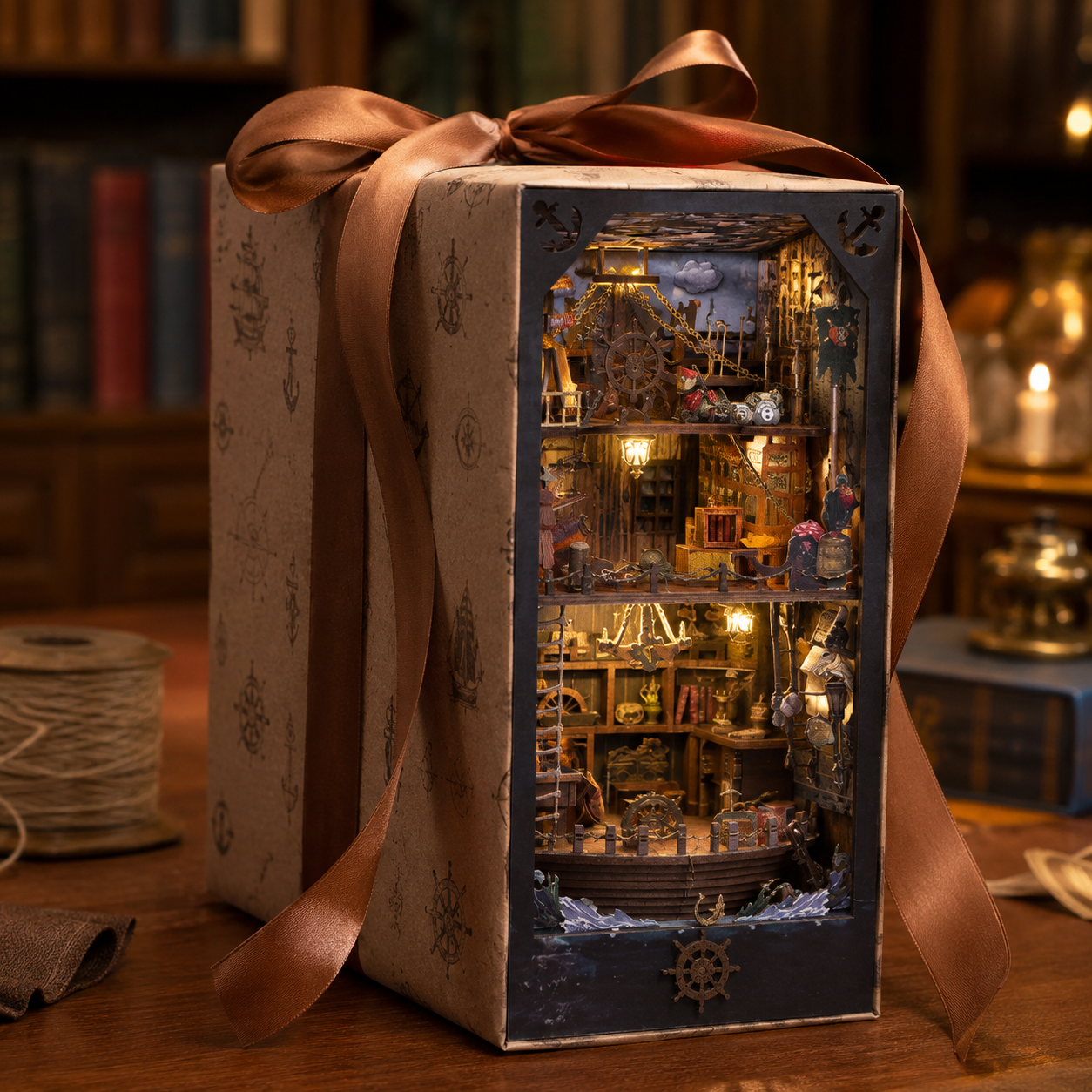
A Book Nook or a DIY miniature house is an excellent gift idea for a book lover, decoration enthusiast, or creative hobbyist.
Unlike a traditional object, it also offers the pleasure of building a unique creation yourself.
Miniature bookstores: a tribute to book lovers
When reading meets DIY
It's impossible to talk about Book Nooks without mentioning miniature bookstores. They perfectly embody the spirit of these creations.
By slipping a Book Nook between two novels, the illusion is striking.
One truly feels like a secret bookstore is hidden behind the books in your library.
The details are numerous:
- shelves filled with books;
- wooden stairs;
- ancient ladders;
- miniature desks;
- ambient lamps;
- decorative plants;
- lighted signs.
I find that these models offer a timeless elegance that appeals to both readers and interior decoration enthusiasts.
Among the most spectacular creations offered at Scientific-MHD, several CUTEBEE models recreate magnificent ancient libraries with an impressive wealth of details.
European streets and charming neighborhoods
A miniature stroll to build yourself
Some Book Nooks immediately evoke the small cobblestone streets of Europe.
It includes:
- shops;
- cafés;
- flowered balconies;
- street lamps;
- storefronts;
- narrow passages.
Once the LED lighting is installed, these decors become particularly immersive.
I really appreciate this category because it brings a lot of depth to a bookshelf while remaining very elegant.
The miniature Japan
A zen and refined atmosphere
Japanese themes are currently very popular.
Models inspired by the streets of Kyoto or Tokyo feature:
- cherry blossoms;
- lanterns;
- traditional houses;
- Japanese signs;
- small shops.
The finely cut wood combined with warm lighting creates a particularly relaxing atmosphere.
These models often make excellent first Book Nooks.
The fantastic worlds
When magic comes to life
If you enjoy fantasy novels, adventure films, or mysterious worlds, CUTEBEE creations should particularly appeal to you.
I'm thinking of models like:
- Library of Wisdom
- Mystic Theurge's Hut
- Darkness Common Room
These creations immediately immerse you in a world of magic.
You'll find:
- old grimoires;
- immense libraries;
- potions;
- candlesticks;
- mysterious laboratories;
- secret staircases.
In my opinion, these are the most immersive Book Nooks in the entire Scientific-MHD range.
They require more patience during assembly, but the result is spectacular.
Miniature shops
Vibrant decors
Shops also represent a large part of the catalog.
For example:
- florists;
- bookstores;
- antique stores;
- groceries;
- artisan shops.
Each storefront is filled with small miniature objects.
I particularly appreciate these models because they truly give the impression that a miniature business is operating behind the facade.
The numerous plants, signs, furniture, and accessories make these kits very enjoyable to build.
DIY miniature houses
A decoration that catches all eyes
Unlike Book Nooks, DIY miniature houses are designed to be displayed.
They replicate real-life scenes.
Depending on the models, you can build:
- a living room;
- a bedroom;
- a kitchen;
- a creative studio;
- a cafe;
- a greenhouse;
- a pastry shop;
- a boutique.
I find that these kits offer an even more immersive experience.
The miniature furniture is particularly detailed.
Everyday objects are reproduced with great realism.
The LED lighting truly brings the whole scene to life.
Why Rolife and Robotime are so appealing?
Internationally recognized quality
For several years, Rolife and Robotime have become essential references in the world of Book Nooks and DIY miniature houses.
In my opinion, their success is based on several qualities.
Excellent precision in cuts
The wooden pieces are laser-cut with great precision.
The assembly process is particularly enjoyable.
The adjustments are precise.
The finishes are meticulous.
Very well-illustrated instructions
Even when a model has hundreds of pieces, the steps are easy to follow.
The diagrams are clear.
This greatly reassures beginners.
Highly diverse themes
Rolife offers:
- Book Nooks;
- DIY miniature houses;
- shops;
- cafés;
- train stations;
- libraries;
- Japanese scenes.
This diversity allows you to always find a project that matches your tastes.
Why CUTEBEE has become a key player?
Even richer decors
CUTEBEE quickly established itself with a slightly different approach.
The brand focuses on:
- very dense decors;
- abundant decoration;
- many accessories;
- remarkable depth effects.
Each miniature diorama is full of details.
I also notice that the universes are often more scripted.
It's not just about assembling a building.
You are truly building a story.
Creations for enthusiasts
CUTEBEE models are often a bit more ambitious.
They particularly appeal to:
- miniature enthusiasts;
- collectors;
- decoration enthusiasts;
- people looking for a creative project over several evenings.
In my opinion, they currently offer some of the most beautiful Book Nooks available on the market.
Rolife or CUTEBEE: which brand to choose?
| Criterion | Rolife / Robotime | CUTEBEE |
|---|---|---|
| Handling | Very accessible | Accessible to intermediate |
| Material quality | ★★★★★ | ★★★★★ |
| Wood cutting | Excellent | Excellent |
| Richness of decorations | ★★★★☆ | ★★★★★ |
| LED effects | Very successful | Very successful |
| Number of pieces | Medium to high | High |
| Universes | Very varied | Very immersive and detailed |
| For beginners | ⭐⭐⭐⭐⭐ | ⭐⭐⭐⭐☆ |
| For enthusiasts | ⭐⭐⭐⭐☆ | ⭐⭐⭐⭐⭐ |
I consider that the two brands are more complementary than competitive.
Rolife and Robotime are an excellent entry point with accessible and very well-crafted kits.
CUTEBEE, on the other hand, will appeal more to creative challenge enthusiasts with denser decorations and particularly immersive staging.
The real common point between these brands remains their ability to transform a few sheets of wood, a LED lighting system, and hundreds of small pieces into a miniature that immediately catches the eye.
Whether you choose a Book Nook to embellish your bookshelf or a DIY miniature house to enhance your decoration, you will build a unique object, as enjoyable to assemble as it is to display.
Why Book Nooks and DIY miniature houses are more than just a creative hobby
At first glance, a Book Nook or a DIY miniature house may seem like a simple wooden model to assemble.
However, after completing several projects, I can affirm that it is a very different experience.
Each Book Nook kit invites you to slow down, focus on the present moment, and see a miniature universe come to life, piece by piece.
This is probably why they are so popular among DIY, decoration, modeling enthusiasts, and even readers.
The goal is not just to finish an assembly, but to enjoy every step of the construction.
Once the project is completed, you get a real miniature diorama that immediately catches the eye and becomes a unique decorative element.
In my opinion, few creative hobbies offer such a balance between creativity, precision, and personal satisfaction.
Tips for successfully completing your first assembly
Even though Book Nooks and DIY miniature houses are designed to be accessible, some good habits can help you achieve an even more polished result.
Prepare your workspace
Before starting your Book Nook kit, I recommend preparing a comfortable, clean, and well-lit space.
A few accessories are enough:
- a stable table;
- a good desk lamp;
- a small box to sort the pieces;
- a precision tweezer;
- a modeling knife if necessary;
- a cutting mat to protect your work surface.
This preparation will save you valuable time throughout the assembly.
Take your time
One of the most common mistakes is wanting to finish your Book Nook in a single day.
I prefer to progress slowly.
Building a miniature diorama is above all a relaxing moment. By taking your time, you reduce the risk of errors and enjoy each step more.
There is no obligation to finish quickly. On the contrary, many enthusiasts enjoy dedicating a few hours each evening to their project.
Read the instructions completely before starting
It may seem obvious, but I always recommend going through the instructions in full before starting the assembly.
This way, you will have an overall view of the project:
- order of the steps;
- installation of LED elements;
- placement of accessories;
- assembly of different structures.
This reading prevents many errors.
Handle wooden pieces with care
The wooden pieces are cut with great precision.
Even though their quality is excellent, it is best to delicately detach them from the sheets.
I recommend never to force them.
If a piece resists slightly, a small cutter or precision cutting pliers will help release it cleanly without damaging it.
🔧 Assembly tip
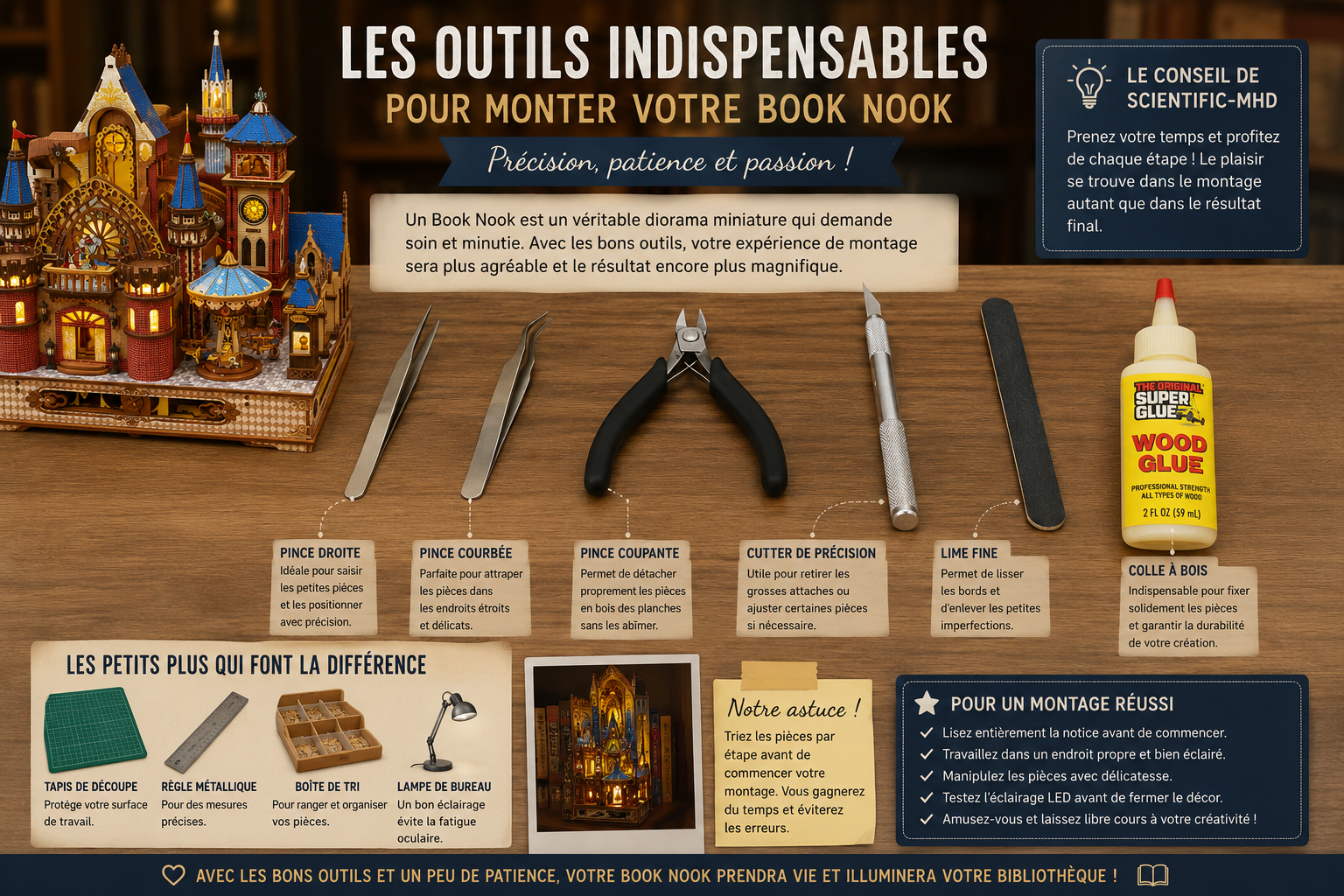
Before starting your kit, sort the pieces by step and prepare your workspace.
You will save time and reduce the risk of errors during assembly.
Accessories that facilitate assembly
Most Book Nook kits and DIY miniature houses already contain everything needed for their construction.
However, a few additional tools can make the experience even more enjoyable.
I recommend in particular:
- a brucelles tweezer to handle small pieces;
- a fine file to remove any micro-attachments;
- a precision cutter;
- a metal ruler;
- a precision cutting pliers;
- a directional lamp.
These accessories are inexpensive and significantly improve assembly comfort.
How to showcase your Book Nook?
Once your Book Nook is finished, it deserves to be displayed in the best conditions.
In a bookcase
It is obviously its natural location.
Placed between two novels, it immediately creates a sense of depth.
Visitors often notice the Book Nook before the books surrounding it.
For a harmonious result, I recommend leaving a slight space around the diorama so that the details remain clearly visible.
In a display case
If you create multiple Book Nooks or DIY miniature houses, a display case is an excellent solution.
It has two advantages:
- protecting the creations from dust;
- highlighting the LED lighting.
The result is particularly spectacular when multiple models are displayed together.
On a desk or shelf
DIY miniature houses naturally find their place on a piece of furniture or a desk.
They quickly become a true decorative object, capable of bringing warmth and originality to a room.
Personalizing your Book Nook: a great idea
Even though the kits are already very complete, there is nothing stopping you from personalizing them.
It is actually one of my favorite aspects.
You can, for example, add:
- additional miniature plants;
- a few characters;
- posters;
- books;
- accessories made with 3D printing;
- a patina paint to age certain elements;
- additional LED lighting.
This customization makes each creation completely unique.
How to maintain your creation?
Once finished, your Book Nook or DIY miniature house will retain its charm for many years if regularly maintained.
I simply recommend:
- to dust gently with a soft brush;
- to avoid prolonged exposure to sunlight to preserve the colors;
- to handle the models with care, always holding them by their base;
- to occasionally check the proper functioning of the LED lighting.
These few gestures are generally enough to preserve all the beauty of your miniature.
Why buy your Book Nook or DIY miniature house from Scientific-MHD?
Choosing a specialized retailer is, in my opinion, almost as important as choosing the model.
By ordering your Book Nook or DIY miniature house from Scientific-MHD, you benefit from a catalog composed of recognized brands such as Rolife, Robotime, and CUTEBEE.
These manufacturers are known for the quality of their materials, the precision of their cuts, and the care taken with every detail.
I also appreciate the diversity of the universes offered.
Whether you are looking for a miniature library, an old bookstore, a Japanese street, a cozy café, an artist's studio, a flower shop, or a fantastic universe, you will find models suitable for all tastes and skill levels.
Finally, buying from a specialist like Scientific-MHD allows you to enjoy a wide selection of references, regularly updated novelties, and an offer dedicated to DIY enthusiasts, modeling, and decoration.
In my opinion, this is the best way to start or gradually enrich a collection of Book Nooks and DIY miniature houses with quality kits designed to provide an assembly experience as enjoyable as the final result is spectacular.
FAQ: Everything you need to know about Book Nooks and DIY miniature houses
Are Book Nooks suitable for beginners?
Yes, many Book Nooks are perfect for a first experience.
The most accessible models from Rolife or Robotime allow you to discover the world of DIY, miniature dioramas, and wood assembly without major difficulty.
The illustrated instructions are generally very clear and accompany each assembly step.
If you are a beginner, I recommend choosing a kit with a reasonable number of pieces to gain confidence before tackling more ambitious projects.
How long does it take to assemble a Book Nook?
The assembly time mainly depends on the chosen model and your experience.
The simplest kits generally take between 3 and 5 hours, while more detailed models require 6 to 10 hours, or even more for the most complex creations.
Large DIY miniature houses can sometimes require several evenings of assembly.
What is the difference between a Book Nook and a DIY miniature house?
The Book Nook is a miniature diorama designed to fit between the books on a bookshelf to create a particularly original depth effect.
The DIY miniature house, on the other hand, is intended to be displayed on a shelf, desk, or in a showcase.
It reproduces a complete scene with detailed furniture, miniature accessories, and LED lighting that adds even more realism.
Are the kits delivered with LED lighting?
The vast majority of Book Nooks and DIY miniature houses offered by Rolife, Robotime, and CUTEBEE integrate an LED lighting system.
This lighting highlights the many details of the decor and creates a warm atmosphere, ideal for transforming your library or decoration space.
Should I use white glue?
Yes, depending on the models, some pieces require a small amount of glue to ensure a durable fixation.
Manufacturers always indicate the steps concerned in the assembly instructions.
An adhesive suitable for modeling ensures a clean and precise result.
From what age can one make a Book Nook?
Most manufacturers recommend these kits from 14 years old, due to the number of small pieces and the precision required during assembly.
Careful teenagers can, however, be accompanied by an adult to gradually discover this creative hobby.
Which Book Nook to choose to start?
I generally recommend a Rolife or Robotime model offering a moderate level of difficulty.
These kits allow you to learn the main assembly techniques while quickly achieving a superb result.
Once this first achievement is completed, it will be easier to move towards CUTEBEE creations that are richer in details.
✨ Did you know?
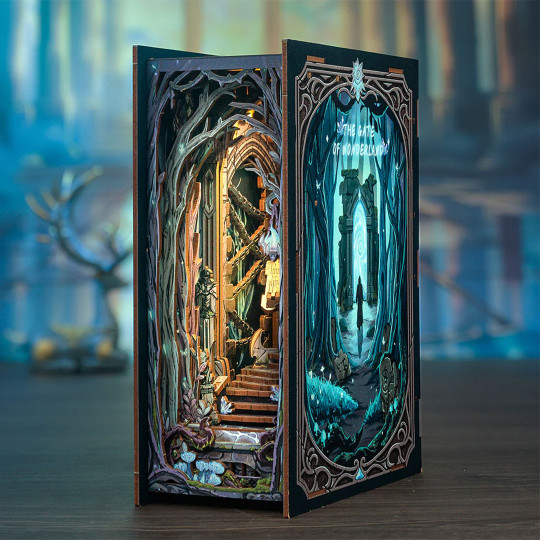
The first Book Nooks appeared in Japan before captivating book enthusiasts worldwide.
Today, they have become essential decorative objects and true miniature works of art.
Which brand to choose between Rolife, Robotime, and CUTEBEE?
These three brands are now references in the world of Book Nooks and DIY miniature houses.
- Rolife is particularly appreciated for its affordable models, excellent manufacturing quality, and diverse universes.
- Robotime, the parent company of Rolife, develops kits known for the precision of their cuts and meticulous finishes.
- CUTEBEE offers highly detailed decors, often more immersive, which appeal to enthusiasts looking for more ambitious projects.
So, the choice mainly depends on your level of experience and the universe you want to build.
Are Book Nooks a good gift idea?
Absolutely. The Book Nook has become a highly appreciated gift idea for book lovers, creative hobbyists, and interior decoration enthusiasts.
Original, elegant, and immersive, it easily fits into a bookshelf while adding a unique decorative touch.
Whether for a birthday, Christmas, Mother's Day, Father's Day or any other occasion, a Book Nook kit is a gift that stands out.
Once assembled, it becomes a true decorative object that its owner can admire for many years.
DIY miniature houses are also an excellent gift idea for people who enjoy crafts, decoration, or miniature worlds.
Can you customize a Book Nook or a DIY miniature house?
Yes, it is one of the great pleasures of these creations.
You can add characters, plants, miniature books, modify certain decorative elements, or enhance the lighting effects with additional LED lighting.
Each project can thus become completely unique.
How to protect a Book Nook from dust?
To preserve your Book Nook or your DIY miniature house, I recommend placing it in a display case whenever possible.
A simple soft brush or a can of compressed air can also be used regularly to remove dust without damaging the numerous miniature accessories.
Can a Book Nook be given as a gift?
Absolutely. The Book Nook has become a highly appreciated gift idea for book lovers, creative hobbyists, and interior decoration enthusiasts.
Original, elegant, and immersive, it easily fits into a bookshelf while adding a unique decorative touch.
Whether for a birthday, Christmas, Mother's Day, Father's Day, or any other occasion, a Book Nook kit is a gift that stands out.
Once assembled, it becomes a true decorative object that its owner can admire for many years.
DIY miniature houses are also an excellent gift idea for people who enjoy crafts, decoration, or miniature worlds.
Do Book Nooks take up a lot of space?
No. That is actually one of their main advantages.
The majority of Book Nooks have a format similar to that of a large book.
They naturally blend into a bookshelf without taking up much space.
DIY miniature houses are generally slightly larger, but still compact enough to be displayed on a shelf or desk.
Are Book Nooks suitable for collectors?
Yes. Many enthusiasts enjoy collecting different worlds to create a library entirely composed of Book Nooks.
Each new model brings a different ambiance: Japanese street, old bookstore, flowery garden, fantasy world, train station, café, castle, or European alley.
This diversity allows for gradually building an original collection that evolves with the new creations offered by manufacturers.
Why buy your Book Nook from Scientific-MHD?
By choosing Scientific-MHD, you benefit from a complete catalog featuring renowned brands such as Rolife, Robotime and CUTEBEE.
You have a wide selection of Book Nooks, DIY miniature houses, accessories, and new products, all while trusting a recognized specialist in modeling and creative hobbies.
This way, you are assured of finding the kit that suits your level, your desires, and your budget.
Why I recommend Book Nooks and DIY miniature houses
Book Nooks and DIY miniature houses are not just decorative objects. They offer a complete creative experience, combining patience, precision, and imagination.
Each Book Nook kit gradually becomes a true miniature diorama, capable of transforming a library or a piece of furniture into a lively and characterful space.
Whether you are a beginner or a DIY enthusiast, you will surely find a universe that resonates with you among the many creations offered by Rolife, Robotime, and CUTEBEE.
From ancient libraries, Japanese alleyways, cozy cafes, florists, artist workshops, to fantastic settings, each creation tells a story and adds a touch of originality to your decor.
If I were to give one last piece of advice, I would encourage you to choose a model that truly inspires you.
The pleasure lies not only in the final result but also in each step of the assembly process.
Once you complete your first creation, it's highly likely that you will want to explore new miniature worlds and gradually expand your collection.