-
News to come
Recreate the skirmishes of the Napoleonic wars with this box of 42 Polish infantry figurines in 1/72 scale.
The Strelets-R 308 reference, Polish Infantry in Skirmish, represents infantrymen of the Duchy of Warsaw in combat situations, for your historical dioramas and Napoleonic wargames.

Polish infantry figurines in skirmish 1:72 ref. 308 - Strelets-R
Fast shipping
Via Chronopost 24H
Via DPD 24/48H
Colissimo 48/72H
342123 products in stock
Real-time stock displayed
Secure payment




Secure payment
In 3 or 4 installments

 4.6/5

Specialist since 1955
Fast shipping
Via Chronopost 24H
Via DPD 24/48H
Colissimo 48/72H
342123 products in stock
Real-time stock displayed
Secure payment
Secure payment
In 3 or 4 installments
4.6/5
Specialist since 1955
This box of Napoleonic toy soldiers is dedicated to Polish infantrymen fighting alongside Napoleon's armies in the early 19th century.
It allows for the representation of detachments engaged in skirmishes, particularly during reconnaissance, advanced engagements, or missions covering the main units.
The Polish Infantry in Skirmish reference includes 42 Polish soldier figures in 1/72 scale.
This format, widely used in military modeling, allows them to be combined with other Napoleonic units to create battle scenes or form detachments for historical strategy games.
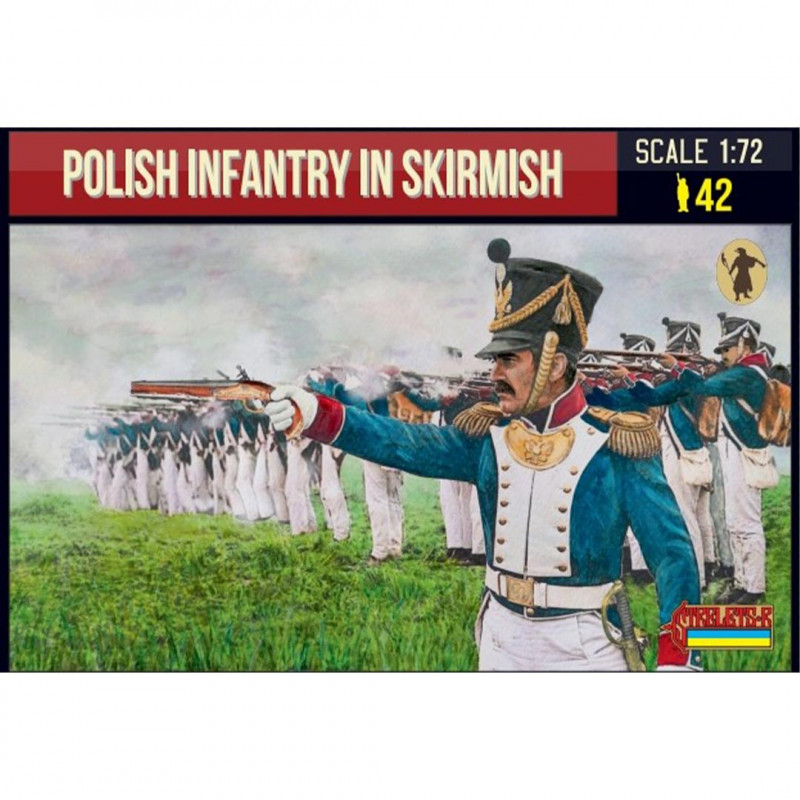
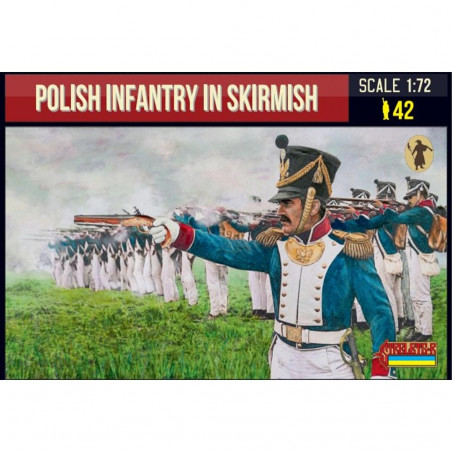
The box illustration features infantrymen equipped with flintlock rifles with bayonets, accompanied by an officer directing his men's movements.
Several soldiers are depicted in firing positions, evoking the engagements of Polish infantry against enemy troops.
The uniforms include blue jackets with white lapels, light trousers, and cross belts on the chest.
The characteristic headgear, called czapkas, have a square top and bear military ornaments.
Individual equipment includes cartridge boxes, knapsacks, and leather straps.
For painting, the contrasts between the blue clothing, the white parts of the uniform, and the metallic details of the weapons help to recreate the appearance of Polish regiments.
The colors of the facings and ornaments may vary depending on the units and periods represented.
At the end of the 18th century, Poland disappeared as an independent state following the partition of its territory between Russia, Prussia, and Austria.
Many Polish soldiers then joined the French armies, hoping to regain their independence through Napoleon's victories.
In 1807, the creation of the Duchy of Warsaw allowed for the formation of a Polish army organized according to principles similar to those of the French army.
Its infantry regiments participated in several major military campaigns, notably against Austria in 1809, during the Russian campaign in 1812, and in the battles in Germany in 1813.
Polish infantrymen are distinguished by their national uniforms, notably the kurtka, a short-tailed military jacket, and the square-topped czapka.
Their organization, armament, and combat methods are heavily influenced by French military practices.
Skirmishers are infantrymen deployed in open order, generally ahead of the main formations.
Their role is to scout enemy positions, slow down enemy movements, and protect the maneuvers of the battalions.
These soldiers use natural obstacles, trees, hedges, or buildings to shield themselves from fire.
They can advance in small groups and alternate movements with musket fire.
Voltigeur companies are particularly trained for this type of combat, although other infantrymen can also be employed as skirmishers depending on the circumstances.
The Strelets-R 308 figures allow for the creation of scenes of Polish skirmishers advancing on open ground, defending a position, or engaging enemy troops near a village.
For historical reenactment, these figures can be combined with Austrian, Russian, or Prussian soldiers in 1/72 scale, depending on the chosen campaign.
Scenery elements such as paths, hedges, trees, and rural buildings help to recreate the landscapes of European battlefields.
This box complements the Strelets-R 307 Polish Infantry in Square reference, dedicated to Polish infantry in defensive formation.
The combination of the two references allows for the representation of different tactics employed by the soldiers of the Duchy of Warsaw during the Napoleonic wars.