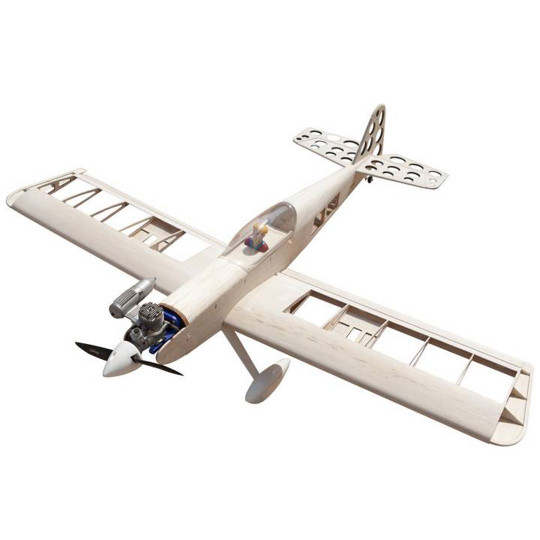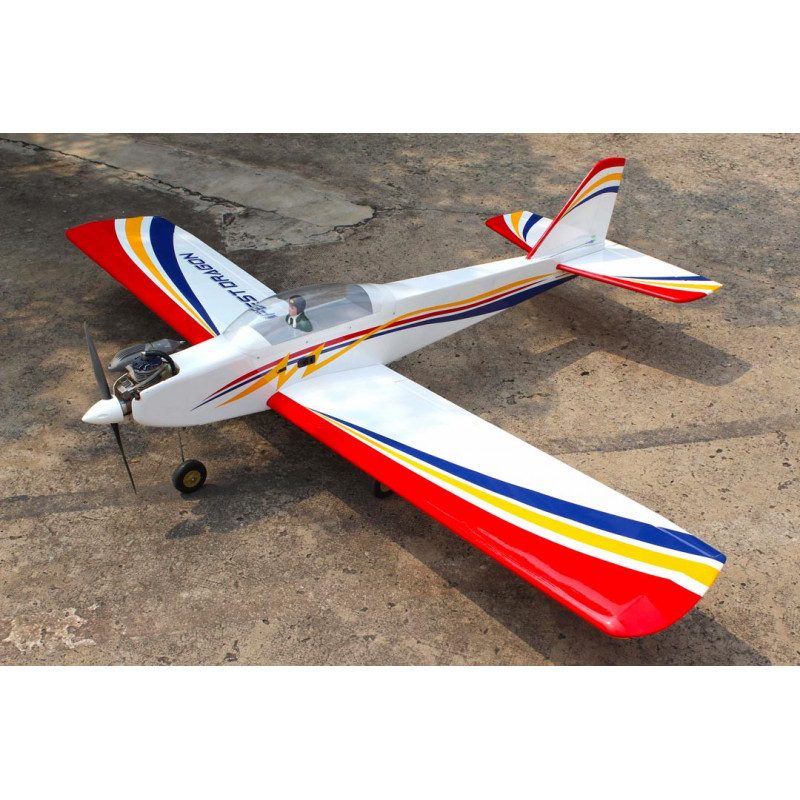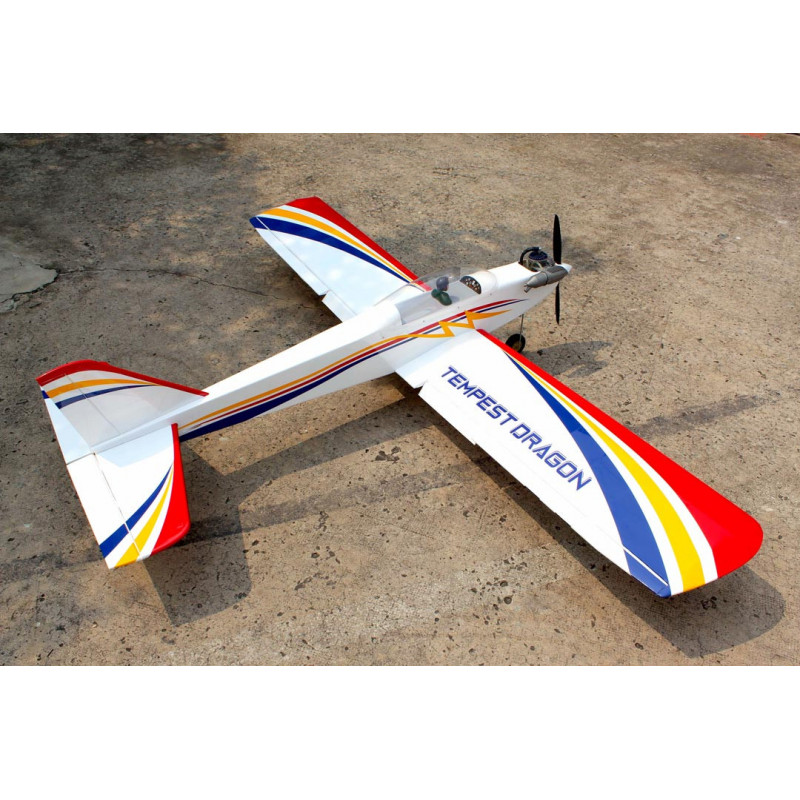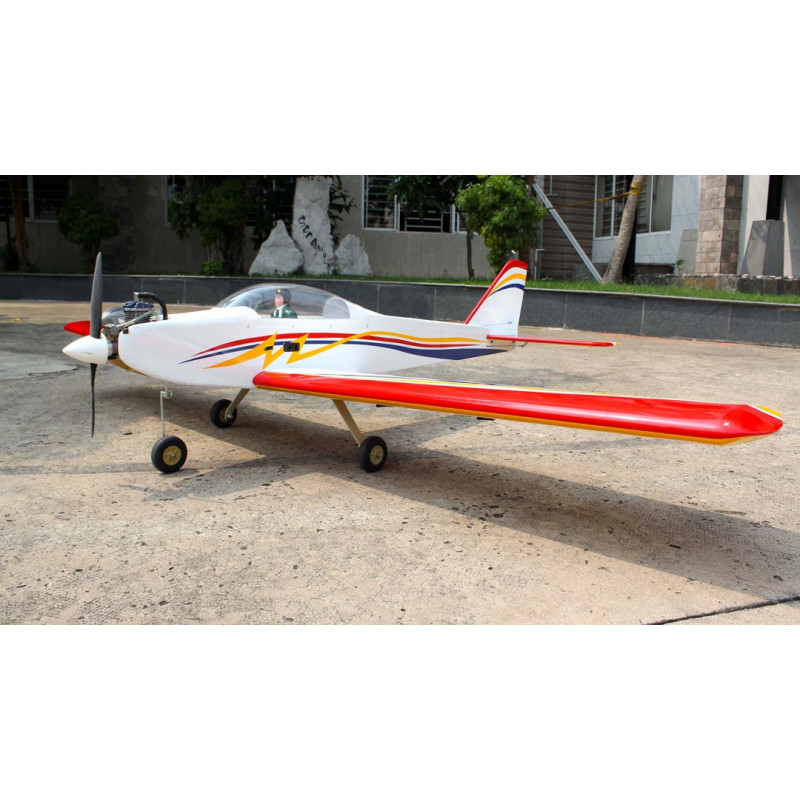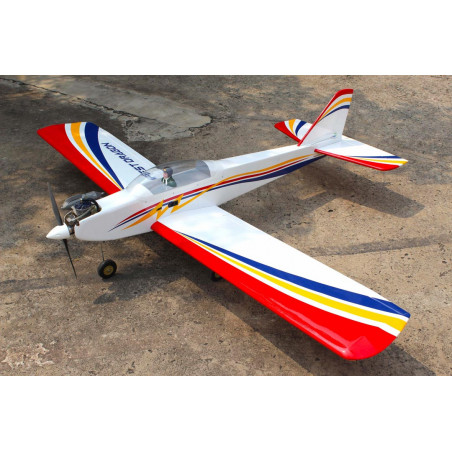
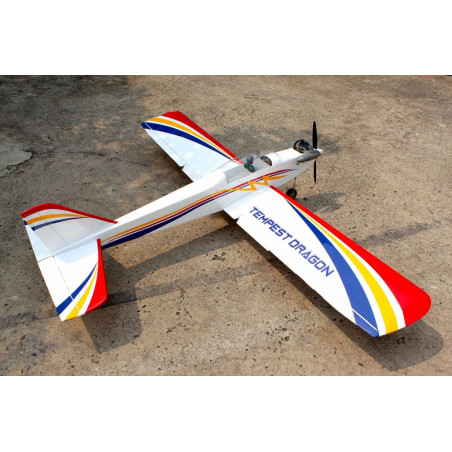
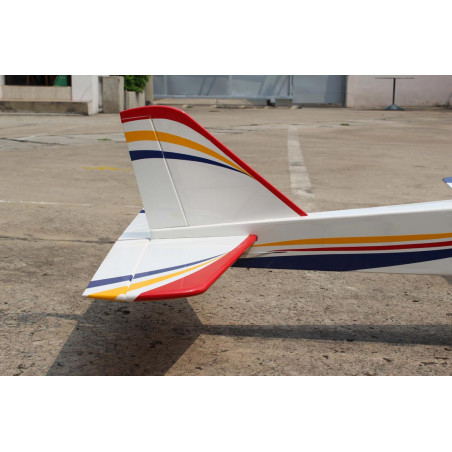
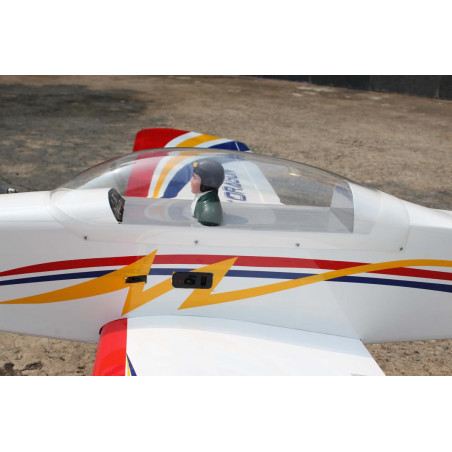
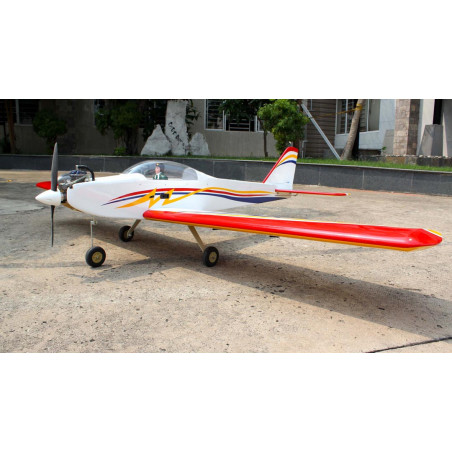
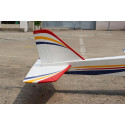
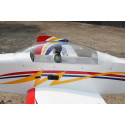
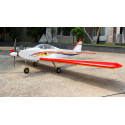
The Seagull Models Tempest Dragon SEA313 is a large 2.06m low-wing ARF RC airplane, designed to accompany the pilot in their progression.
With its balsa and plywood construction, functional flaps, fixed tricycle landing gear, removable wing, and around 15cc glow engine power, it offers a very complete setup.
I consider it especially as a transition RC airplane, intended for pilots looking to move from a classic trainer to a more advanced low-wing aircraft.
If you're wondering which RC airplane to choose after a trainer, I find the Tempest Dragon particularly relevant.
It remains accessible, but also provides a real room for progression.
And that's precisely what I personally look for in a recreational airplane: a reassuring model at the beginning, but interesting enough to keep flying with for a long time.

Radio-controlled airplane Tempest Dragon Trainer 15cc ARF SEAGULL Models
Plus de detailsRadio-controlled airplane Tempest Dragon Trainer 15cc ARF SEAGULL Models
Fast shipping
Via Chronopost 24H
Via DPD 24/48H
Colissimo 48/72H
331203 products in stock
Real-time stock displayed
Secure payment




Secure payment
In 3 or 4 installments

 4.6/5
4.6/5

Specialist since 1955
Fast shipping
Via Chronopost 24H
Via DPD 24/48H
Colissimo 48/72H
331203 products in stock
Real-time stock displayed
Secure payment
Secure payment
In 3 or 4 installments
4.6/5
Specialist since 1955
Low-wing RC transition aircraft, designed to help you progress after a trainer aircraft.
2.06 m wingspan, providing excellent visibility in flight and good stability.
Traditional balsa and plywood construction, strong and lightweight.
Recommended glow/gas engine around 15cc.
Electric conversion possible, with approximately 1800 W of power.
Functional flaps, making approaches and landings easier.
Two-piece removable wing, with an aluminum wing joiner.
Fixed tricycle landing gear, practical for takeoff and taxiing.
ARF model, largely pre-assembled and covered.
Recommended CG at 90 mm behind the leading edge at the wing root.
Clearly defined control throws, for a confident start.
An excellent choice if you are looking for an RC aircraft after a trainer.
A particularly interesting model as an RC transition aircraft.
A relevant choice if you are looking for a 15cc low-wing trainer.
An aircraft that can stay with you as your flying skills improve.
With the Seagull Models Tempest Dragon SEA313, I am primarily addressing modelers who want to take the next step.
You may already have flown a high-wing trainer. You are now comfortable with takeoffs, turns, approaches and landings. You want to go further, without immediately moving to a model that is too lively.
This is precisely the situation in which I find the Tempest Dragon particularly interesting.
This model is a low-wing RC transition aircraft. It retains reassuring handling, while allowing you to discover the feel of a low-wing aircraft.
I therefore consider the Tempest Dragon an excellent choice if you are wondering which RC aircraft to choose after a trainer.
It is not a true beginner's aircraft. Its purpose is different. It accompanies you as you progress, once you have already mastered the basics of RC flying.
Its generous wing area, 2.06 m wingspan and traditional construction give it a particularly pleasant presence in the air.
The Tempest Dragon has a 2060 mm wingspan, or just over 2 meters.
Its length is 1460 mm, with a wing area of 62.7 dm².
With an advertised weight of around 4.5 kg, you have a genuine large sport RC aircraft.
| Feature | Data |
|---|---|
| Brand | Seagull Models |
| Reference | SEA313 |
| Type | Low-wing RC aircraft / trainer |
| Construction | Balsa and plywood |
| Wingspan | 2060 mm |
| Length | 1460 mm |
| Wing area | 62.7 dm² |
| Approximate weight | 4.5 kg |
| Glow/gas engine | Approx. 15cc |
| Electric power | Approx. 1800 W |
| Flaps | Functional |
| Landing gear | Fixed, tricycle |
| Wing | 2-piece |
| Version | ARF |
In my opinion, this size is one of the Tempest Dragon's major strengths.
An aircraft of this size remains clearly visible at a distance. You can easily see its attitude, roll and flight path.
This is particularly valuable when you start flying a low-wing aircraft.
Moving from a high-wing trainer to a low-wing aircraft can be an important step.
The aircraft's handling changes. So do the sensations.
With an RC aircraft after a trainer, you need to learn how to handle a more dynamic machine.
You also need to get used to approaching certain phases of flight differently.
I therefore prefer a progressive model rather than an aircraft that is immediately very demanding.
The Tempest Dragon fits this philosophy well.
It offers enough stability to build your confidence.
At the same time, it allows you to learn to fly a more sporty machine.
You can therefore progress at your own pace.
For me, that is the whole point of a well-designed RC transition aircraft.
The term 15cc low-wing trainer sums up the Tempest Dragon's positioning quite well.
However, it should not be confused with a trainer intended for a very first flight.
I recommend it instead for a pilot who already has RC flying experience.
You can therefore benefit from its stable handling while gradually discovering the possibilities offered by a low-wing aircraft.
The model can also stay with you as your flying becomes more precise.
You can work on your flight paths, improve your approaches, learn to use the flaps, and then begin exploring some basic aerobatic maneuvers.
The Tempest Dragon retains a design that is highly appreciated by modelers.
The airframe uses traditional balsa and plywood construction.
This construction provides a structure that is both rigid and relatively lightweight.
The main components are largely factory-prepared.
The model is supplied in ARF format, with much of the construction work already completed.
You therefore do not have to build the entire airframe yourself.
You must nevertheless complete the final assembly, install the servos, power system and radio, and carry out the various adjustments.
I find this format particularly interesting for a modeler who wants to spend more time flying than fully building an aircraft.
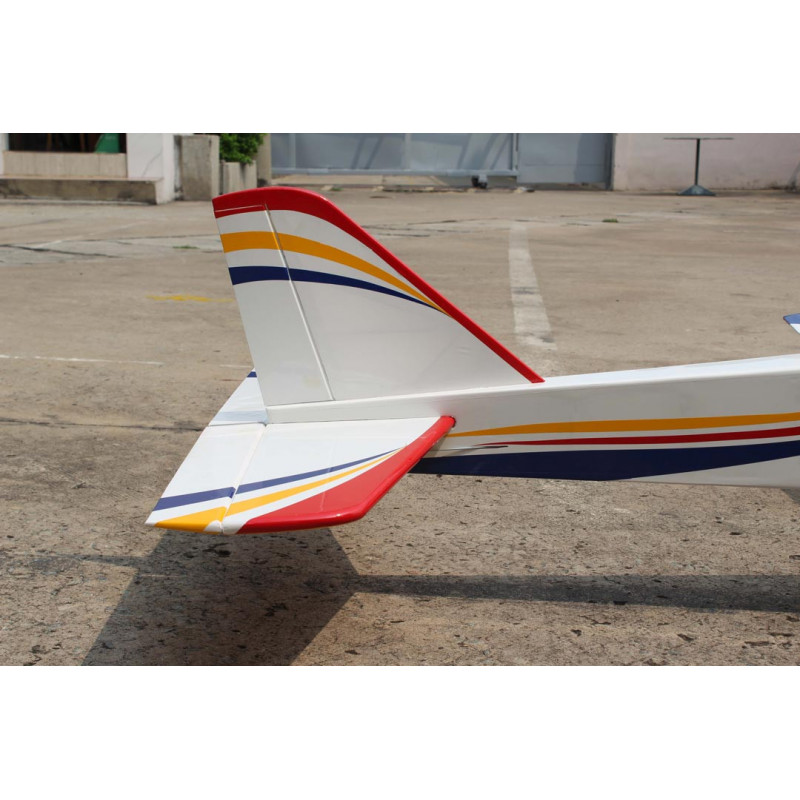
The Tempest Dragon is supplied pre-covered and decorated.
The finish provides a neat appearance, but it also serves a practical purpose.
On an aircraft with a wingspan of more than 2 meters, visibility in flight is essential. The different colors and decorative areas make it easier to identify the aircraft's attitude.
You can more easily distinguish the top and underside of the wing.
It may seem like a minor detail on the ground, but it becomes important when the aircraft moves farther away.
With a wingspan of more than 2 meters, the Tempest Dragon is a substantial aircraft.
Fortunately, the wing is designed in two sections.
An aluminum wing joiner connects the two wing halves.
This design makes transport to the flying field considerably easier.
You can also remove the wing for storage, making the model easier to handle.
For me, this is an essential feature on an aircraft in this category.
The Tempest Dragon has functional flaps.
This is a feature I particularly appreciate on a transition aircraft.
The flaps allow you to change the aircraft's behavior during certain phases of flight.
You can use them in particular to:
reduce approach speed;
make landings easier;
improve low-speed control;
gradually work on different flight configurations;
familiarize yourself with a function you will find on more advanced aircraft.
The manufacturer specifies approximately 30 mm of flap travel in the intermediate position.
If you are coming from a conventional trainer, this also allows you to develop new flying habits.
The Tempest Dragon uses fixed tricycle landing gear.
You have a main landing gear and a steerable nose wheel.
This configuration is very reassuring during taxiing.
It also makes it easier to maintain the centerline during takeoff.
For a transition aircraft, I find this choice particularly logical.
It avoids unnecessarily complicating the model's operation.
You can therefore concentrate on your flying.
The Tempest Dragon is designed to accept a glow/gas engine of around 15cc.
This is the configuration I would choose if you are looking for the classic behavior of a large glow/gas-powered aircraft.
An engine of this displacement provides a suitable power reserve for the model's weight and dimensions.
The engine bay is designed for a conventional glow/gas power system.
The manual specifies approximately 135 mm between the firewall and the propeller drive washer, which is useful information when choosing and installing the engine.
Depending on the engine you choose, you should of course check:
mount dimensions;
shaft exit position;
engine weight;
recommended propeller;
operating RPM;
final aircraft weight;
center of gravity.
I recommend always considering the complete engine, muffler, fuel tank and propeller combination rather than choosing based solely on theoretical power.
If you prefer electric power, the Tempest Dragon can also be converted.
This option is interesting if you want to retain the model's flight characteristics while benefiting from the simplicity of electric propulsion.
I would choose a sufficiently powerful brushless power system to provide a comfortable reserve without seeking excessive power.
The choice of motor must also take the battery weight into account.
A battery that is too light may require additional ballast to achieve the correct CG. Conversely, an excessively heavy setup can unnecessarily increase wing loading.
This is a point I recommend paying attention to.
The Tempest Dragon is a relatively large aircraft. The choice of power system therefore directly affects the CG.
I would not systematically look for the most powerful motor.
I would instead look for a motor, battery and propeller combination that is consistent with the model's final weight.
This is even more important with an electric conversion.
A correctly sized power system helps keep the aircraft balanced, pleasant and predictable.
The glow/gas configuration requires approximately 7 servos.
They control:
both ailerons;
elevator;
rudder;
throttle;
both flaps.
The documentation specifies a minimum torque of approximately 3.9 kg/cm at 4.8 V, or 4.8 kg/cm at 6 V.
I therefore recommend choosing sufficiently strong and precise servos.
On a 4.5 kg model, I always prefer to keep a small safety margin.
A reliable servo is an essential component on an RC aircraft of this size.
The CG is one of the most important settings before the first flight.
The recommended CG is 90 mm behind the wing leading edge, measured at the wing root.
I strongly recommend starting with this setting.
Do not immediately try to make the aircraft more responsive by moving the CG rearward.
A slightly nose-heavy aircraft is generally more reassuring for the first flights.
You can then gradually adjust the CG if you have a thorough understanding of the model's handling.
The manual also provides reference values.
| Control | Low rate | High rate |
| Ailerons | ±12 mm | ±15 mm |
| Elevator | ±12 mm | ±15 mm |
| Rudder | ±20 mm | ±25 mm |
| Flaps | — | approx. 30 mm |
I recommend starting with the low rates.
This will allow you to gradually discover the Tempest Dragon's handling.
Once you are fully comfortable with the model, you can increase the control throws according to your preferences.
If you are looking for a 2-meter 15cc glow/gas RC aircraft, the Tempest Dragon clearly deserves your attention.
Its 2060 mm wingspan gives it an excellent presence in the air.
Its 62.7 dm² wing area contributes to its relatively stable handling.
You therefore have an aircraft large enough to remain clearly visible, without reaching the sometimes cumbersome dimensions of much larger models.
In my opinion, this is an excellent compromise for sport and recreational model flying.
This is probably one of the questions the Tempest Dragon answers best.
If you already have several hours of flight time on a high-wing trainer, I find it worthwhile to move to a model that is not overly demanding.
You need to learn.
You need to progress.
But you also need to retain enough confidence to enjoy your flights.
The Tempest Dragon provides precisely this transition.
You move from a trainer to a more elegant and dynamic low-wing aircraft that remains accessible to a pilot who has already mastered the fundamentals.
The Tempest Dragon is not only a transition aircraft.
Once mastered, it can also allow you to discover basic RC aerobatics.
You can gradually work on:
loops;
rolls;
stall turns;
high-speed passes;
coordinated turns;
flap-assisted approaches.
However, I would not describe it as a dedicated aerobatic aircraft.
Its primary purpose remains recreational flying and progression.
That is precisely what makes it interesting.
You have an aircraft that can evolve with your skill level.
ARF does not mean “ready to fly.”
The Tempest Dragon is largely pre-assembled, but you still need to carry out the work required to make it ready to fly.
In particular, you will need to:
install the servos;
install the control linkages;
install the power system;
install the fuel tank or electrical equipment;
position the receiver;
adjust the control surfaces;
check the hinges;
set the control throws;
check the CG;
check all fasteners.
I also recommend taking your time during assembly.
On a model of this size, a small assembly error can have greater consequences than on a small aircraft.
The ARF kit includes in particular:
the fuselage;
the two wing halves;
the tail assembly;
the canopy;
the engine cowl;
the wing joiner;
the landing gear;
the nose gear;
the wheels;
the fuel tank;
the control accessories;
the power system mount;
the spinner;
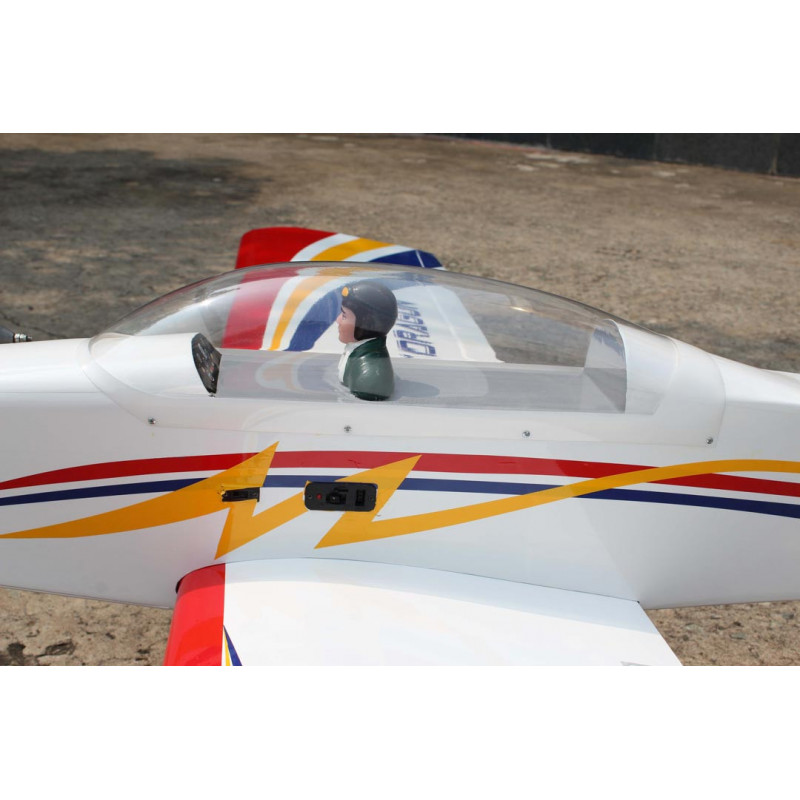
the pilot figure.
I appreciate the inclusion of the pilot figure.
On a model of this size, it genuinely contributes to the aircraft's overall appearance.
I recommend a radio with at least 6 channels.
You must be able to control the model's main functions, especially the flaps.
A programmable radio is obviously preferable.
It will allow you to precisely adjust:
control throws;
dual rates;
exponential rates;
flaps;
any required trims;
different flight modes.
For a transition aircraft, this is particularly useful.
You can therefore keep the controls gentle at first, then gradually adapt the model's handling to your skill level.
I find that the Seagull Models Tempest Dragon SEA313 has a particularly relevant positioning.
There are many RC aircraft capable of flying fast.
There are also many trainers designed for beginners.
But it is harder to find a model that is genuinely interesting for the intermediate stage.
This is where the Tempest Dragon stands out.
You have a low-wing aircraft of more than 2 meters, with flaps, traditional construction, a glow/gas power system around 15cc, and the option of electric conversion.
You can start with conservative settings.
Then, as you gain flight time, refine your flying skills.
I find this progression much more interesting than making an abrupt move to a much more demanding aircraft.
I particularly recommend it if you are in one of these situations:
you already master a high-wing trainer;
you are looking for your first low-wing aircraft;
you want an RC aircraft after a trainer;
you are looking for an RC transition aircraft;
you want to gradually move into aerobatics;
you are looking for a 15cc low-wing trainer;
you want a large sport aircraft of around 2 meters;
you prefer traditional wooden construction;
you want a glow/gas model with the option of electric conversion.
On the other hand, if you have never flown an RC aircraft, I recommend starting with a model specifically designed for learning.
The Tempest Dragon is more suitable once you have already mastered the basics.
Ultimately, this is what I like most about this model.
You are not simply choosing an aircraft to learn to fly.
You are choosing an aircraft that you can continue to progress with.
At first, you can use the low rates and keep a conservative CG.
You then learn to make use of the flaps.
You refine your flight paths.
You gradually improve your precision.
Then you discover your first aerobatic maneuvers.
The Tempest Dragon then becomes a true progression aircraft.
For me, this is an excellent definition of a low-wing RC aircraft for experienced beginners: not a model for a very first flight, but a particularly well-suited aircraft for an already trained pilot who wants to take the next step.
Customers who bought this product also bought: