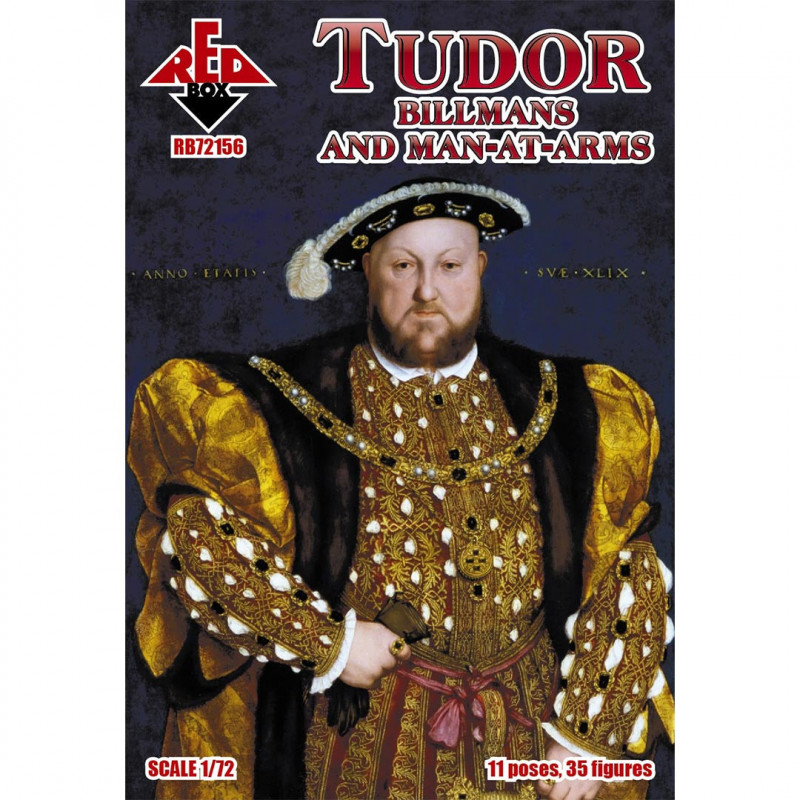
Recreate the English armies of the 16th century with this box of 35 Tudor infantry figurines at 1/72 scale from Red Box.
The reference RB72156, Tudor Billmen and Men-at-Arms, includes 11 different poses representing billmen, a man-at-arms, and command figures.

Tudor Infantry Figurines, Halberdiers and Men-at-Arms 1:72 ref. RB72156 - Red Box
Plus de details Out-of-StockTudor Infantry Figurines, Halberdiers and Men-at-Arms 1:72 ref. RB72156 - Red Box
Fast shipping
Via Chronopost 24H
Via DPD 24/48H
Colissimo 48/72H
341648 products in stock
Real-time stock displayed
Secure payment




Secure payment
In 3 or 4 installments

 4.6/5

Specialist since 1955
Fast shipping
Via Chronopost 24H
Via DPD 24/48H
Colissimo 48/72H
341648 products in stock
Real-time stock displayed
Secure payment
Secure payment
In 3 or 4 installments
4.6/5
Specialist since 1955
This Red Box RB72156 set represents English Renaissance infantrymen, primarily from the mid-16th century.
It allows for the creation of a Tudor infantry detachment equipped with polearms, with soldiers in combat positions and several figures intended for unit leadership.
The Tudor Billmen and Men-at-Arms reference contains 35 gray plastic figures, divided into 11 different poses, in 1/72 scale.
The soldiers are supplied unpainted, with an average height of about 23 mm.
The figures mainly represent English billmen, wielding their weapons in various positions.
Some poses show soldiers ready to strike, others advancing their weapon to keep an opponent at bay.
The box also includes a man-at-arms equipped with armor and a poleaxe, as well as three types of command figures: a captain, a standard bearer, and a drummer.
The clothing and equipment display a characteristic diversity of the period: metal helmets, armor pieces, chainmail protection, quilted jackets, and various hairstyles.
For painting, the variations in fabric, leather, and metal allow for differentiating the soldiers without assigning them identical uniforms.
The Tudor dynasty ruled England from 1485 to 1603. Under Henry VIII, English armies retained a military organization inherited from the late Middle Ages, while gradually integrating new weapons and tactics from the Renaissance.
In the early 16th century, English infantry included archers, billmen, and soldiers equipped with polearms.
These troops participated in military campaigns against France and Scotland, as well as operations to maintain royal authority.
In the second half of the century, the evolution of military techniques favored the development of pikemen and arquebusiers.
The billmen gradually lost their importance, even though their weapons remained in use for several decades.
The billmen are infantrymen equipped with an English polearm called a bill.
This polearm generally has a sharp blade, a point, and a hook. It allows for striking, pushing back an opponent, or hooking them to unbalance them.
The billmen are notably employed to protect the flanks of formations, defend positions, and participate in close combat.
They fight alongside archers and, gradually, pikemen and soldiers armed with arquebuses.
The men-at-arms generally have more significant defensive equipment, including metal armor elements. They can use swords, poleaxes, or other weapons suited for combat against protected opponents.
The 35 Red Box RB72156 figures allow for representing an English infantry unit in formation, a close combat scene, or a detachment protecting a standard bearer.
The 11 different poses facilitate the composition of groups of soldiers with varied attitudes.
For a historical diorama, these figures can be combined with English archers, arquebusiers, or pikemen from the same period.
The Red Box RB72155 Tudor Light Infantry and RB72157 Tudor Pikemen references are particularly interesting complements.
A setting with fortifications, paths, palisades, or a countryside landscape evokes the Anglo-Scottish wars of the 16th century.
This box is also suitable for collectors of historical miniatures and enthusiasts of wargames dedicated to Renaissance armies.