-
News to come
Recreate the 19th-century American cavalry patrols with this Strelets-R 309 American Mounted Dragoons box.
It includes 12 riders and 12 horses at a 1/72 scale, allowing representation of the American dragoons engaged in Western military operations and during the Mexican-American War.

American dragon figurines on horseback 1:72 ref. 309 - Strelets-R
Fast shipping
Via Chronopost 24H
Via DPD 24/48H
Colissimo 48/72H
342122 products in stock
Real-time stock displayed
Secure payment




Secure payment
In 3 or 4 installments

 4.6/5

Specialist since 1955
Fast shipping
Via Chronopost 24H
Via DPD 24/48H
Colissimo 48/72H
342122 products in stock
Real-time stock displayed
Secure payment
Secure payment
In 3 or 4 installments
4.6/5
Specialist since 1955
This box of American cavalry figures represents mounted soldiers of the United States Army in the first half of the 19th century.
The American Dragoons, or US Dragoons, were military personnel capable of fighting on horseback or on foot, depending on the terrain and missions assigned to them.
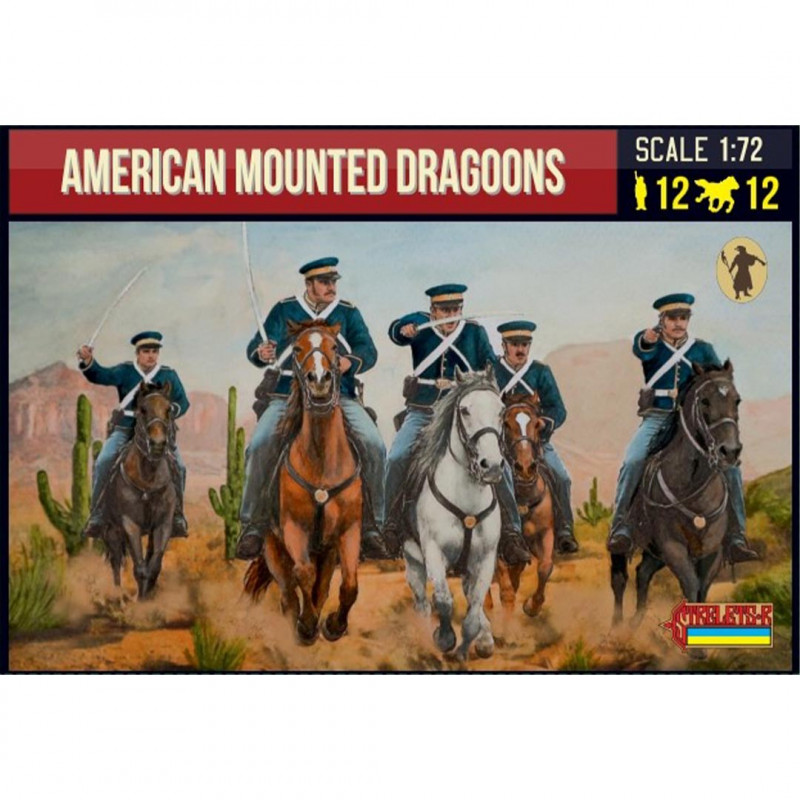
The American Mounted Dragoons reference from Strelets-R includes 12 rider figures and 12 horses in 1/72 scale.
This format allows for the creation of a cavalry detachment for historical dioramas, small soldier collections, and wargames dedicated to 19th-century North American conflicts.
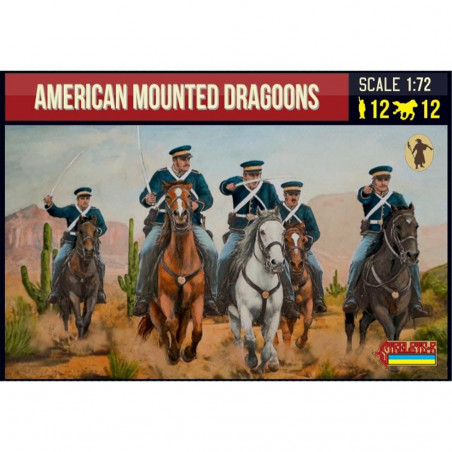
The box illustration shows riders wearing dark blue jackets, light blue pants, military caps with visors, and white leather gear.
Several soldiers are depicted with raised sabers or pistols in hand, evoking different mounted combat situations.
For painting, the blue uniforms can be paired with leather equipment, metal parts of weapons, and horse harnesses.
The diversity of coats, notably brown, gray, or black, contributes to giving a natural look to the unit.
In 1833, the American army created its first regular regiment of dragoons to meet military needs related to the westward expansion of the United States.
A second regiment was formed in 1836, enhancing the reconnaissance and mobility capabilities of federal forces.
Unlike cavalry units exclusively intended for charges, dragoons are trained to fight both mounted and dismounted. They carry out patrol, reconnaissance, escort, and border territory surveillance missions.
These regiments notably participate in military campaigns against Native American populations, as well as operations aimed at controlling roads and new territories occupied by the United States.
Between 1846 and 1848, American dragoons took part in the Mexican-American War.
The 1st regiment notably participated in Colonel Stephen Watts Kearny's expedition to New Mexico and California, while the 2nd regiment was involved in General Zachary Taylor's campaigns.
The dragoons conducted reconnaissance, pursued enemy units, and sometimes fought on foot when the terrain did not allow for the use of horses.
Their mobility represented a significant advantage in the vast regions traversed by American armies.
In the 1830s and 1840s, American dragoons generally wore a dark blue jacket, light blue pants, and a military headgear suited for field service.
The equipment and details of the uniforms evolved according to regulations and periods.
Their armament included a cavalry saber, pistols, and a carbine. This combination allowed them to engage in mounted engagements while retaining the ability to fight as infantry.
The 12 American Dragoons on horseback from Strelets-R allow for the creation of a patrol in the Western landscapes, a military reconnaissance, or a combat scene during the Mexican-American War.
A setting composed of rocky terrains, dusty trails, cacti, or military buildings can evoke the regions of Texas, New Mexico, and California in the mid-19th century.
To complete a reconstruction, these figures can be associated with Mexican soldiers, American infantrymen, or other historical units in 1/72, respecting the chosen period.
The Strelets-R 309 American Mounted Dragoons box is thus aimed at modelers, small soldier collectors, and wargame enthusiasts wishing to represent the first regular units of American cavalry, before the Civil War.