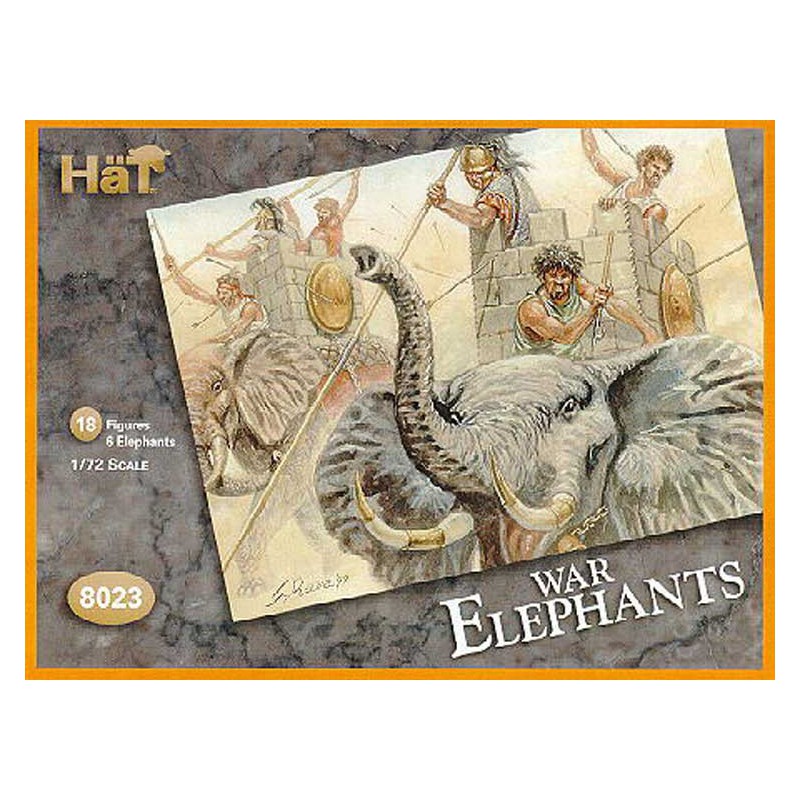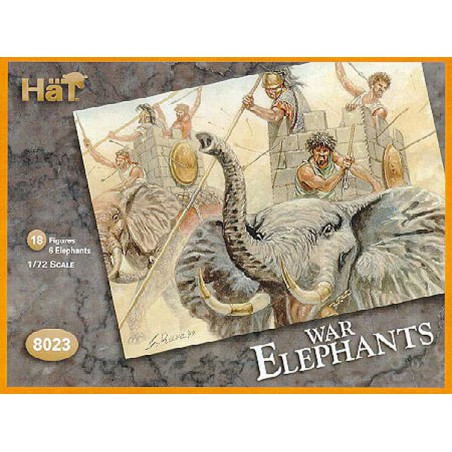

The HAT Industrie 8023 - Carthaginian War Elephants box is a well-known reference for enthusiasts of ancient figures in 1/72 scale.
It represents the war elephants used by Carthage during the Punic Wars, particularly in the time of Hannibal Barca.
The box contains:
Distribution of figures:
This size corresponds to HAT's interpretation of North African forest elephants, assumed to be smaller than African savanna elephants.

Carthaginian War Elephants Figurine 1/72
Plus de detailsCarthaginian War Elephants Figurine 1/72
Fast shipping
Via Chronopost 24H
Via DPD 24/48H
Colissimo 48/72H
333125 products in stock
Real-time stock displayed
Secure payment




Secure payment
In 3 or 4 installments

 4.6/5
4.6/5

Specialist since 1955
Fast shipping
Via Chronopost 24H
Via DPD 24/48H
Colissimo 48/72H
333125 products in stock
Real-time stock displayed
Secure payment
Secure payment
In 3 or 4 installments
4.6/5
Specialist since 1955
The subject is debated among historians:
Strengths:
| Reference | HAT 8023 |
|---|---|
| Subject | Carthaginian War Elephants |
| Scale | 1/72 |
| Year of Release | 1999 |
| Number of Elephants | 6 |
| Number of Figures | 18 |
| Towers | 6 |
| Material | Injected Plastic |
| Poses | 4 for men, 2 for elephants |
For a collector or an ancient wargame player, this reference remains one of the few boxes specifically representing Carthaginian War Elephants in 1/72 scale today.
About the Elephants, here are notes from a specialist:
Editor's Note: All the texts I have read about the North African forest elephant Loxodonta africana cyclotis indicate that it is extinct.
There is no doubt that these elephants no longer live in North Africa. I was somewhat surprised to discover in the February 1999 issue of National Geographic that the Loxodonta africana cyclotis, or African forest elephant, is still very much alive in Central Africa.
Although no dimensions are given for these elephants, they seem to be the same as those used by Carthage in the past.
Around 200,000 individuals still exist today (compared to 400,000 large African elephants), but, like their North African cousins before them, they are threatened with extinction.
This time, it's not as transport or war animals, but for their ivory tusks.
Elephant, jumbo, mammoth... however they are considered, elephants are large animals, whether African or Indian.
Except for one: ours. The Carthaginians used the North African forest elephant Loxodonta africana cyclotis, now extinct (likely due to humans).
These animals measured only about 2.10 to 2.40 meters at the shoulder. Sources depict them sometimes equipped with a combat tower, sometimes without.
With a tower, their role was clear: to throw javelins or shoot at the enemy from a mobile elevated platform.
Without a tower, their function mainly involved trampling the enemy or breaking enemy formations with their sheer imposing mass.
Ancient authors also reported that horses, when faced with elephants for the first time, tended to panic due to their unusual smell.
However, elephants themselves were easily prone to panic, and several battles were lost because they would panic or turn against their own troops.
Customers who bought this product also bought: