-
News to come
Recreate the defensive formations of Napoleon's army during the Egyptian campaign with this box of 42 French infantry figurines in 1/72 scale.
The Strelets-R 304 reference, French Infantry in Square (Egypt), represents infantrymen forming a square to withstand Mamluk cavalry charges.

French infantry figurines in square Egypt 1:72 ref. 304 - Strelets-R
Fast shipping
Via Chronopost 24H
Via DPD 24/48H
Colissimo 48/72H
341936 products in stock
Real-time stock displayed
Secure payment




Secure payment
In 3 or 4 installments

 4.6/5

Specialist since 1955
Fast shipping
Via Chronopost 24H
Via DPD 24/48H
Colissimo 48/72H
341936 products in stock
Real-time stock displayed
Secure payment
Secure payment
In 3 or 4 installments
4.6/5
Specialist since 1955
This box of historical toy soldiers represents the infantrymen of the Army of the Orient in a combat formation characteristic of the French expedition in Egypt, between 1798 and 1801.
The infantry square allowed the troops to present a defense on multiple sides, particularly against the rapid attacks of enemy cavalry.
The Strelets-R 304 French Infantry in Square (Egypt) reference includes 42 French soldier figures at 1/72 scale.
This format, commonly used for Napoleonic figures, allows them to be combined with other military units from the same period.
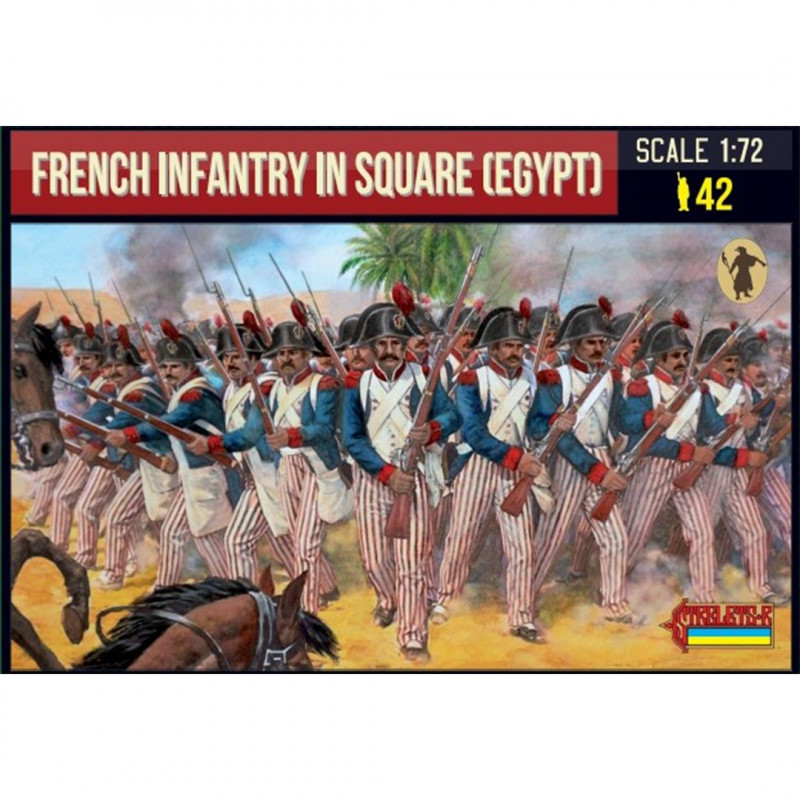
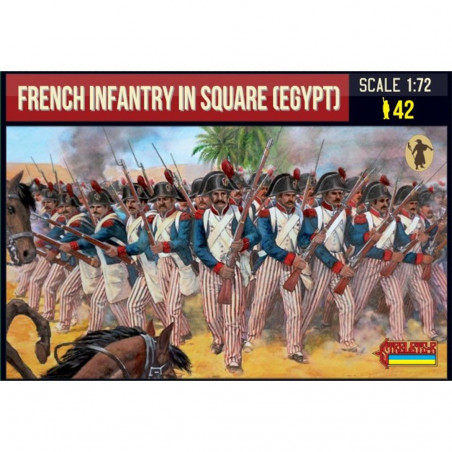
The box illustration features infantrymen wearing blue uniforms with red facings, white leather gear, and black headgear adorned with red plumes.
The red and white striped pants are a visual peculiarity of the French uniforms used during the Egyptian campaign.
The soldiers are equipped with flintlock rifles with bayonets, essential for close defense against cavalry.
For painting, the contrasts between the uniforms, leather equipment, and metallic parts of the weapons allow distinguishing the different elements of each figure.
In 1798, General Napoleon Bonaparte led a military expedition aimed at establishing a French presence in Egypt and weakening British interests in the Orient.
After landing near Alexandria, the French army advanced towards Cairo, notably confronting the Mamluk forces.
The French infantrymen had to adapt to difficult climatic conditions, long marches, and supply issues.
The uniforms gradually evolved, with the use of lighter clothing and locally made garments.
The campaign continued after Bonaparte's departure in 1799, under the command of Generals Kléber and then Menou, until the French evacuation in 1801.
The infantry square played an essential role during the Egyptian campaign.
This formation involved arranging soldiers in multiple ranks, facing outward, to present rifles and bayonets in all directions.
During the Battle of the Pyramids on July 21, 1798, the French divisions adopted large square formations.
Artillery was placed at the corners, while cavalry and reserves could be protected inside the setup.
The charges of the Mamluk cavalry thus encountered the coordinated fire of the French infantrymen and cannons.
This tactic contributed to Bonaparte's victory and the capture of Cairo.
The 42 Strelets-R 304 figures allow for the reproduction of a portion of an infantry square or to evoke a larger defensive formation.
A sandy terrain, a few palm trees, and elements of Egyptian architecture can serve as a backdrop for a scene inspired by the Battle of the Pyramids.
To enrich this reconstruction, these figures can be combined with Mamluk cavalry, French artillery pieces, or other soldiers of the Army of the Orient at 1/72 scale.
This box thus completes collections dedicated to figures from the Egyptian campaign and is also suitable for historical wargame enthusiasts wishing to represent the tactics of the French infantry at the end of the 18th century.