ValuePlanes is a Chinese brand specialising in build-it-yourself radio-controlled aircraft kits, with a range combining legendary aircraft, Old Timers, gliders, seaplanes and large-scale models.
The brand has been developing its own kits since 2016, with particular attention to traditional construction, detail and precision-cut parts.
If you are discovering ValuePlanes, you will quickly see that the brand is not simply trying to offer...
What is ValuePlanes?
ValuePlanes is a Chinese brand specialising in build-it-yourself radio-controlled aircraft kits, with a range combining legendary aircraft, Old Timers, gliders, seaplanes and large-scale models.
The brand has been developing its own kits since 2016, with particular attention to traditional construction, detail and precision-cut parts.
If you are discovering ValuePlanes, you will quickly see that the brand is not simply trying to offer ready-to-fly RC aircraft.
Its speciality is construction. You start with a set of wooden parts, plans, accessories and instructions, then gradually build your aircraft.
That is precisely what makes these models interesting.
I find this approach particularly appealing for model builders who want to rediscover the pleasure of working with balsa, plywood and traditional construction techniques.
Some models are relatively accessible. Others, such as the Tiger Moth or the large First World War aircraft, require considerably more experience.
Scientific MHD is the official ValuePlanes distributor. You can find the ValuePlanes build-it-yourself kits available for sale on its online store.
Key points to remember
ValuePlanes is a Chinese manufacturer founded in 2016, specialising in traditionally built RC aircraft, scale models, gliders and seaplanes.
The range extends from small kits such as the 1.20 m Mini Grunau Baby to large models exceeding 3 metres in wingspan.
The kits make extensive use of laser-cut balsa and plywood, with some models also featuring fibreglass, carbon or metal components.
The level of construction varies considerably from one model to another. A Cloud Clipper 71 does not involve the same amount of work as a 2.36 m Tiger Moth or a 2.83 m Nieuport 28.
Why did ValuePlanes specialise in build-it-yourself kits?
ValuePlanes was founded in 2016 with the stated aim of developing more realistic, better-designed RC aircraft, with quality parts and more detailed instructions.
The manufacturer also explains that its development team consists of people who practise aeromodelling.
This is interesting because the range is not limited to a few generic aircraft.
It includes detailed reproductions of historical aircraft, classic gliders and Old Timers.
The brand's philosophy is therefore based on a simple principle: offering a model that you will actually build and customise, rather than an aircraft whose main work has already been completed at the factory.
I can see this approach in the choice of models.
The catalogue includes, for example, a 2.10 m Fokker D.VII, a 2.36 m Tiger Moth, a 2.83 m Nieuport 28C-1, as well as a 1.20 m Mini Grunau Baby.
This range in sizes makes it possible to appeal to very different model builders.
What types of RC aircraft does ValuePlanes manufacture?
ValuePlanes mainly divides its products into classic aircraft, scale aircraft, gliders, seaplanes and accessories.
ValuePlanes scale aircraft
Scale aircraft represent an important part of the ValuePlanes range.
They include:
Fokker D.VII;
Nieuport 28C-1;
SE5a;
De Havilland DH82a Tiger Moth;
Miles Hawk Major;
Grunau Baby;
SG-38 Schulgleiter;
Slingsby T45 Swallow.
These models reproduce historical aircraft on a sufficiently large scale to give them an interesting presence in flight.
The 2.10 m Fokker D.VII is a good example. It is a German First World War fighter offered as a build-it-yourself kit.
The Nieuport 28C-1, meanwhile, reaches approximately 2.83 m in wingspan in its 1/3 scale version.
Old Timers
ValuePlanes also offers aircraft reminiscent of the great era of traditional aeromodelling.
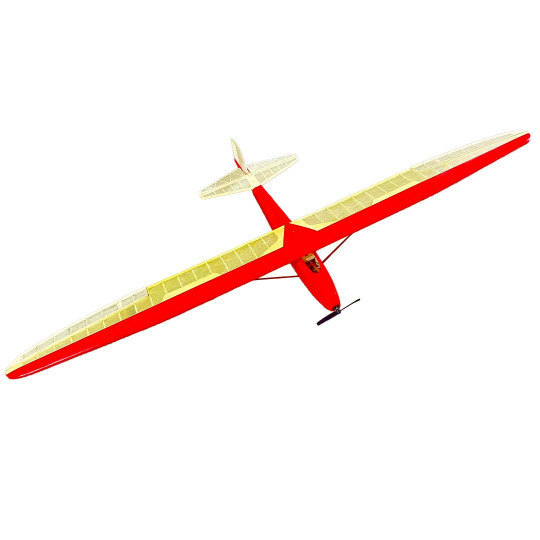
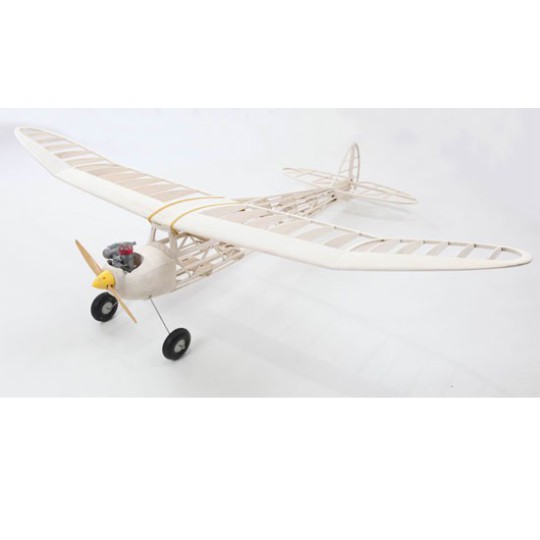
The Cloud Clipper 71 is probably one of the clearest examples. With its 1.80 m wingspan, relatively simple wing and two-axis control, it is very different from a large scale biplane.
The Cloud Walker 65 follows the same philosophy.
These models have a distinctive appearance. You build an aircraft that evokes another era of aeromodelling, while benefiting from modern techniques such as laser cutting.
Gliders
The glider range is particularly interesting.
It includes:
VP2600;
SB98;
Leprechaun Pro 102";
Grunau Baby;
Lippisch G108;
SG-38 Schulgleiter;
Slingsby T45 Swallow;
Mini Grunau Baby.
Dimensions vary considerably from one model to another.
The Mini Grunau Baby has a 1.20 m wingspan, while the VP2600 reaches 2.60 m and the 1/4 scale Grunau Baby reaches approximately 3.40 m.
Seaplanes
ValuePlanes also offers seaplanes, including a 1.57 m wingspan Seagull model.
This part of the range is more specialised, but it clearly shows that the manufacturer is not limited to traditional land-based aircraft.
What are the main ValuePlanes kits?
The ValuePlanes catalogue includes many models. I recommend looking at them according to their type and size rather than simply comparing their prices.
Model
Type
Wingspan
Feature
Mini Grunau Baby
Glider
1200 mm
Small construction kit
Cloud Clipper 71
Old Timer
1800 mm
Two-axis model
Slingsby T45 Swallow
Glider
1800 mm
Compact version
Fokker D.VII
WWI scale aircraft
2100 mm
First World War fighter
SE5a
WWI scale aircraft
2200 mm
1/4 scale construction
Tiger Moth
Scale biplane
2360 mm
1/3.8 scale
SB98
Glider
2500 mm
Construction glider
VP2600
Glider
2600 mm
Kit and ARF versions
Lippisch G108
Glider
2750 mm
Traditional construction
Nieuport 28C-1
WWI scale aircraft
2830 mm
1/3 scale
Grunau Baby
Glider
3400 mm
1/4 scale
SG-38 Schulgleiter
Historical glider
3400 mm
1/3 scale
This diversity is important. When you choose a ValuePlanes model, you are not simply choosing a reference.
You are also choosing an amount of work, a workshop size and a level of construction experience.
How are ValuePlanes kits made?
ValuePlanes kits mainly use laser-cut balsa and plywood parts, supplemented depending on the model by metal, fibreglass or carbon components.
Laser cutting makes it possible to obtain highly precise parts. These parts are then found in the various aircraft subassemblies: ribs, formers, fuselage sides, reinforcements and other structural components.
This is an interesting development compared with older kits, where considerable time could sometimes be spent reproducing or adjusting certain parts.
Wood nevertheless remains at the heart of the concept.
For me, this is where ValuePlanes really makes sense. You are not simply gluing together a few pre-assembled components. You are actually building an airframe.
Why does laser cutting change the building process?
Laser cutting mainly provides precision and better repeatability between parts.
On a kit such as the Cloud Clipper 71, the balsa and plywood parts are laser-cut. The components are designed to fit together accurately, reducing the need for marking and cutting.
This does not mean that construction becomes automatic.
Misalignment is still possible. A wing can still twist. A glue joint can still be made incorrectly.
Precise cutting makes the work easier, but it does not replace the builder's skills.
How good are ValuePlanes kits?
Available feedback particularly highlights the quality of the laser cutting and wood, but perceived quality also depends on the model and your building experience.
This is a point where I prefer to be nuanced.
A wooden kit is still a wooden kit. You will select the parts, check their positioning, verify the angles and progressively build the structure.
For the Cloud Clipper 71, building feedback mentions well-regarded balsa wood and clean laser cutting.
However, some builders have also found the documentation too brief for certain stages.
The distinction between the physical quality of the kit and the quality of the instructions is important.
You can have very well-cut parts and still need to think about how to complete a particular construction stage.
Are ValuePlanes instructions detailed?
ValuePlanes instructions are available for many models, but the level of detail is not identical for every build.
The manufacturer provides documentation for models including the Fokker D.VII, Tiger Moth, Nieuport 28, Cloud Clipper 71, VP2600, SE5a, Grunau Baby, Lippisch G108, SB98 and several other references.
You can therefore check the documentation before starting your project.
I find this particularly useful for large kits.
Before buying a 2.50 or 3.00 m model, I recommend looking at the plans and assembly stages when they are available. You will immediately see whether the level of detail matches your experience.
Why is builder experience still important?
A plan does not always explain everything that an experienced modeller can immediately deduce.
With a complex aircraft, you may sometimes need to interpret a drawing, understand the orientation of a part, plan the gluing sequence or determine how to hold a structure during assembly.
The Tiger Moth illustrates this situation well.
Its biplane structure, wings, struts and numerous details require more methodical work than a two-axis aircraft such as the Cloud Clipper 71.
If you are building your first balsa aircraft, I therefore would not choose a large scale biplane simply because you like its appearance.
What level of experience do you need to build a ValuePlanes kit?
The level required depends greatly on the model, not on the brand as a whole.
I would divide the range into three broad categories.
Kits accessible to beginner builders
The Cloud Clipper 71 is the clearest example.
Its 1.80 m wingspan remains reasonable. It is a two-axis aircraft with a relatively simple design.
The manufacturer also allows for either electric or glow-powered propulsion.
This makes it an interesting model for discovering traditional construction without immediately starting with a large scale aircraft.
Kits for modellers already familiar with balsa
Models such as the VP2600, SB98 or Lippisch G108 require more work.
The VP2600 measures 2.60 m and has an advertised weight of around 850 g in its ARF version. Its design combines wood, fibreglass and carbon.
The build-it-yourself kit naturally requires more work than the ARF version.
Large scale models
Large models such as the Tiger Moth, Nieuport 28, Fokker D.VII, SE5a, Grunau Baby or SG-38 are intended as more ambitious projects.
The Tiger Moth, for example, has a 2.36 m wingspan and is 1.85 m long. Its advertised ready-to-fly weight is around 8.5 kg.
At this size, construction, transport, equipment and setup all take on another dimension.
What does a ValuePlanes kit contain?
The contents depend on the model, but a ValuePlanes kit generally includes the components required to build the airframe, plans and the accessories specified by the manufacturer.
Depending on the reference, you may find:
laser-cut balsa parts;
plywood parts;
metal components;
landing gear;
wheels;
mounting hardware;
control linkages;
assembly accessories;
canopy;
rigging on certain models;
engine cowling on some large models;
plans;
construction instructions.
The exact contents should nevertheless be checked for each individual reference.
This is particularly important with large models.
What is generally not included?
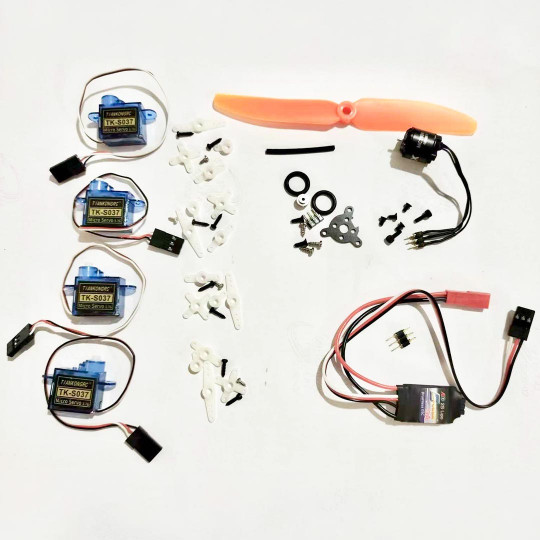
The radio system and propulsion equipment generally need to be purchased separately.
Depending on the model, you will therefore need to choose:
transmitter;
receiver;
servos;
motor;
ESC;
battery;
propeller;
covering;
glue;
electrical accessories.
The Cloud Clipper 71, for example, can be fitted with electric or glow propulsion. The manufacturer and distributors specify different equipment depending on the solution selected.
I recommend preparing your equipment list before starting construction. This avoids discovering halfway through the build that a servo, battery or motor does not fit the available space.
Which propulsion should you choose for a ValuePlanes model?
Propulsion should be selected according to the model's specifications, weight and configuration recommended by ValuePlanes.
There is no universal ValuePlanes power system.
The Cloud Clipper 71 can be fitted with electric or glow propulsion.
The suggested configurations include a brushless motor with a 3S LiPo battery for the electric version, or a small-displacement glow engine.
The 2360 mm Tiger Moth is on a completely different scale.
The published specifications call for a glow engine in the region of 30 to 60 cc depending on the configuration, with a preference indicated for suitable two-stroke or four-stroke engines.
I therefore recommend that you do not choose your engine solely according to wingspan.
Final weight, wing area, flight characteristics and the propulsion recommended by the manufacturer should all be considered together.
Is the VP2600 available as a kit and as an ARF?
The VP2600 is available both as a build-it-yourself kit and as an ARF, allowing you to compare two different approaches to aeromodelling.
The VP2600 has a 2.60 m wingspan and is 1.35 m long. Its advertised flying weight is approximately 850 g.
The ARF version uses a fibreglass front fuselage section and a carbon rear boom, with prepared wooden components.
The kit version leaves you with more construction work.
This is an interesting choice if you are hesitating between the pleasure of building and the desire to fly quickly.
If your main objective is construction, I would choose the kit. If you mainly want a lightweight glider ready to fly quickly, the ARF version follows a different logic.
What are the advantages of a kit compared with an ARF?
A kit gives you more control over construction and finishing, while an ARF considerably reduces the time required before the first flight.
With a kit, you can choose your covering, reinforce certain areas, modify certain details and customise the colour scheme.
You also gain a much better understanding of your aircraft's structure.
That is useful when repairs become necessary.
With an ARF, a substantial part of this work has already been completed.
The VP2600 illustrates this difference perfectly. The ARF version retains the spirit of the model but saves you much of the wooden construction work.
How do you choose your first ValuePlanes kit?
I would first choose the model according to your building experience, and only then according to its appearance.
If you want to discover ValuePlanes and have only built a few models, the Cloud Clipper 71 is a much more manageable project than a 2.36 m Tiger Moth.
If you are already comfortable building balsa structures and enjoy gliders, the VP2600 is an interesting option.
If you are looking for a historical scale project, you can then look at the Fokker D.VII, Nieuport 28, SE5a or Tiger Moth.
For the largest models, I would reserve the project for an experienced builder with sufficient workshop space.
Why do First World War aircraft have such an important place in the ValuePlanes range?
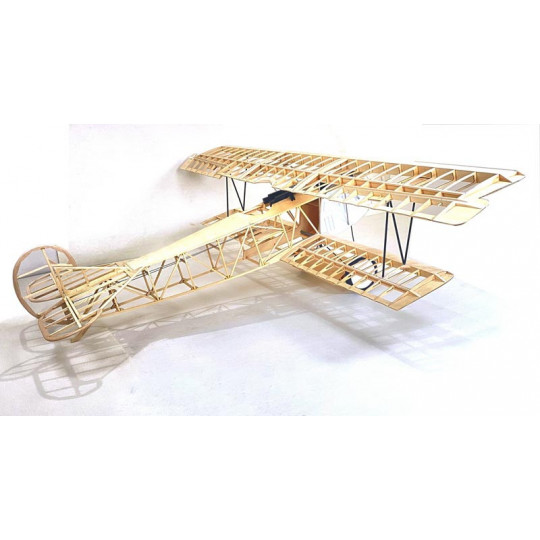
First World War aircraft are particularly well suited to traditional construction because their exposed structures and rigging allow the builder's work to be clearly showcased.
The Fokker D.VII, Nieuport 28C-1 and SE5a are three examples.
These models are also particularly appealing on an aeromodelling field. Their silhouettes are immediately recognisable.
But their construction involves more than assembling a wing and fuselage.
Structural details, control systems, rigging, finishing elements and decoration all play an important role in the final result.
That is precisely what attracts model builders who enjoy construction.
What should you know before building a ValuePlanes Tiger Moth?
The ValuePlanes Tiger Moth is a large 2.36 m scale biplane with an advertised ready-to-fly weight of approximately 8.5 kg.
The kit includes laser-cut balsa and plywood parts, a fibreglass cowling, landing gear, wheels, metal components, rigging, plans and instructions.
For balsa and plywood structures, cyanoacrylate can be practical for certain operations, and we invite you to read our model-making glue guide.
Construction is therefore considerably more ambitious than that of a small leisure aircraft.
You must also plan for five servos, a suitable radio system, the engine, propeller, batteries and covering.
The rigging is another aspect that deserves attention.
On a biplane of this size, it contributes to the appearance, but also to rigidity and the correct construction of the model. I would therefore reserve this kit for a builder who already knows how to work accurately with a wooden structure.
What should you know before building a Fokker D.VII?
The ValuePlanes Fokker D.VII is a First World War aircraft offered with a 2.10 m wingspan.
This model will particularly appeal to enthusiasts of historical aeromodelling.
The construction allows you to work on an airframe with a very distinctive appearance, with a large fuselage surface and details that can be carefully developed during finishing.
The manufacturer provides construction instructions.
I recommend planning your colour scheme carefully before beginning the covering stage.
On a historical model, the finish represents a significant part of the visual result.
What should you know before building a Nieuport 28?
The ValuePlanes Nieuport 28C-1 is a large 1/3 scale model with a wingspan of approximately 2.83 m.
This clearly places it in the large scale model category.
It is therefore not a kit I would recommend for discovering balsa construction.
For an experienced modeller who wants to build a large First World War aircraft, however, the Nieuport 28 offers a particularly interesting project.
The large size also makes it easier to work on certain finishing details, while imposing greater constraints for transport and storage.
Are ValuePlanes kits only intended for historical aircraft?
No. ValuePlanes also offers gliders, Old Timers and more contemporary models.
The VP2600, SB98, Lippisch G108, Slingsby T45 Swallow and Grunau Baby demonstrate the breadth of the range.
This diversity is important because it prevents ValuePlanes from being automatically associated only with First World War aircraft.
The brand actually has a much broader identity: that of traditionally built RC models.
What ValuePlanes accessories are available?
ValuePlanes also develops accessories intended to complement its models and certain construction requirements.
The catalogue includes metal components, control accessories and parts intended for wooden structures.
For example, you can find metal clevises and brass tensioners designed for cables and rigging.
These small components may seem secondary.
They are not when you are building a large scale model.
Choosing the wrong fixing or an unsuitable component can complicate a construction that initially appeared straightforward.
Where can you find ValuePlanes kits in France?
Scientific MHD is the official ValuePlanes distributor and offers the brand's kits through its online store.
You can therefore find the various available models, consult their specifications and select the accessories required for their construction.
For me, this is an important advantage when preparing a project lasting several weeks or months.
The availability of parts and the possibility of obtaining the components required for assembly are part of the project, just as much as choosing the engine or covering.
Can you find ValuePlanes instructions before starting construction?
Yes. ValuePlanes provides construction instructions for many models.
You can find documents for the Tiger Moth, Fokker D.VII, Nieuport 28, Cloud Clipper 71, VP2600, SE5a, Grunau Baby, Lippisch G108, SB98 and several gliders.
I find this possibility particularly useful.
If you are hesitating between two models, look at their documentation before making your decision.
The number of stages, the type of structure and the complexity of the assemblies will already give you a good idea of the work involved.
What tools do you need to build a ValuePlanes kit?
To properly build a ValuePlanes kit, I would plan at least a flat work surface, rulers, a square, modelling pins, clamps, craft knives, sandpaper and suitable glues.
For balsa and plywood structures, cyanoacrylate can be practical for certain operations.
Wood glue is also very useful when you want a progressive and clean assembly.
For a large model, I would add a system allowing you to keep components perfectly aligned while the glue dries.
This is often where the final quality of a build is determined.
A wing can be perfectly laser-cut and still end up twisted if it is not built on a flat surface.
How long does it take to build a ValuePlanes kit?
There is no single construction time because the duration depends greatly on the model and your working method.
A Cloud Clipper 71 and a 2.36 m Tiger Moth obviously cannot be compared in this respect.
You should also distinguish pure construction time from the time spent on finishing.
Building the airframe is only one stage. You then need to sand, cover, install the control systems, fit the servos, install the propulsion system, make the electrical connections and carry out the setup.
On a large scale model, the colour scheme itself can represent a substantial project.
I therefore prefer to think in terms of the overall project rather than a number of hours.
Which ValuePlanes kit should you choose for your project?
I recommend starting with what you want to build and fly, rather than looking for a model presented as universally suitable.
Your project
Model to consider
Why
Discovering wooden construction
Cloud Clipper 71
1.80 m, two-axis, traditional structure
Building a compact glider
Mini Grunau Baby
1.20 m wingspan
Building a 2.60 m glider
VP2600
Large wingspan for an advertised low weight
Building a historical aircraft
Fokker D.VII
2.10 m WWI model
Building a scale biplane
Tiger Moth
2.36 m, 1/3.8 scale
Building a large WWI aircraft
Nieuport 28C-1
Approximately 2.83 m, 1/3 scale
Building a large historical glider
Grunau Baby
Approximately 3.40 m, 1/4 scale
This selection is not a ranking. It simply puts each project alongside a model matching its characteristics.
What should you check before ordering a ValuePlanes kit?
Before ordering, I recommend checking eight points.
The amount of space available to build and store the aircraft.
This last point is often forgotten.
A 2.36 m Tiger Moth or a 3.40 m Grunau Baby requires space.
You need enough room to build the aircraft, but also to turn it around, work around it and eventually transport it.
Why choose a ValuePlanes kit rather than a ready-to-fly aircraft?
A ValuePlanes kit is primarily aimed at someone who wants to take part in creating their aircraft.
That is the fundamental difference.
When you open a box containing laser-cut balsa parts, you do not yet have an aircraft. You have a project.
You will choose the assembly sequence, build the joints, sand, adjust, cover and install the radio equipment.
The finished result belongs much more to you than a ready-to-fly model.
It is also an excellent learning experience.
After building a complete airframe, you understand better why a wing must be perfectly aligned, how a control system works, why a structure needs reinforcement in certain areas and how to repair your aircraft after an incident.
Is ValuePlanes suitable for modellers who enjoy building?
Yes. The ValuePlanes philosophy clearly matches traditional model building, but not every model requires the same level of experience.
This is probably the most important point to remember.
If you enjoy building, working with wood and customising your aircraft, the range is worth exploring.
If you are simply looking for an aircraft to get into the air quickly, a kit several metres across is probably not the most suitable project.
I would first look at the Cloud Clipper 71 or a reasonably sized model.
Then, once you have mastered the technique, there is nothing stopping you from moving on to a Tiger Moth, Fokker D.VII or large glider.
What is the ValuePlanes range really like?
ValuePlanes occupies a distinctive position among RC aircraft kit manufacturers, with a range centred on traditional construction, scale models and historical gliders.
What I find most interesting is the variety of projects.
You can start with a 1.20 or 1.80 m model, then move on to a 2.60 m glider or a large scale aircraft close to 3 metres.
The construction techniques remain similar, but the level of preparation and precision required increases with the size of the model.
Available builder feedback also highlights a reality worth knowing before buying: the quality of the parts and cutting is appreciated, but some models require you to know how to interpret a plan and supplement the information provided by the instructions.
That is not necessarily a drawback.
For a modeller who genuinely enjoys building, part of the pleasure lies precisely in understanding the model progressively.
FAQ about ValuePlanes kits
Is ValuePlanes a Chinese brand?
Yes. ValuePlanes is a Chinese manufacturer of radio-controlled scale models.
ValuePlanes Model Manufacturing states that it began its activity in 2016.
What types of kits does ValuePlanes manufacture?
ValuePlanes mainly manufactures traditionally built RC aircraft, military and civilian scale aircraft, Old Timers, gliders and seaplanes.
Are ValuePlanes kits made of wood?
Most of the construction structures use balsa and plywood. Some models also incorporate fibreglass, carbon or metal components.
Are the parts laser-cut?
Yes. Laser cutting is used on many ValuePlanes kits, particularly for balsa and plywood parts.
What is the smallest ValuePlanes kit?
The range includes the 1.20 m Mini Grunau Baby.
What is the largest ValuePlanes model?
The range includes several models around or above 3 metres.
The 1/4 scale Grunau Baby and 1/3 scale SG-38 both have a wingspan of approximately 3.40 m.
Is the Cloud Clipper 71 suitable for a beginner?
The Cloud Clipper 71 is one of the more accessible ValuePlanes models thanks to its two-axis design and 1.80 m wingspan. However, you still need to know how to build a wooden structure accurately.
What is the wingspan of the Cloud Clipper 71?
The Cloud Clipper 71 has a 1,800 mm wingspan and is approximately 1,320 mm long. Its advertised ready-to-fly weight is around 1.8 kg.
What is the wingspan of the ValuePlanes Tiger Moth?
The Tiger Moth DH82a has a 2,360 mm wingspan and is approximately 1,850 mm long.
How much does the ValuePlanes Tiger Moth weigh?
Its advertised ready-to-fly weight is approximately 8.5 kg.
Is the ValuePlanes Tiger Moth difficult to build?
Yes, it requires considerably more experience than a small two-axis aircraft.
Its large size, biplane structure, rigging and numerous finishing components make it a project intended for a builder already familiar with wooden kits.
What is the wingspan of the VP2600?
The VP2600 has a 2,600 mm wingspan and is 1,350 mm long.
Its advertised flying weight is approximately 850 g.
Is the VP2600 available as a build-it-yourself kit?
Yes. ValuePlanes offers the VP2600 as a build-it-yourself kit, as well as in an ARF version.
Can a ValuePlanes model be powered electrically?
Yes. Several models can be fitted with electric propulsion.
The Cloud Clipper 71 can, for example, be fitted with electric or glow propulsion, while the VP2600 can be configured as an electric glider.
Can a ValuePlanes model be powered by a glow engine?
Yes. Some models are designed for glow propulsion.
The Cloud Clipper 71 and Tiger Moth are two examples, with engine capacities suited to their respective sizes.
Are engines and servos included in the kits?
They are not included in the construction kit.
You should check the contents of each individual reference and plan separately for the radio system, servos and propulsion.
Are ValuePlanes instructions available?
Yes. ValuePlanes provides instructions for many models, including the Fokker D.VII, Tiger Moth, Nieuport 28, Cloud Clipper 71, VP2600, SE5a and several gliders.
Where can you buy ValuePlanes kits in France?
Scientific MHD is the official ValuePlanes distributor.
The brand's available kits are offered through its online store, with the technical information corresponding to each reference.
Which ValuePlanes model should you choose to start building?
I would first look at a reasonably sized model with a relatively simple structure, such as the Cloud Clipper 71.
Once you have mastered the basics of balsa construction, you can move on to larger and more complex models.