-
-€25.00
-
Promotion
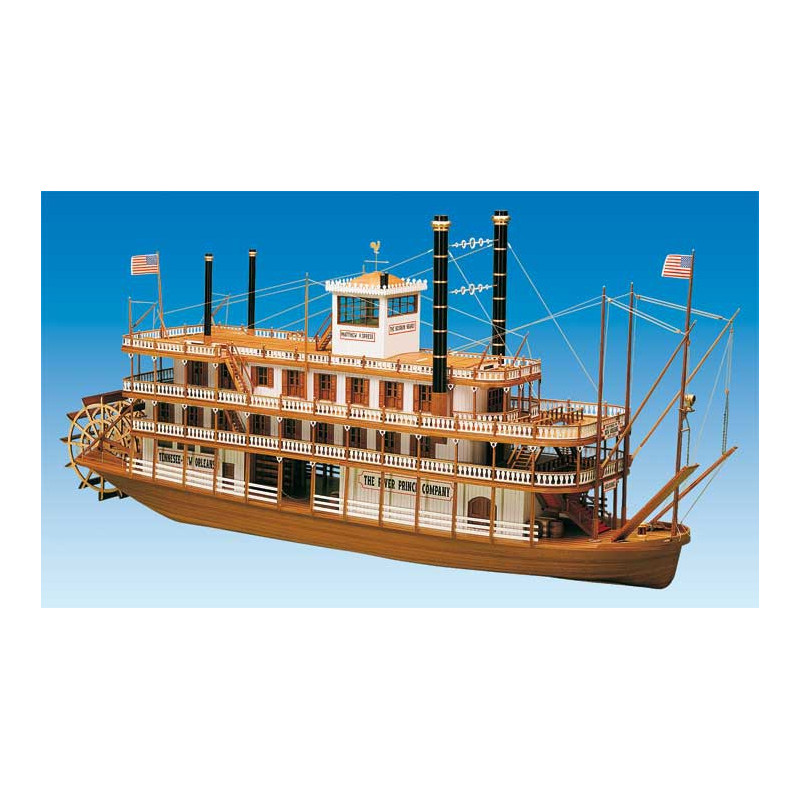
Discover the world of great American steamboats with the Mississippi 1/50 Mantua Sergal model ship, reference S068734.
This wooden ship modeling kit reproduces a paddlewheel riverboat characteristic of navigation on the Mississippi between the late 19th and early 20th centuries.
With its stacked decks, two tall chimneys, wheelhouse, and rear paddlewheel, this reproduction evokes the famous steamboats that transported travelers and goods on American waterways.
Measuring 105 cm at a 1/50 scale, this model to build combines a double-planked wooden hull, laser-cut parts, and numerous wood and metal fittings.
Mainly intended for experienced modelers, it allows for the creation of a detailed reproduction of a Mississippi steamboat, ideal for completing a collection of historical naval models.
Dimensions of the assembled boat:
Length 1050 mm
Width 240 mm
Height 470 mm

Model static steamship Mississippi 1-50 – Sergal 734
|
|
|
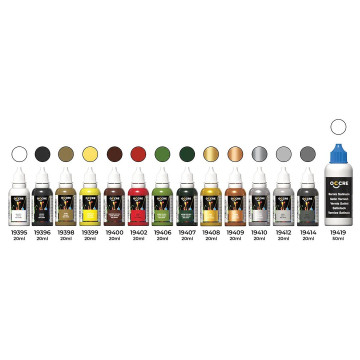
Pack paints Mississippi - 14 pots - OcCre€56.95 - ref. S06190523 |
|
|
|
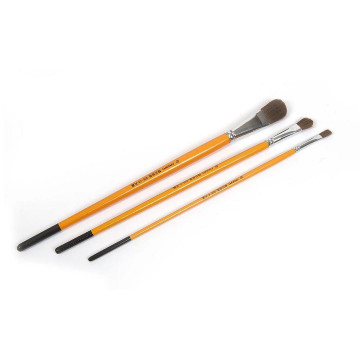
Set of 3 specific brushes for wooden boat model - OcCRE€5.95 - ref. S06110511 |
|
|
|
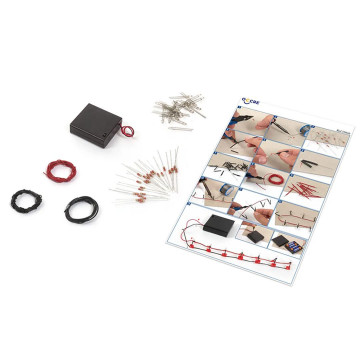
LED lighting kit for boat and train models with 25 LEDs - OcCre€43.95 - ref. S06155010 |
Fast shipping
Via Chronopost 24H
Via DPD 24/48H
Colissimo 48/72H
335072 products in stock
Real-time stock displayed
Secure payment




Secure payment
In 3 or 4 installments

 4.6/5

Specialist since 1955
Fast shipping
Via Chronopost 24H
Via DPD 24/48H
Colissimo 48/72H
335072 products in stock
Real-time stock displayed
Secure payment
Secure payment
In 3 or 4 installments
4.6/5
Specialist since 1955
In the 19th century, the Mississippi River and its tributaries formed a vast transportation network connecting agricultural regions, industrial cities, and major ports in the United States.
Long before the widespread development of railway networks, steamboats played an essential role in trade and population movement.
The development of steam propulsion gradually transformed river navigation.
Unlike vessels dependent on the current, sail, or human traction, steamboats could navigate both directions of the river thanks to their steam engines driving large paddle wheels.
These ships transported cotton, agricultural products, goods, mail, and passengers.
They provided connections between many riverside cities, including St. Louis, Memphis, Natchez, and New Orleans.
The Mississippi steamboats thus became symbols of the development of American river transport, as well as witnesses to the economic and social transformations of this period.
American steamboats were notably distinguished by their shallow draft hulls, adapted to rivers whose depth varied with the seasons.
This architecture allowed navigation on sometimes shallow waterways and access to docks located directly on the banks.
Two major paddle wheel propulsion configurations developed: sidewheelers, with side wheels, and sternwheelers, with a rear wheel.
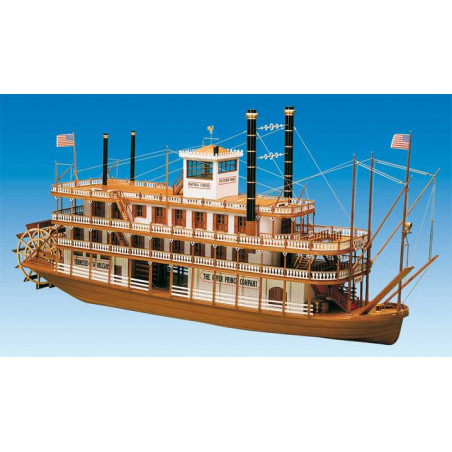
The Mantua Sergal Mississippi model represents a sternwheel paddle steamboat.
Its silhouette includes several deck levels, walkways, railings, vertical chimneys, and an elevated pilothouse.
These architectural elements illustrate the particularities of American riverboats from the second half of the 19th century and the early 20th century.
The Mississippi Mantua model does not represent a unique ship with a precisely identified name, launch date, and career.
It reproduces a type of American steamboat characteristic of the period between the 1870s and 1920s.
This approach allows for the discovery of the major technical and aesthetic features of historical steamboats: an elongated hull, a paddle wheel for propulsion, superimposed decks, and a wheelhouse offering a clear view of the river.
Manufactured by Mantua Model in the Sergal range, this wooden boat model is offered under the manufacturer reference 734, also marketed under the reference S068734.
Its 1/50 scale allows for the reproduction of many architectural and technical details, while offering dimensions suitable for display on a stand or in a large exhibition showcase.
Manufacturer: Mantua Model
Range: Sergal
Reference: 734 / S068734
Model: Mississippi
Type of boat: American river steamboat
Period represented: 1870-1920
Scale: 1/50
Assembled length: 1,050 mm (105 cm)
Assembled width: 240 mm (24 cm)
Main material: wood
Hull construction: double planking on frames
Fittings: wood and metal, including brass
Type of kit: static model to build
Recommended level: advanced.
The construction of the model requires the assembly of the wooden structure, the construction of the decks and superstructures, and then the installation of various decorative and technical elements.
The Mississippi Mantua Sergal model uses a traditional naval modeling construction method: planking on frames.
The internal structure consists of laser-cut plywood elements intended to form the framework of the hull.
After assembling the frames and fixing them on the longitudinal structure, the modeler performs the planking by gradually adjusting the wooden strips.
The double planking system involves creating a first layer of covering, then a second layer intended to ensure the exterior finish of the hull.
This method allows for careful work on the boat's shapes and the final appearance of the wood.
The kit includes notably walnut and limewood strips, two essences commonly used in the construction of wooden ship models.
The assembly requires particular attention to the alignment of the frames, the bending of the strips, and the regularity of the planking.
These steps directly determine the quality of the finished hull.
The plywood elements are laser-cut to facilitate their identification and assembly.
This technique allows for regularly shaped pieces that serve as the basis for the construction of the boat.
The modeler must still check the fittings, prepare the bonding surfaces, and carry out the necessary sanding operations before final assembly.
The various wooden pieces contribute to the construction of the hull, decks, fittings, and characteristic superstructures of this American riverboat.
One of the features of this Mississippi steamboat model lies in the construction of its different deck levels.
The exterior walkways, railings, stairs, openings, and deck structures help reproduce the appearance of large American riverboats.
The elevated wheelhouse, located above the main decks, is a characteristic element of the ship's silhouette.
On real steamboats, this position allowed the pilot to have an extended view of the waterway and its obstacles.
The assembly of these structures requires precision to maintain consistent alignments and clean assemblies, especially at the railings and repetitive elements.
The Mantua Sergal kit includes two aluminum chimneys, particularly recognizable on American steamboats.
These vertical elements directly contribute to the visual identity of the Mississippi.
They recall the installations related to steam engines that provided propulsion for riverboats.
The fittings also include brass elements, including lost-wax cast pieces and photo-etched brass details.
Photo etching allows for the reproduction of some fine components on a miniature scale, while the cast metal pieces are intended to complete the fittings and details of the boat.
The rear paddle wheel represents one of the most emblematic elements of this model.
On real sternwheelers, the steam engine drove a large wheel equipped with blades.
By turning in the water, these produced the thrust necessary for the boat's progress.
This propulsion system was particularly suited to some shallow waterways.
The rear placement of the wheel also allowed it to be partially protected from obstacles encountered during navigation.
On the Mantua model, the reproduction of the paddle wheel is an important step in the construction.
The assembly of its components and their positioning must follow the plan instructions to maintain the geometry and proportions of the model.
The construction kit gathers the main components necessary for the realization of the static model.
It notably includes:
The diversity of materials allows for working with several naval modeling techniques, from assembling wooden structures to placing small fittings pieces.
The glue, paints, and tools must be provided separately to carry out the assembly and finishing operations.
The Mississippi 1/50 model is mainly intended for experienced modelers or enthusiasts who already have experience in building wooden boats.
Several technical features explain this level of difficulty: the construction of a double-planked hull, the numerous deck structures, the small metal elements, and the reproduction of the paddle wheel.
The assembly requires knowing how to prepare and adjust wooden pieces, maintain assemblies during drying, perform sanding operations, and work on miniature components.
The construction of overlapping decks requires rigorous organization to maintain accessibility to different assembly areas before their closure.
The treatment of finishing elements, particularly railings and fittings, also requires patience and good mastery of precision tools.
Before starting, it is recommended to study all the plans and identify the main construction steps.
A dry fit of the structural parts allows for checking their positioning before gluing. For the hull, it is preferable to work gradually and check the symmetry of the planking strips.
The fragile elements of the superstructures can be prepared separately when the plans allow, to facilitate their handling.
Finally, it is advisable to determine the painting and finishing operations before installing the last detailed parts.
Some areas of the decks become difficult to access once the railings and upper levels are assembled.
The Mississippi Mantua Sergal kit is marketed as a static wooden boat model.
It is therefore initially intended to be built and then displayed.
However, the manufacturer indicates that a transformation into a motorized model can be considered by experienced modelers. This adaptation requires additional work and specific skills in radio-controlled shipbuilding.
Possible motorization may require structural modifications, suitable waterproofing, installation of a transmission, a motor, a power supply, and radio control equipment.
These pieces of equipment should not be considered as included in the static kit. The possibility of navigating depends on the quality of the modifications made, the stability of the model, and the compliance of its technical installation.
For a classic assembly, it is recommended to follow the manufacturer's plans and maintain the originally intended static configuration.
With its 105 cm length and 24 cm width, the Mississippi Mantua is a significant presentation piece for a naval modeling collection.
Its numerous decks, paddle wheel, chimneys, and railings offer a particularly recognizable silhouette, different from traditional sailing ships and steam military vessels.
The finished model can be displayed on a stand suitable for its hull or installed in a sufficiently large protective showcase.
It is advisable to allow clearance around the most fragile elements, notably the chimneys, rigging, and railings.
The Mississippi can also serve as the centerpiece of a diorama inspired by river navigation in the United States at the end of the 19th century.
A scene with a dock, miniature goods, port elements, or a riverside decor would evoke the passenger and freight transport activities of that era.
These decor elements are to be made or acquired separately, taking into account the 1/50 scale and the significant dimensions of the boat.
The Mississippi model by Mantua Sergal, reference 734 or S068734, is made at a 1/50 scale.
It reproduces an American river paddle steamer, characteristic of the 1870-1920 period.
The Mississippi model measures 1,050 mm in length and 240 mm in width, or 105 cm long and 24 cm wide.
It is a large wooden boat model that requires suitable display space.
The Mantua model represents a type of American steamship used on rivers between the late 19th century and the early 20th century.
It does not correspond to the documented reproduction of a single vessel but to a reconstruction of the characteristic steamboats of that era.
On historical boats, the steam engine drives a wheel equipped with blades that successively enter the water.
Their movement produces the thrust necessary for propulsion.
The Mississippi Mantua reproduces this architecture with a paddle wheel placed at the rear of the boat.
This model is rather recommended for experienced modelers.
Its double-planked hull, various decks, paddle wheel, and numerous details require precision and prior experience in assembling wooden models.
The kit includes walnut and lime wood elements, laser-cut plywood parts, wooden and brass fittings components, photo-etched elements, aluminum chimneys, rigging, and flags.
Plans and instructions in English accompany the pieces.
Yes. The kit uses a frame construction with two layers of planking.
This method allows for the shaping of the hull, followed by finishing its exterior with suitable wooden strips.
The glue, paints, and assembly tools must be obtained separately.
The choice of products depends on the materials to be assembled and the type of finish desired for the model.
The manufacturer indicates that a motorized conversion is possible for experienced modelers.
This modification requires additional equipment, construction adaptation, and special precautions regarding waterproofing and stability.
The kit is initially designed as a static model.
Yes. The model can be placed in a showcase suitable for its dimensions.
A transparent cover helps limit dust deposits on the decks, chimneys, rigging, and various details of this naval model.
A Mississippi steamboat model allows for the exploration of a particular form of naval construction, different from traditional sailing ships. The assembly combines woodworking, the creation of layered decks, installation of metal details, and reproduction of a paddle wheel.
The finished model also evokes the history of American river transport during the steam era.
Customers who bought this product also bought: