-
Novelty
If you are looking for a Mirage F.1 1/48 scale model, a Dassault aircraft model to assemble, a French military aircraft plastic kit, or even a Mirage F.1B scale model, this reference is currently one of the most attractive options available.
Its level of detail, numerous display options, overall quality of design, and the originality of the subject make it a particularly appealing project.
In my opinion, the Mirage F.1 remains one of the most beautiful fighters designed by Dassault. Its balance between elegance, performance, and versatility explains why it continues to fascinate both aviation historians and modelers.
Once assembled and carefully painted, a Mirage F.1 model immediately stands out in a collection dedicated to modern military aviation.

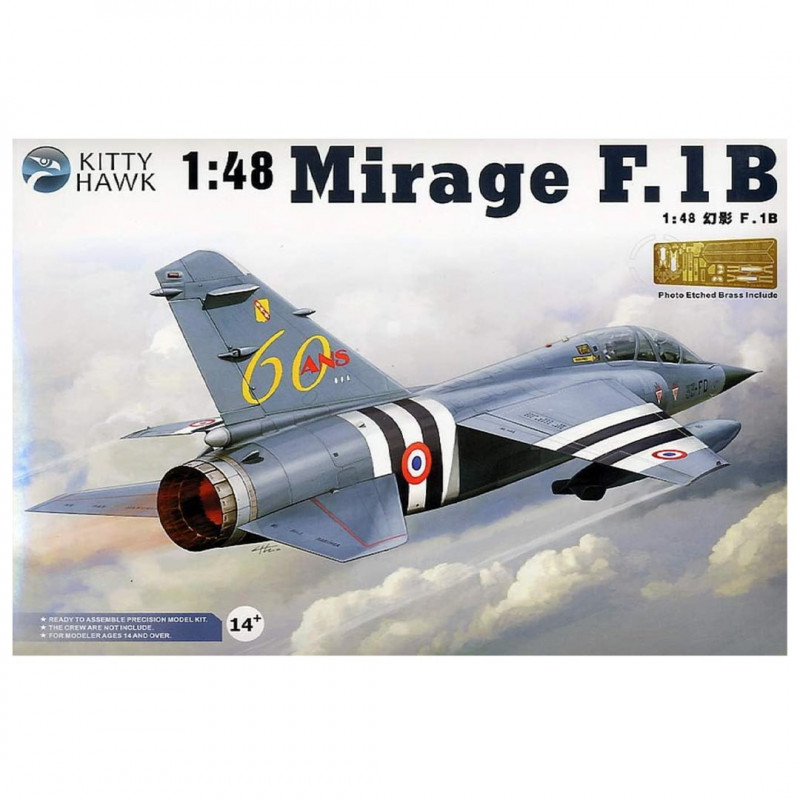
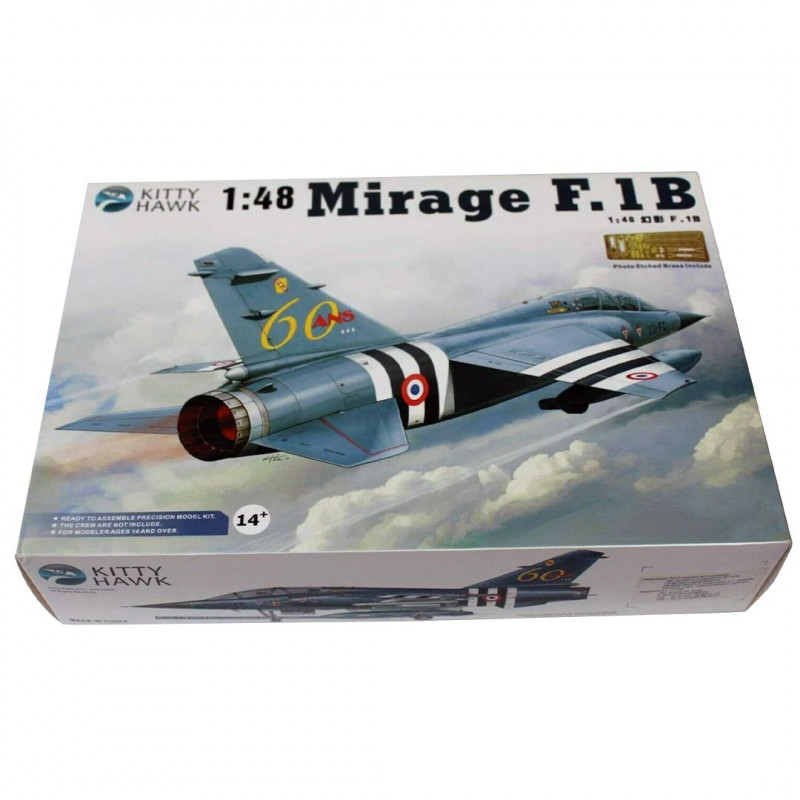
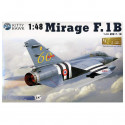
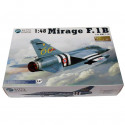
Plastic model of Mirage F1 B aircraft 1/48 Kittyhawk
Plus de detailsPlastic model of Mirage F1 B aircraft 1/48 Kittyhawk
Fast shipping
Via Chronopost 24H
Via DPD 24/48H
Colissimo 48/72H
327500 products in stock
Real-time stock displayed
Secure payment




Secure payment
In 3 or 4 installments

 4.6/5
4.6/5

Specialist since 1955
Fast shipping
Via Chronopost 24H
Via DPD 24/48H
Colissimo 48/72H
327500 products in stock
Real-time stock displayed
Secure payment
Secure payment
In 3 or 4 installments
4.6/5
Specialist since 1955
When a modeler is looking for a Mirage F.1 model, a military aircraft plastic kit, a 1/48 scale Dassault Mirage F.1, or even a French fighter aircraft to assemble, they are generally interested in one of the most iconic aircraft in the French aerospace industry.
The Dassault Mirage F.1 appeared at a time when the Mirage III and Mirage V family already dominated the international market for combat aircraft.
In order to continue this success, Dassault Aviation developed a completely new aircraft, while retaining certain qualities that had built the reputation of its predecessors.
The first prototype made its maiden flight on December 23, 1966. From the initial tests, the aircraft demonstrated remarkable potential. Its high performance allowed it to set several speed records, reaching speeds of over Mach 2 at high altitudes.
Unlike the Mirage III, recognizable by its delta wing, the Mirage F.1 adopted a different aerodynamic configuration with a classic swept wing and a traditional rear horizontal tail.
This technical choice significantly improved performance at low speeds and operational capabilities on relatively short runways.
This evolution was not insignificant. Air forces were then looking for aircraft capable of operating quickly, with minimal logistical support, while maintaining excellent performance in interception and ground attack.
The Mirage F.1 was designed around the Atar 9K engine, already used in other French aircraft.
Thanks to this engine, it could reach a maximum speed exceeding Mach 2.2.
Its range was also a major advancement. The integration of larger internal tanks allowed it to carry about 40% more fuel than the Mirage III.
This characteristic significantly increased its autonomy, especially during patrol or interception missions.
Pilots also appreciated its quick deployment. The time between missions was particularly short, providing a significant strategic advantage during the Cold War.
The Thomson-CSF Cyrano IV radar represented another significant advancement. Its range was significantly greater than previous systems installed on the Mirage III.
Once the target was selected by the pilot, the radar automatically tracked it, enhancing engagement capabilities in complex conditions.
Even today, these equipment contribute to the historical interest of the Mirage F.1 among military aviation enthusiasts and model collectors.
The F.1C version is probably the most well-known. Primarily intended for air superiority missions, it also retained a significant ground attack capability.
Entering service in the late 1960s, it was long the backbone of the French air force.
To train pilots, Dassault developed the Mirage F.1B, a two-seater training version.
Unlike many training aircraft of the time, the F.1B was not limited to training. It retained real operational capabilities and could participate in combat missions.
For enthusiasts of Mirage F.1B models, this variant is particularly interesting due to its additional rear cockpit which adds more details and realism during assembly.
In the early 1990s, the Mirage F.1CT was introduced, specially adapted for ground attack missions.
This modernized version demonstrated the Mirage F.1's ability to evolve over the decades to meet new operational needs.
Few French aircraft can boast such an international career.
In total, nearly 770 units were produced. In addition to the French Air Force, the Mirage F.1 was used by numerous air forces around the world.
It was notably found in Spain, Morocco, South Africa, Greece, Iraq, Iran, Libya, Jordan, Kuwait, Qatar, Gabon, and Ecuador.
This global distribution explains the wide variety of available decorations for modelers today. Whether you are passionate about French, Spanish, or African aircraft, there are numerous liveries available to customize your scale model.
I also find that this historical richness is one of the main attractions of the Mirage F.1 in modeling.
Each decoration tells a different story and allows you to break away from the usual paint schemes.
When you look at a Mirage F.1, it's hard to mistake it for another aircraft.
Its sleek nose, side air intakes, high tail, and swept wings give it a particular elegance.
This dynamic silhouette naturally attracts enthusiasts of military aircraft models, Dassault scale models, or modern fighter jet kits.
The Mirage F.1 also offers many interesting elements to replicate:
All these elements help create a particularly lifelike model once completed.
For many years, enthusiasts wishing to build a 1/48 Mirage F.1 had few truly modern options.
The arrival of the Kitty Hawk kit has therefore generated real excitement in the aeronautical modeling community.
This kit notably represents the first modern depiction of the two-seater Mirage F.1B at this scale, a subject long awaited by enthusiasts.
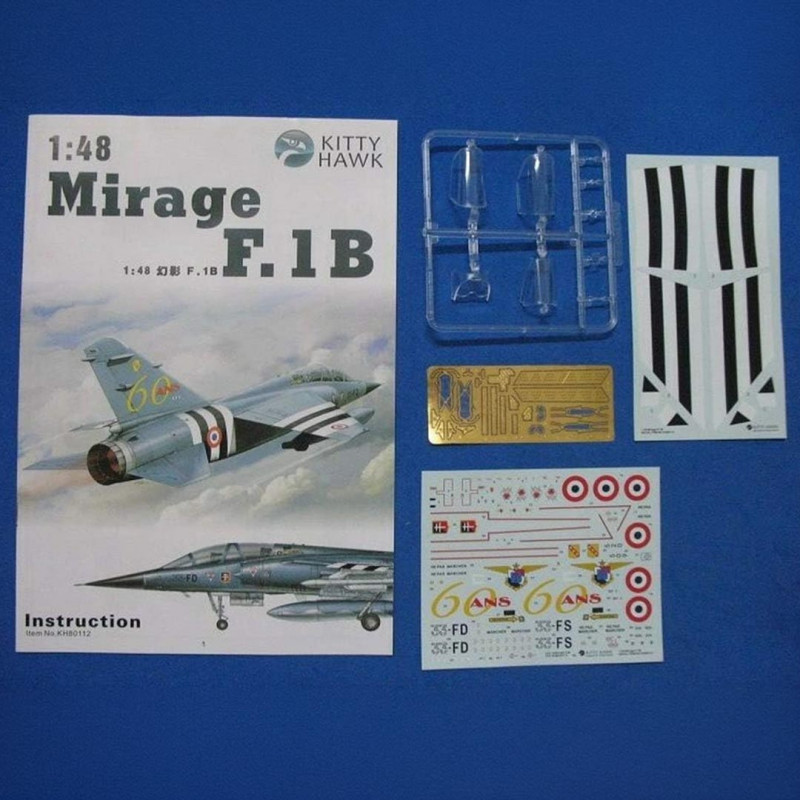
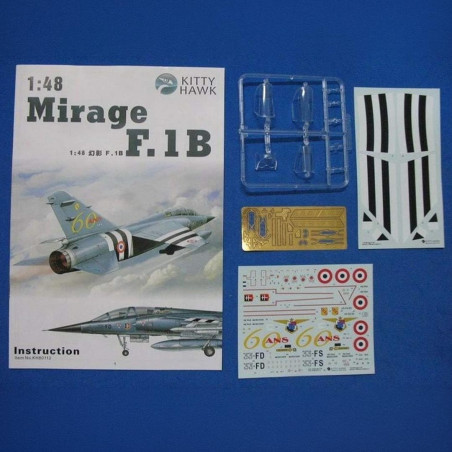
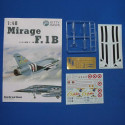
The kit is molded in a good quality light gray plastic and includes several sprues and a photo-etched sheet.
Upon opening the box, one can see the attention to the overall design.
Both the front and rear cockpits feature a particularly convincing level of detail. The side consoles, ejection seats, and instrument panels provide an excellent foundation for creating a realistic model.
The canopies can be displayed open or closed, allowing the interior of the aircraft to be showcased.
One of the most appealing aspects of this model lies in the customization possibilities.
The modeler can choose the position of many elements:
This modularity allows representing the aircraft in different phases of use, whether parked at an air base or ready for takeoff.
The box contains several options for external load.
Among the available equipment are additional tanks as well as Matra Super 530 missiles.
Many other military loads are also included. Even if not all are used on the Mirage F.1B, they can enhance your spare parts box for future projects.
For enthusiasts of 1/48 scale fighter aircraft models, these accessories represent a real advantage.
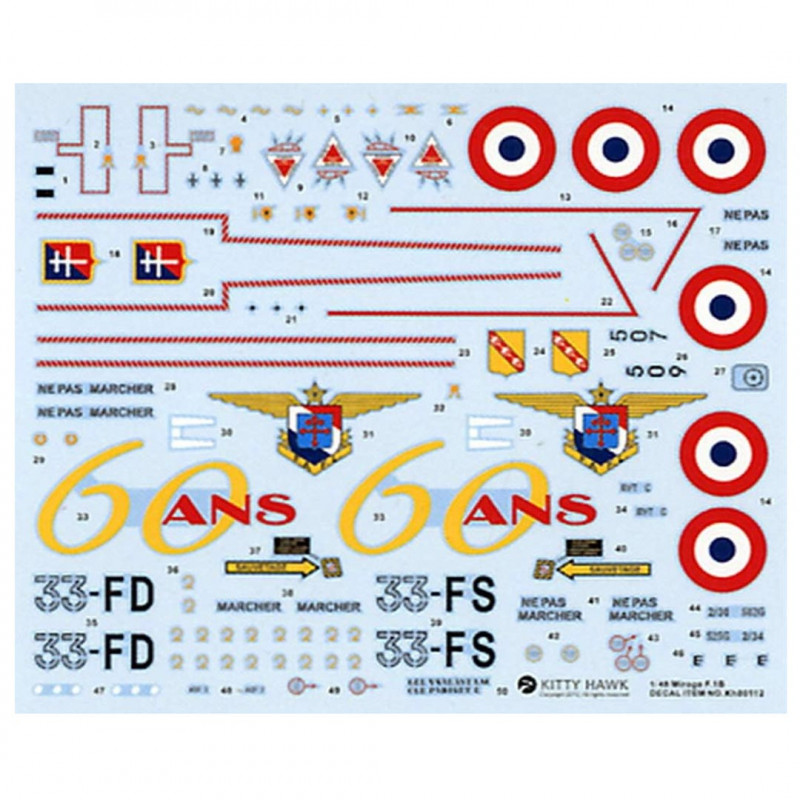
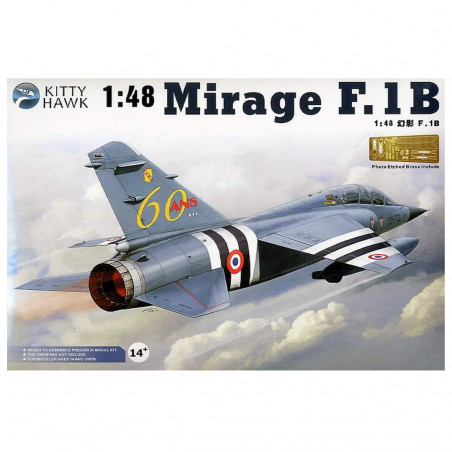
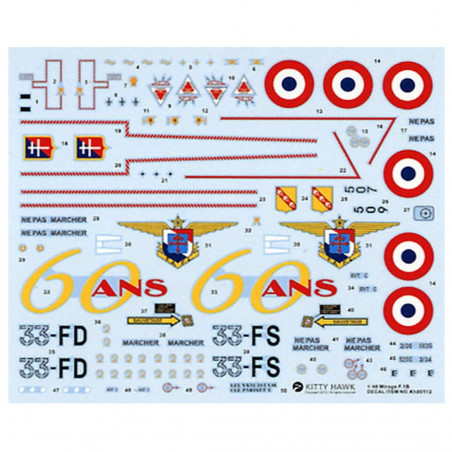
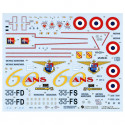
Kitty Hawk offers two decorations of the French Air Force.
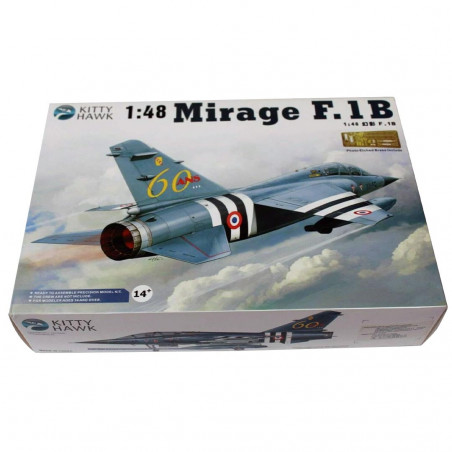
The first represents a commemorative aircraft celebrating the sixtieth anniversary of the Normandy Landings in 2004.
The second corresponds to a more classic operational decoration.
These markings allow for creating an elegant and historically interesting model, while highlighting the characteristic lines of the Mirage F.1B.
If you are looking for a 1/48 scale Mirage F.1 model, a Dassault aircraft model to assemble, a French military plastic aircraft kit, or even a scaled-down Mirage F.1B model, this reference is currently one of the most attractive options available.
Its level of detail, numerous presentation options, overall quality of design, and originality of the subject make it a particularly appealing accomplishment.
In my opinion, the Mirage F.1 remains one of the most beautiful fighters designed by Dassault. Its balance between elegance, performance, and versatility explains why it continues to fascinate both aviation historians and modelers.
Once assembled and carefully painted, a Mirage F.1 model immediately stands out in a collection dedicated to modern military aviation.
Customers who bought this product also bought: