






The OcCre Adler locomotive model at 1/24 scale allows you to discover railway modeling through the reproduction of an iconic train from the early days of the German railway.
This wooden and metal locomotive kit includes 434 pieces and requires approximately 120 hours to assemble.
Its intermediate level is suitable for modelers with some experience who want to create a detailed model.
The downloadable assembly instructions guide you through the various construction steps.
Model dimensions:
337 mm in length
180 mm in height
94 mm in width
Intermediate level

Model Wooden Adler Locomotive - 1-24 - OcCre
|
|
|
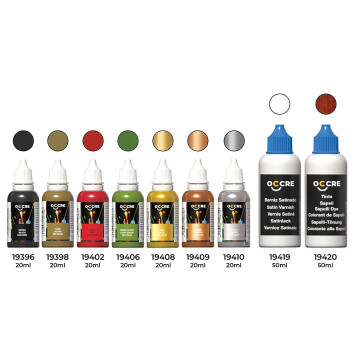
Adler Paint Pack - 9 pots - OcCre€43.95 - ref. S06190540 |
|
|
|
Exhibition base for small locomotives - OcCre€38.95 - ref. S06155101 |
|
|
|
Model Wooden Adler locomotive car model - 1-24 - OcCre€159.95 - ref. S06156001 |
Fast shipping
Via Chronopost 24H
Via DPD 24/48H
Colissimo 48/72H
329409 products in stock
Real-time stock displayed
Secure payment




Secure payment
In 3 or 4 installments

 4.6/5

Specialist since 1955
Fast shipping
Via Chronopost 24H
Via DPD 24/48H
Colissimo 48/72H
329409 products in stock
Real-time stock displayed
Secure payment
Secure payment
In 3 or 4 installments
4.6/5
Specialist since 1955
This train model kit combines significant railway history with a construction project that requires method and precision.
• Scale 1/24, designated G-45 by OcCre.
• Intermediate level, suitable for modelers who already have some experience.
• 434 pieces and an estimated assembly time of around 120 hours.
• Dimensions of the finished model: 337 mm in length, 180 mm in height, and 94 mm in width.
• Materials: various types of wood, photo-etched brass parts, and zamak cast elements.
• Downloadable assembly instructions to guide the building process.
On December 7, 1835, the Adler made the first public railway journey in Germany on the line connecting Nuremberg to Fürth.
The approximately 6-kilometer journey was completed in a few minutes and marked an important milestone in the development of German railway transport.
Built by the company Robert Stephenson & Co. in Newcastle, England, the locomotive had to travel a long distance before reaching its destination.
Transported by boat and then by land, it was assembled in Nuremberg.
Its engineer, William Wilson, oversaw its commissioning and assisted in training the local staff.
The original locomotive has disappeared, but a replica made for the centenary of the German railway in 1935 has helped preserve its memory.
The OcCre model thus allows the reconstruction of a vehicle associated with the early years of steam traction and the development of railways in Europe.
With 434 pieces and an estimated 120 hours of work, the Adler model requires more precision than a kit designed for beginners.
The assembly process allows you to become familiar with wood adjustments, surface preparation, and the placement of small detail elements. Progress step by step, checking the position of the pieces before gluing.
The laser-cut wooden boards facilitate the preparation and adjustment of the elements.
To work cleanly, set up on a stable and well-lit surface, then organize the pieces by step.
The downloadable instructions help you follow the construction sequence and minimize assembly errors.
The tools, accessories, and products needed for assembling and finishing the model are not included.
We have selected the main items useful for its construction.
For simplicity and cost-effectiveness, order them at the same time as your model:
in metropolitan France, shipping is free for orders over €150.
Simply check the boxes above for the items you want to add to your order.
The Adler OcCre model combines several materials to reproduce the different parts of the locomotive. Wood types are used for the structure and visible finishes.
The photo-etched brass elements allow for fine detail reproduction, while the zamak cast parts complete small accessories and complex-shaped elements.
Before gluing a piece, check its fit and lightly sand the surfaces that require it.
If you wish to paint the miniature locomotive, apply the products in thin layers and test on a piece of wood to control the result.
You can also choose a finish that preserves the natural appearance of the material. Paint and finishing products are to be planned separately.
With dimensions of 337 × 94 × 180 mm, the Adler model easily fits into a display case or on a shelf dedicated to railway modeling.
Its size highlights the silhouette of this 19th-century locomotive without requiring a large display space.
To create a diorama, you can imagine a scene inspired by the first German railway line, with a platform, a track, or some elements evoking a station from that era.
Check the dimensions of the decorative accessories before integrating them to maintain consistent proportions.
The kit sheet does not include functional tracks, a network, or scenery.
The 1/24 scale Adler model is aimed at enthusiasts of vintage trains, steam locomotive lovers, and modelers looking to deepen their skills.
Its intermediate level, 434 pieces, and estimated 120 hours of assembly make it a project suitable for those already familiar with assembly basics.
Once completed, this miniature locomotive becomes an exhibition piece dedicated to the early days of the German railway.