



The model of the Jupiter OcCre locomotive at 1/32 scale allows you to replicate a famous American steam locomotive known for its role in completing the first transcontinental railroad in the United States.
This model railway kit consists of 942 pieces and represents approximately 250 hours of assembly time.
Classified as advanced level, this wooden and metal train model is aimed at experienced hobbyists who want to create a detailed miniature locomotive inspired by a major event in railway history.
Model dimensions:
503 mm in length
150 mm in height
82 mm in width
Confirmed level

Wooden locomotive model Jupiter - 1-32 - OcCre
|
|
|
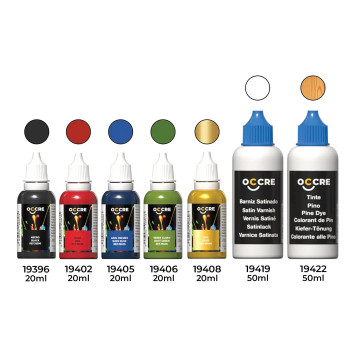
Jupiter 7-pot Paint Pack - OcCre€29.95 - ref. S06190503 |
|
|
|
Exhibition base for large locomotives - OcCre€75.95 - ref. S06155103 |
Fast shipping
Via Chronopost 24H
Via DPD 24/48H
Colissimo 48/72H
329409 products in stock
Real-time stock displayed
Secure payment




Secure payment
In 3 or 4 installments

 4.6/5

Specialist since 1955
Fast shipping
Via Chronopost 24H
Via DPD 24/48H
Colissimo 48/72H
329409 products in stock
Real-time stock displayed
Secure payment
Secure payment
In 3 or 4 installments
4.6/5
Specialist since 1955
This train model kit combines a demanding construction with a historical subject that can also be presented with the Rogers 119 locomotive.
Scale: 1/32, with the designation G-45 indicated by OcCre.
Difficulty level: advanced, for experienced modelers.
Number of pieces: 942, for an estimated assembly time of about 250 hours.
Dimensions of the finished model: 503 mm in length, 82 mm in width, and 150 mm in height.
Materials: various types of wood, parts in photo-etched brass, and cast zamak elements.
Assembly instructions are downloadable to guide the locomotive assembly.
Built in September 1868 in the workshops of Schenectady, New York, the Jupiter belonged to the Central Pacific Railroad.
This American 4-4-0 type locomotive ran on wood, a fuel that explains the presence of a chimney designed to limit spark projection.
To reach California, the locomotive was transported by boat, disassembled, to San Francisco, then reassembled in Sacramento. At that time, the transcontinental railroad line was not yet completed.
The Jupiter then participated in the Golden Spike ceremony on May 10, 1869, at Promontory Summit, Utah. It represented the Central Pacific against the Union Pacific's Rogers 119.
This meeting symbolized the joining of the railroad lines from the east and west of the United States. The original Jupiter was eventually scrapped, but a replica is now displayed at the Golden Spike National Historical Park.
The OcCre model allows you to bring this iconic locomotive back to life in a collection dedicated to historic trains.
With 942 pieces and an estimated 250 hours of work, building this miniature locomotive requires method and a good mastery of assembly techniques.
The advanced level indicated by OcCre is intended for modelers accustomed to working on detailed kits.
The laser-cut wooden boards facilitate part adjustment, while the metal pieces provide additional details.
Before starting, prepare a stable, well-lit workspace large enough to organize the parts.
Prepare suitable cutting and sanding tools, glue compatible with the materials, and tools to hold the parts during drying.
Consult the downloadable instructions and carefully check the fit of each piece before fixing it.
The tools, accessories, and products needed for assembling and finishing the model are not included.
We have selected the main useful items for its construction.
For more simplicity and savings, order them at the same time as your model:
In metropolitan France, shipping is free for orders over €150.
Simply check the boxes above for the items you want to add to your order.
The Jupiter OcCre model combines several materials to reproduce the different parts of the locomotive.
Wood types are used for the structure, cladding, and visible finishes.
The photo-etched brass parts provide fine details, while the cast zamak elements complete the accessories and complex shapes.
For a clean assembly, check the fits and lightly sand the surfaces that require it before gluing.
If you want to paint your steam locomotive, prepare the paints and finishing products separately.
Apply the products in controlled layers and perform a preliminary test on a piece of wood to check the finish.
Depending on the desired effect, you can also leave some wood surfaces exposed.
With its 503 mm length, 82 mm width, and 150 mm height, the Jupiter model requires a space suitable for its dimensions.
A display case or stand will showcase the locomotive and its details without the need for frequent handling.
To create a historical railroad diorama, you can depict a section of track inspired by the 1869 Golden Spike ceremony.
Pairing it with the Rogers 119 model, also linked to this event, would evoke the meeting of the two railroad companies.
The rails, scenery, and staging elements are to be planned separately as they are not included in the kit.
This historical train model is intended for enthusiasts of American steam locomotives, railway modeling enthusiasts, and collectors interested in the Westward Expansion.
Its advanced level, 942 pieces, and an estimated 250 hours of assembly make it a project suitable for modelers with solid experience.
Once completed, the Jupiter becomes an exhibit dedicated to the history of the American transcontinental railroad.