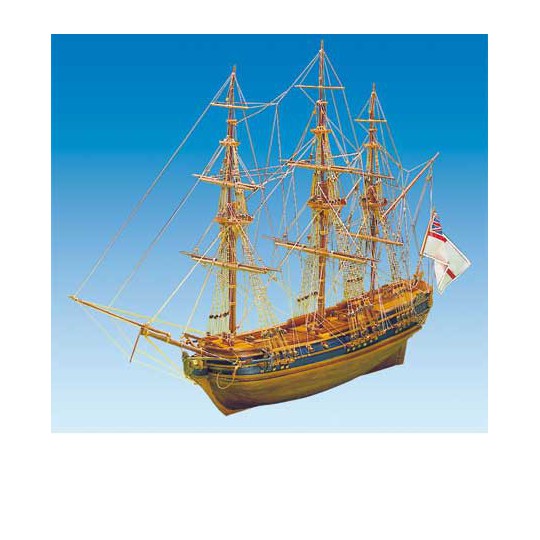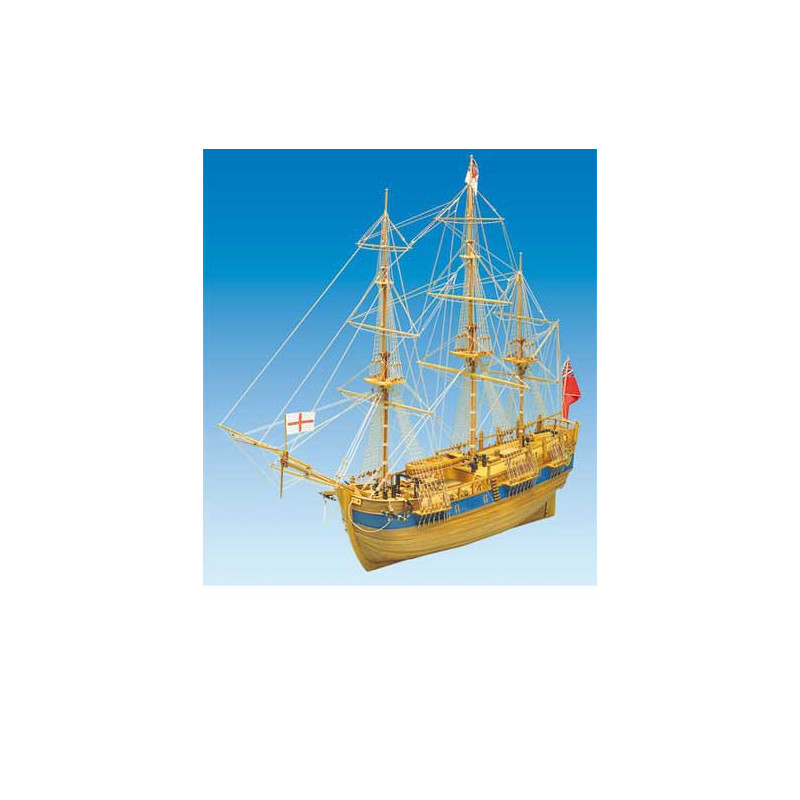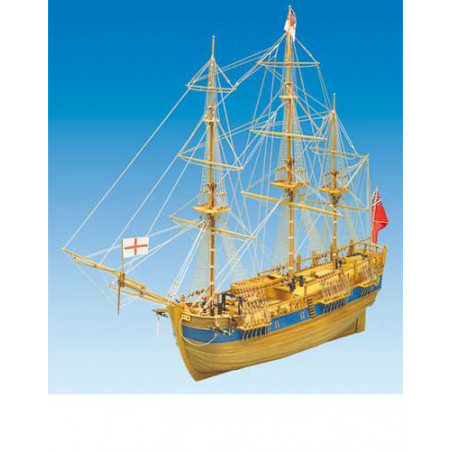
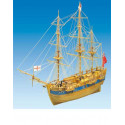
Relive the great maritime expeditions of the 18th century with the Mantua wooden Endeavour ship model, reference 774 / S068774.
This naval modeling kit reproduces the famous HM Bark Endeavour, the ship commanded by James Cook during his first voyage in the Pacific Ocean, from 1768 to 1771.
With its wooden hull, three masts, numerous riggings, and detailed fittings, this model allows you to rediscover the characteristics of a British exploration sailing ship.
Intended for enthusiasts of wooden ship models to build, this Mantua reproduction combines a hull structure on frames, planking strips, laser-cut plywood elements, and wooden and brass accessories.
The pulleys, deadeyes, cannons, anchors, and various deck pieces help to recreate the architecture of the historic ship.
The construction of the Endeavour is a particularly interesting naval modeling project for enthusiasts wishing to deepen their assembly, planking, and rigging techniques.
Once completed, this static model can take its place in a collection dedicated to great sailing ships and exploration vessels.

Model static ship Endeavour 1-60 - Mantua 774
|
|
|
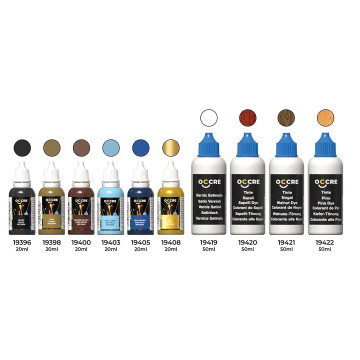
Pack paints Endeavour - 10 pots - OcCre€35.95 - ref. S06190524 |
|
|
|
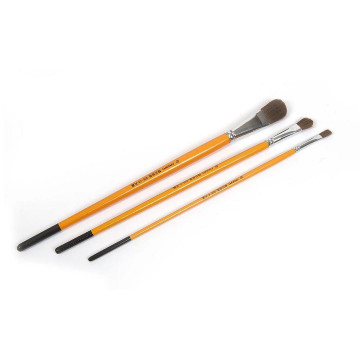
Set of 3 specific brushes for wooden boat model - OcCRE€5.95 - ref. S06110511 |
|
|

|
100 ml white glue for white glue model€8.80 - ref. S0681015 |
|
|
|
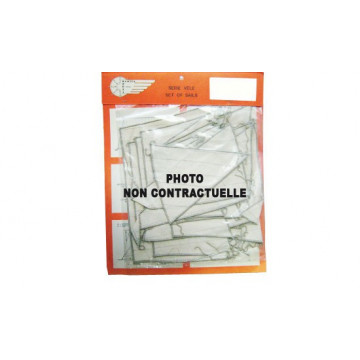
Boat accommodation sails for Endeavor€67.95 - ref. S06834205 |
|
|
|
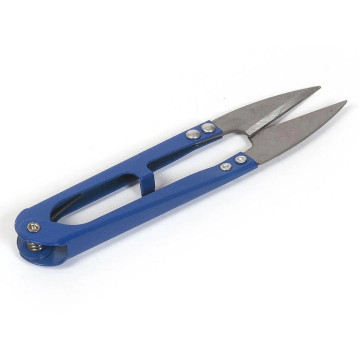
Wire cutter for boat rigging - Occre€3.95 - ref. S06110513 |
Fast shipping
Via Chronopost 24H
Via DPD 24/48H
Colissimo 48/72H
335072 products in stock
Real-time stock displayed
Secure payment




Secure payment
In 3 or 4 installments

 4.6/5

Specialist since 1955
Fast shipping
Via Chronopost 24H
Via DPD 24/48H
Colissimo 48/72H
335072 products in stock
Real-time stock displayed
Secure payment
Secure payment
In 3 or 4 installments
4.6/5
Specialist since 1955
Before becoming one of the most well-known ships in British maritime history, the Endeavour was a merchant ship named Earl of Pembroke.
Built in Whitby, England, it was intended for transporting coal along the British coasts.
Its sturdy hull, shallow draft, and loading capacity caught the attention of the Royal Navy, which was looking for a ship suitable for a long scientific expedition in the Pacific Ocean.
In 1768, the vessel was purchased by the British Admiralty and then transformed at the Deptford shipyard on the Thames. Several modifications were made to accommodate the crew, scientists, provisions, and equipment necessary for a multi-year voyage.
The ship was then renamed HM Bark Endeavour, also known as HMS Endeavour. Its command was entrusted to Lieutenant James Cook, an experienced sailor with strong skills in navigation and cartography.
On August 26, 1768, the Endeavour left Plymouth for an expedition organized with the support of the Royal Society and the British Admiralty. One of the scientific objectives of the voyage was to observe the transit of Venus across the Sun from Tahiti, an astronomical phenomenon expected in June 1769.
The expedition notably included the naturalist Joseph Banks, the botanist Daniel Solander, and several specialists tasked with observing, collecting, and documenting the plant and animal species encountered during the voyage.
After its stay in Tahiti, the Endeavour continued its navigation in the Pacific. James Cook notably conducted cartographic surveys around New Zealand, then along the eastern coast of Australia, territories already known and inhabited by their indigenous populations.
The ship encountered several difficulties during this expedition, notably when it struck the Great Barrier Reef in 1770. After repairs, it continued its journey and returned to England in July 1771.
This expedition marked an important step in the history of natural sciences and European cartography of the Pacific, while fitting into the context of British colonial expansion.
The Endeavour stands out from large military frigates by its merchant origin and construction adapted for transporting large loads. Its relatively wide hull and storage spaces allowed for carrying the provisions and equipment essential for a long crossing.
Its three masts, yards, and complex rigging illustrate the sailing navigation techniques of the second half of the 18th century.
These characteristics make the model ship of James Cook a particularly interesting subject for maritime history enthusiasts and traditional shipbuilding.
Manufactured by Mantua Model, this static model reproduces the Endeavour in the form of a kit to assemble, combining wooden components and numerous rigging parts.
The construction is based on a miniature framework consisting of frames and a keel. The different structures are then completed with planking strips, decks, superstructure elements, and the ship's characteristic equipment.
Main features:
Manufacturer: Mantua Model
Reference: 774 / S068774
Model: HM Bark Endeavour
Era represented: 1768-1771
Type of ship: British exploration sailing ship
Main materials: wood and brass
Construction: plank-on-frame hull
Planking: single planking
Cutting: laser-cut plywood parts
Rigging: masts, yards, and ropes to assemble
Type of model: static model to build
Recommended level: intermediate to advanced.
The diversity of materials and assembly techniques allows for a detailed reproduction of the sailing ship while developing skills in naval modeling.
The construction begins with the preparation of the elements constituting the ship's framework. The laser-cut plywood parts are assembled to form the keel, frames, and supports for the different decks.
The precise positioning of the frames is essential to obtain a regular hull. The modeler must notably control their perpendicularity to the keel and check the symmetry of the structure before final gluing.
It is advisable to proceed with a dry fit, without glue, to identify any necessary adjustments. This operation facilitates assembly and limits the risk of hull deformation.
The Endeavour Mantua 774 model uses a single planking construction. Unlike double-planked models, a single layer of wooden strips directly forms the outer surface of the hull.
This feature requires significant attention when laying the strips, as their positioning and adjustment determine the final appearance of the model.
The strips must be adapted to the curves of the frames and gradually fixed onto the structure. The work must be done in a balanced manner on both sides of the boat to limit stress and deformation.
Proper bending of the strips may be necessary at the bow and stern. After gluing, the surfaces can be carefully sanded to achieve a homogeneous finish.
The Mantua instructions also include preparation and finishing operations for the wood to enhance the hull's shapes.
The kit includes boxwood blocks and deadeyes, characteristic elements of the rigging of old sailing ships.
The blocks are used to guide the ropes of the various rigging maneuvers. The deadeyes, on the other hand, are used to replicate the systems used to maintain and adjust the tension of the shrouds.
Their installation requires a good understanding of the assembly plans as well as precise handling of small components and threads.
The Endeavour model includes several miniature armament elements, including cannons and swivel guns, as well as decorative brass pieces.
These components help to replicate the ship's equipment during its expedition in the Pacific.
The metal elements require appropriate preparation before being fixed. Depending on the desired finish, some pieces can be kept in their original appearance or receive suitable paint.
The various deck arrangements also contribute to the quality of this historical ship model.
The kit notably includes anchors, miniature boats, gratings, and a windlass, also known as an anchor winch, intended to replicate the maneuvering equipment present on board.
The gratings evoke the openings and ventilation systems of the decks. The auxiliary boats recall the means used to reach the shore or ensure certain movements when the main ship remained at anchor.
The positioning of these elements must follow the plan indications to maintain the proportions and historical coherence of the model.
One of the most interesting stages of the Endeavour's construction involves the assembly of its three masts and various yards.
The wooden mast elements must be prepared and adjusted according to the dimensions indicated on the plans. Their assembly requires regular control of alignments and the position of the pieces.
The masts allow for the recreation of the characteristic silhouette of 18th-century British exploration sailing ships.
The creation of the rigging of the Endeavour model requires the installation of numerous ropes. These serve to represent the standing rigging, which supports the masts, as well as the running rigging, used to adjust the sails and yards.
The ropes are guided by the blocks and fixed on the various attachment points indicated in the plans.
The assembly requires following the order of operations and maintaining appropriate tension to avoid deforming the masts or yards.
Careful preparation of the threads, accompanied by a light wax treatment for the ropes that need it, can help limit fraying and facilitate handling.
The standard configuration of the Mantua Endeavour 774 model is designed for a presentation with the masts and rigging, without deployed sails.
The manufacturer offers a set of separately made sails, reference Mantua 34205, allowing for a presentation of the ship with its sails.
This set of sails is an optional accessory and should not be considered included in the basic kit.
The modeler can thus favor a presentation highlighting the complexity of the rigging or complete their construction with suitable sails.
The kit gathers the main elements intended for the construction of a complete static model of the Endeavour.
It notably includes:
The Mantua assembly manual helps identify the different parts and follow the main assembly operations of the hull, decks, fittings, and rigging.
Tools, glue, paints, and the optional set of pre-made sails should be provided separately.
The Endeavour wooden ship model is mainly intended for intermediate to advanced modelers.
Its construction requires some experience in assembling small parts, working with wood, and making rigging.
The single planking is one of the main precision steps, as the layer of strips directly forms the visible surface of the hull.
The installation of numerous ropes, pulleys, and deadeyes also requires patience and good organization.
For enthusiasts who have already built a simple wooden model, the Endeavour allows for deepening several construction techniques:
The progression of the assembly allows discovering the organization of a historical sailing ship and understanding the interactions between its hull, decks, masts, and rigging.
The construction of this Mantua model requires modeling tools suitable for small parts and woodworking.
A precision cutter, fine sandpaper, small pliers, miniature drills, holding clamps, and wood glue are useful equipment for the initial assembly operations.
For metal parts and certain fixings, glue suitable for the materials concerned may be necessary.
A strip bending tool can also facilitate the preparation of strips intended for the curved parts of the hull.
Before any gluing, it is recommended to check the fit of the parts and study the next assembly steps.
For planking, it is advisable to prepare the strips gradually and check their positioning to maintain the symmetry of the hull.
Finishes should be anticipated, especially in areas that will become difficult to access after assembling the decks or installing various equipment.
The Mantua manual provides for a presentation that can highlight the natural tones of the wood with a matte varnish finish.
This solution allows preserving the appearance of the materials while protecting the surfaces.
The rigging assembly should be carried out gradually, starting with the attachment points and maneuvers provided in the plans, before finishing with the most accessible ropes.
Once assembled, the historical Endeavour Mantua model can become a centerpiece of a collection dedicated to Royal Navy sailing ships, major maritime expeditions, or 18th-century ships.
Its wooden hull, three masts, rigging, and numerous fittings allow appreciating the complexity of traditional naval construction.
The kit includes an exhibition cradle designed to support the finished model. To protect fragile elements, especially ropes, yards, and decorations, a showcase adapted to the dimensions of the assembled ship can be considered.
Diorama enthusiasts can also consider a presentation evoking the scientific expeditions of the 18th century.
A port setting, quay elements, or a scene representing a historical anchorage can complement the ship's presentation, provided the model's proportions are respected.
These decor elements are to be made or acquired separately. They allow contextualizing the model and evoking the different stages of major maritime explorations.
The Mantua 774 model reproduces the HM Bark Endeavour, the British sailing ship commanded by James Cook during his first voyage in the Pacific Ocean, from 1768 to 1771.
This ship was originally a merchant vessel named Earl of Pembroke, transformed for a scientific and maritime expedition.
Yes. Both names are used to refer to James Cook's ship.
HM Bark Endeavour corresponds to a historical designation related to its type of vessel, while HMS Endeavour is a widely used name in books and research dedicated to the ship.
This kit is rather recommended for intermediate or experienced modelers. The assembly requires building a single-planked hull, assembling the decks, preparing the rigging elements, and creating a rigging with numerous ropes.
The assembly instructions for the Mantua 774 reference provide for a single-planked hull on frames. A single layer of wooden strips directly forms the outer covering of the hull. It is therefore important to carefully cut, curve, and fit them.
The standard configuration is intended for presentation without sails. Mantua offers a set of sails separately under reference 34205.
This optional accessory allows for completing the model's presentation with its sails.
The kit primarily uses wooden elements, including walnut and lime, as well as laser-cut plywood components.
It also includes rigging parts made of boxwood and brass, ropes, and decorative elements intended to reproduce the ship's equipment.
Yes. The Mantua Endeavour 774 kit includes miniature armament elements, anchors, and various rigging parts necessary for reproducing the ship. These components are to be assembled and installed according to the provided assembly plans.
Yes. The model comes with three sheets of plans and construction instructions. These documents present the hull elements, the different assembly stages, and the operations related to the rigging.
No. Glue, paints, and tools must be provided separately. It is advisable to select products suitable for working with wood, small metal elements, and the desired type of finish.
No. The model can be completed with its rigging without installing sails. The Mantua 34205 set is an optional accessory for modelers wishing to present the Endeavour with its sails.
Yes. This static model is intended for display. The kit includes a presentation cradle, and the finished model can be placed in a showcase large enough to protect the masts, ropes, and other fragile details.
The Mantua Endeavour 774 model combines traditional wooden shipbuilding with the reproduction of an important ship in 18th-century maritime history.
Its assembly allows for working on the framework, planking, rigging, and rigging while discovering the characteristics of the sailing ship used by James Cook during his first voyage in the Pacific.
Customers who bought this product also bought: