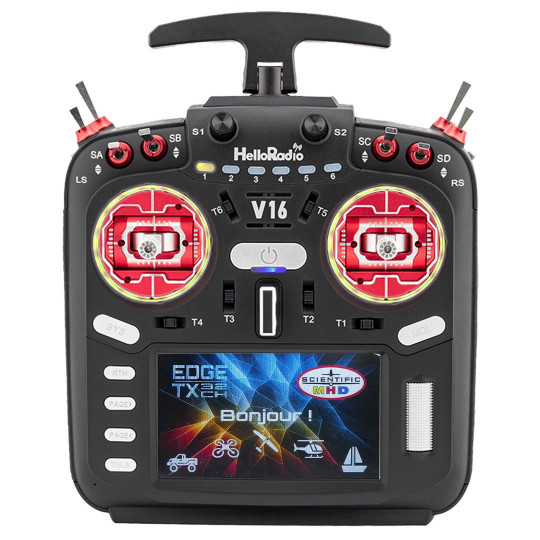
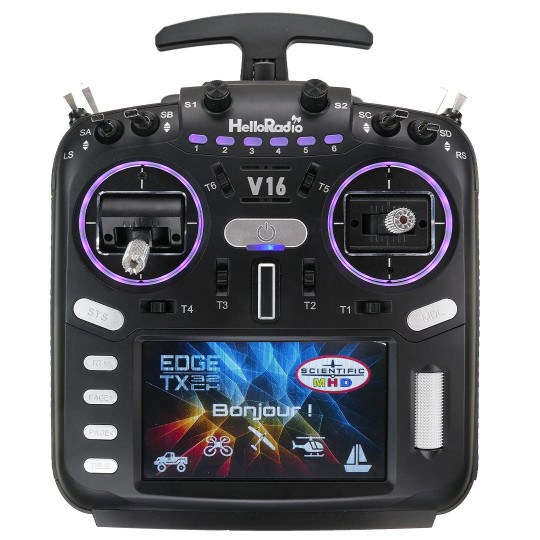
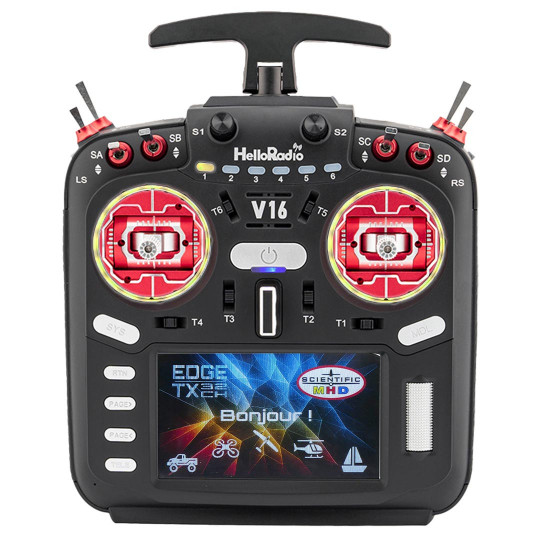
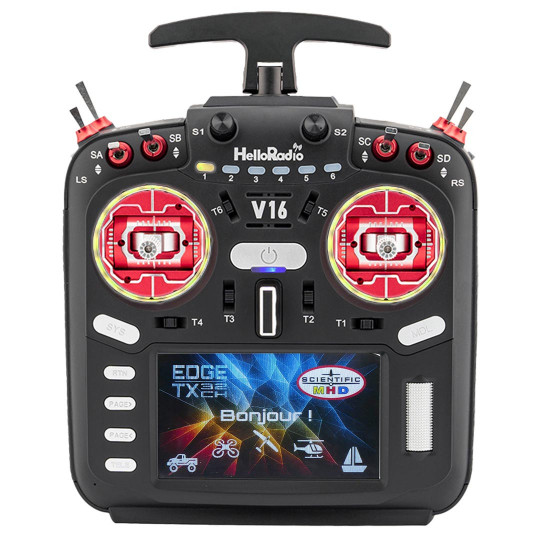
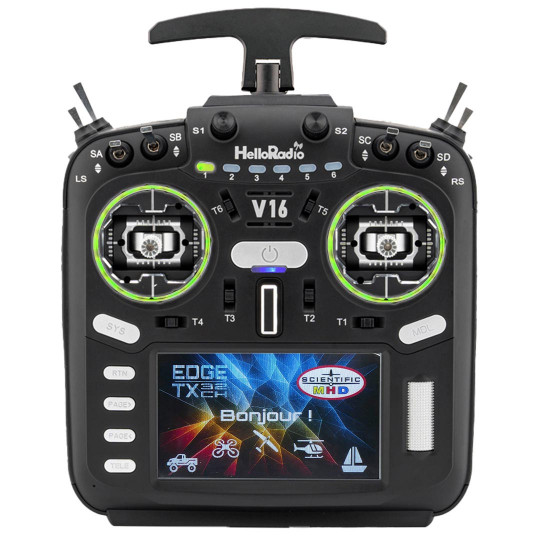
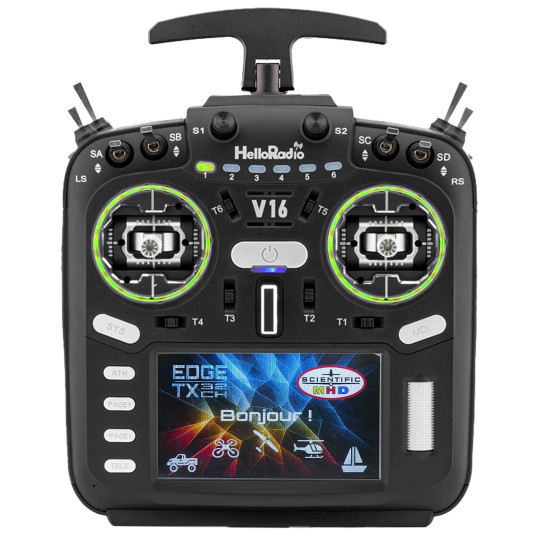
HELLORADIO: programmable RC transmitters for radio-controlled models
HELLORADIO, also known as HELLORADIOSKY, offers RC transmitters designed for pilots of model aircraft, gliders, helicopters, drones and other radio-controlled models.
The V15 and V16 transmitters combine open-source EdgeTX software, precision gimbals, a colour touchscreen and various radio transmission technologies, including ExpressLRS and 4-in-1 multiprotocol systems.
Depending on the version,...
HELLORADIO: programmable RC transmitters for radio-controlled models
HELLORADIO, also known as HELLORADIOSKY, offers RC transmitters designed for pilots of model aircraft, gliders, helicopters, drones and other radio-controlled models.
The V15 and V16 transmitters combine open-source EdgeTX software, precision gimbals, a colour touchscreen and various radio transmission technologies, including ExpressLRS and 4-in-1 multiprotocol systems.
Depending on the version, they include advanced telemetry, electronic diagnostics, voice commands and model programming functions.
HELLORADIO is therefore aimed at RC enthusiasts looking for a customisable, upgradeable transmitter suitable for both recreational flying and complex RC configurations.
Why choose a HELLORADIO RC transmitter?
Choosing an RC transmitter depends on several criteria: the number of channels required, receiver compatibility, stick precision, programming capabilities and ease of use in the field.
HELLORADIO transmitters meet these requirements through modern electronic architecture combined with EdgeTX software.
This software allows pilots to create customised control configurations without being restricted to the predefined mixes generally offered by traditional transmitters.
The V15 and V16 ranges can manage up to 32 logical channels with EdgeTX.
However, the number of channels actually available depends on the transmission protocol, the selected receiver and the model's configuration.
This programming flexibility is particularly useful for RC aircraft pilots using multiple aileron servos, flaps or retractable landing gear.
It is also suitable for competition gliders, helicopters and radio-controlled models requiring specific functions.
HELLORADIO transmitters also stand out for their different radio transmission options.
ExpressLRS versions focus on responsive, configurable transmission, while models equipped with a 4-in-1 multiprotocol module can operate with numerous existing receivers, subject to compatibility.
For an RC enthusiast comparing a HELLORADIO transmitter with Futaba, RadioMaster, Jeti or Graupner, the key factors are therefore the transmission system, ergonomics, software capabilities and equipment genuinely required for their particular application.
Discover the HELLORADIO V15, V16 and V14 RC transmitters
The HELLORADIO range includes several transmitters designed for RC enthusiasts seeking precise controls and extensive customisation options.
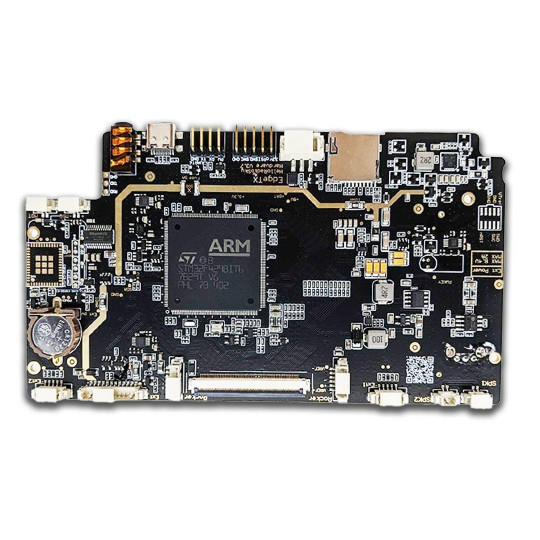
The V15 Standard, V15 MAX and V15 ULTRA share a common architecture based on ExpressLRS Gemini Dual Band, featuring a 4.3-inch colour touchscreen and integrated measurement and diagnostic tools.
The V16 PRO and V16 MAX offer a different approach, particularly through their 4-in-1 multiprotocol versions, ergonomic design and voice recognition functions.
Some V16 models are also available in ELRS versions.
HELLORADIO V15 Standard: an EdgeTX transmitter with ExpressLRS Gemini
The HELLORADIO V15 Standard is designed for pilots looking for a programmable RC transmitter with integrated ExpressLRS connectivity and advanced model control functions.
It features fully adjustable Hall sensor gimbals, allowing users to modify spring tension, throttle resistance, stick height and control mode.
This technology uses magnetic sensing to measure stick position, reducing wear associated with the electrical contacts found in conventional potentiometers.
Its 4.3-inch colour touchscreen provides easy access to model memories, settings and telemetry data.
Navigation is also supported by physical buttons and a multidirectional control wheel.
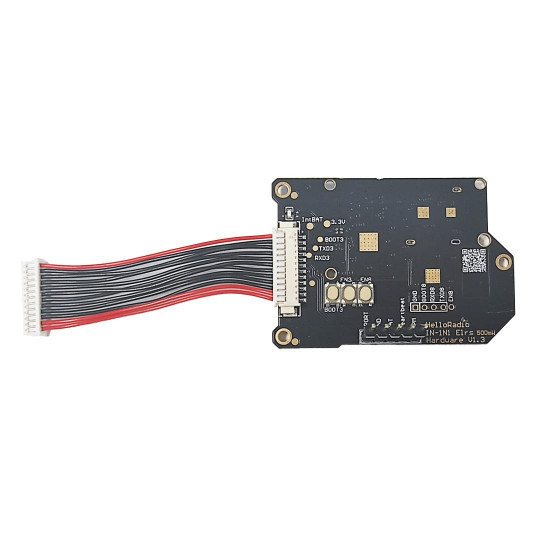
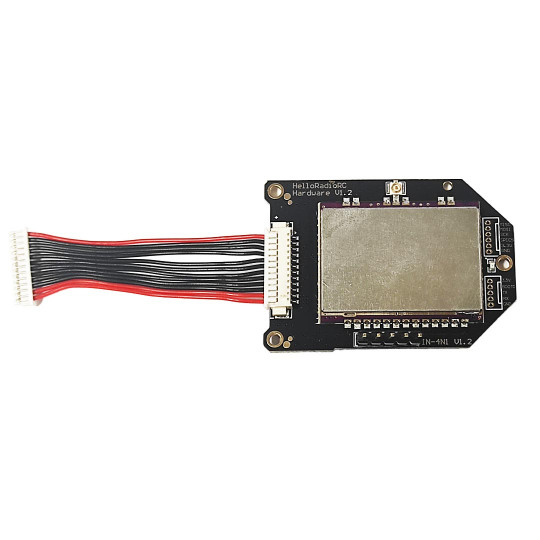
The V15 Standard incorporates an ExpressLRS Gemini Dual Band radio module, allowing operation on 2.4 GHz, 868 MHz or both frequency bands simultaneously with a compatible Gemini X receiver and the appropriate configuration.
It also includes HRS TOOLS functions, enabling users to test servos, analyse various RC signals and check certain batteries directly from the transmitter.
HELLORADIO V15 MAX: CNC aluminium gimbals with Hall sensors
The HELLORADIO V15 MAX retains the main electronic features of the Standard version, with particular attention paid to the mechanical design of its gimbals.
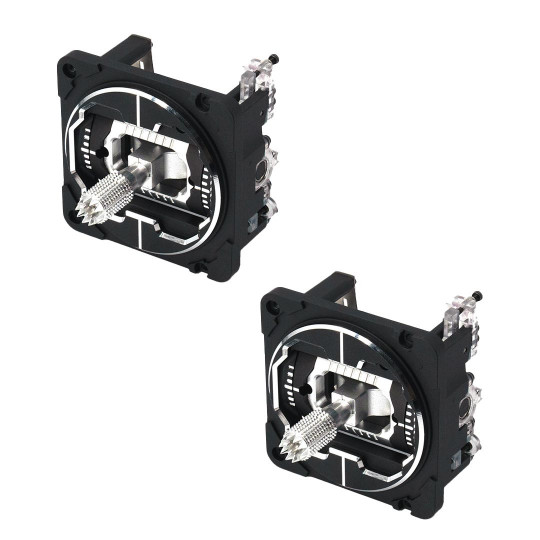
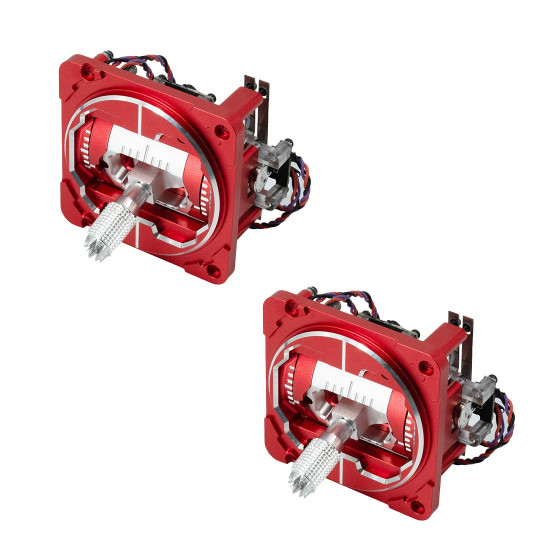
This model features CNC-machined aluminium gimbals mounted on ball bearings and equipped with Hall sensors.
This design provides precise mechanical guidance and allows pilots to adjust stick feel according to their preferences.
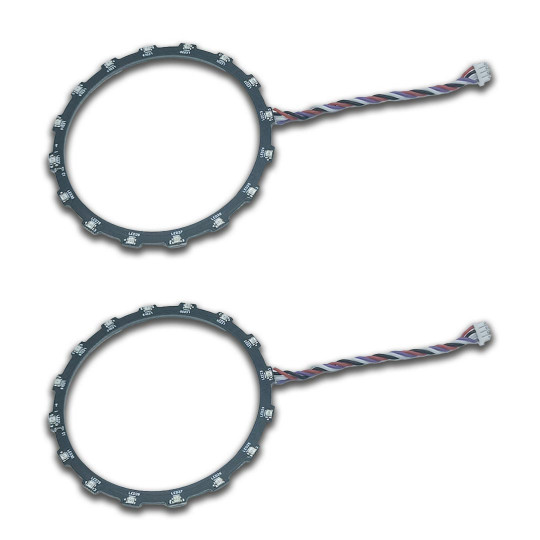
The gimbals also feature programmable multicolour LED rings.
The lighting can be linked to different conditions or events, such as throttle position or activation of a motor safety function.
The V15 MAX retains the 4.3-inch touchscreen, EdgeTX software, ExpressLRS Gemini system and HRS TOOLS diagnostic functions.
It is particularly suitable for pilots who attach importance to the mechanical quality of their controls and want a configurable transmitter for several radio-controlled models.
HELLORADIO V15 ULTRA: RDC90 gimbals and an artificial intelligence assistant
The V15 ULTRA differs from the other two V15 models through its RDC90 sensors, fitted to CNC-machined aluminium gimbals mounted on ball bearings.
These sensors are designed to provide accurate stick position measurements while offering a long service life.
Mechanical adjustments allow pilots to customise resistance, centring force and stick travel.
The V15 ULTRA also features an artificial intelligence assistant that can be accessed by voice through an integrated microphone.
This function allows users to ask the assistant questions in English or French, depending on the configuration.
It requires a Wi-Fi Internet connection, for example through a smartphone's mobile hotspot.
This assistant should not be confused with voice-operated flight controls: its stated purpose is to enable spoken interactions with artificial intelligence, rather than directly replacing servo controls.
The V15 ULTRA retains the other features of the V15 family, including EdgeTX, ExpressLRS Gemini Dual Band, the colour touchscreen and integrated diagnostic functions.
HELLORADIO V16 PRO: a 4-in-1 multiprotocol RC transmitter
Its integrated multiprotocol module operates on 2.4 GHz and supports numerous families of RC protocols, including certain versions compatible with Futaba SFHSS, FrSky, FlySky, Spektrum DSMX and Graupner HoTT.
Compatibility must be checked for each receiver reference, as not all protocols and versions are necessarily supported.
The V16 PRO features Hall sensor gimbals mounted on ball bearings, programmable LED rings, a colour touchscreen and EdgeTX software.
It also incorporates a voice recognition function with 26 announced commands in English, allowing users to trigger certain actions or interact with transmitter functions.
This version provides a solution for pilots looking for a programmable radio capable of managing a fleet of RC models using different compatible protocols.
HELLORADIO V16 MAX: CNC aluminium controls and multiprotocol connectivity
Hall sensors measure control positions, while RGB LED rings provide customisable visual information.
The V16 MAX also features EdgeTX software, advanced telemetry functions, voice recognition and transmitter tilt control, known as Motion Control.
It is available with different transmission configurations, including 4-in-1 multiprotocol and, depending on the reference, ExpressLRS.
The V16 MAX is suitable for RC enthusiasts wishing to combine CNC aluminium gimbals, programmable functions and a radio link adapted to their receivers.
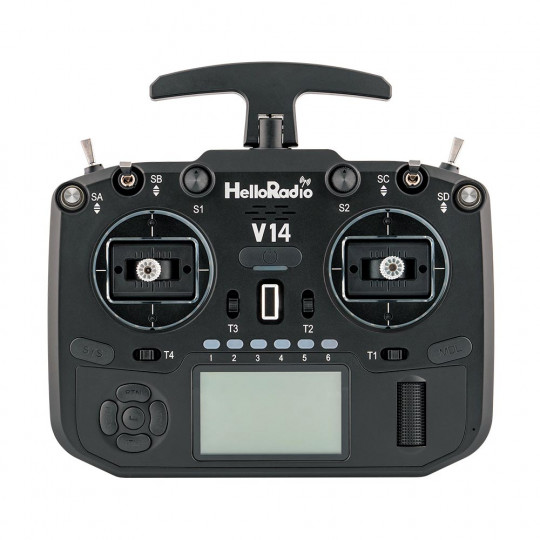
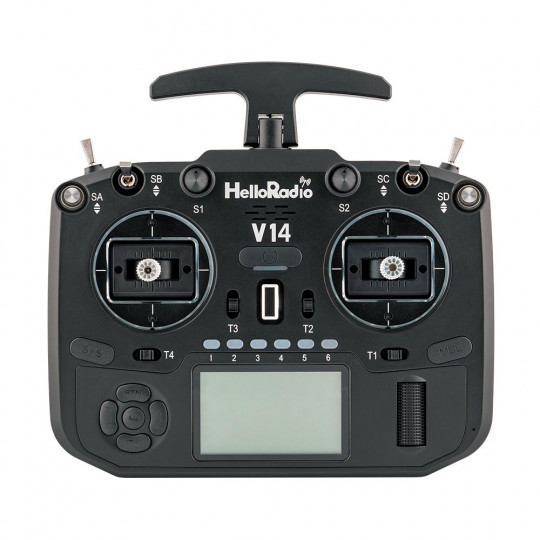
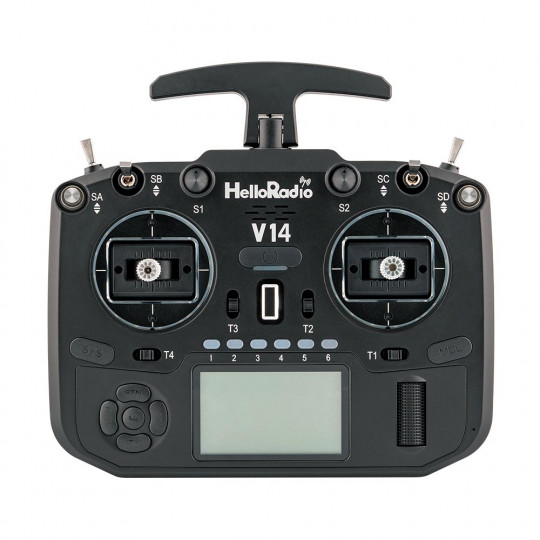
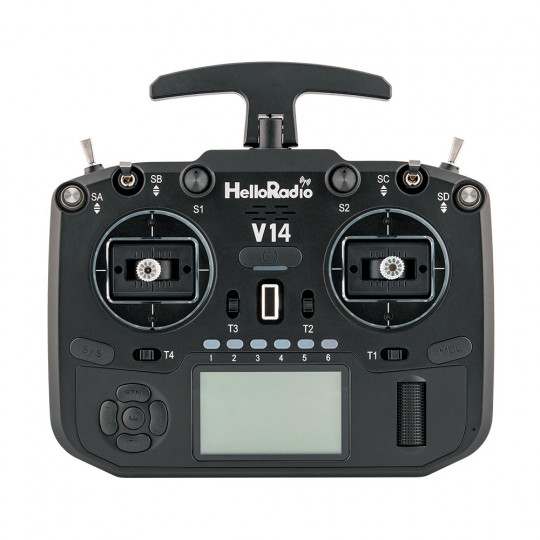
HELLORADIO V14 PRO: a compact RC transmitter compared with the V15 and V16
The HELLORADIO V14 PRO ELRS transmitter is designed for RC enthusiasts looking for a compact, versatile and programmable transmitter for their RC aircraft, gliders, helicopters or drones.
Lighter and less bulky than the V15 and V16 models, it focuses on ease of transport while retaining features suitable for experienced pilots.
Equipped with open-source EdgeTX software, the V14 PRO allows pilots to customise mixes, control curves, flight modes and telemetry.
It offers up to 32 logical channels and 60 model memories. Its Hall sensor gimbals, mounted on ball bearings, can be adjusted from the rear without disassembling the transmitter.
Programmable multicolour LED rings, vibration alerts and voice commands complete its ergonomic features.
Unlike the V15 models, which feature a 4.3-inch colour touchscreen, the V14 PRO has a backlit LCD screen, physical buttons and a navigation wheel.
It does not feature the HRS TOOLS diagnostic system integrated into the V15 models, but retains the essential programming, trainer and simulation functions.
The V14 PRO ELRS LBT version uses a 2.4 GHz ExpressLRS link, while the V15 models offer ExpressLRS Gemini Dual Band on 2.4 GHz and 868 MHz.
The V16 models, particularly those available with a 4-in-1 multiprotocol module, are better suited to pilots wishing to retain various compatible receivers. The V14 is also available in a 4-in-1 version.
With a claimed operating time of up to 35 hours using a 5,000 mAh battery, depending on settings, and a slot for an external JR-format RF module, the V14 PRO offers an alternative to the V15 and V16 for pilots prioritising compact dimensions, EdgeTX programming and budget control, without giving up the advanced features of an RC transmitter.
Notice regarding technical specifications:
The specifications of the HELLORADIO V15 transmitters presented on this page are based on samples supplied by the manufacturer HELLORADIOSKY to Scientific MHD for evaluation.
This information is provided for guidance only and is subject to change.
The manufacturer reserves the right to modify the technical specifications, equipment and features of its products at any time without prior notice.
Consequently, certain specifications of commercially available models may differ from those described on this page.
Comparison table of HELLORADIO V15 and V16 RC transmitters
When choosing between a HELLORADIO V15 Standard, V15 MAX, V15 ULTRA, V16 PRO or V16 MAX, it is useful to compare the features that directly affect RC modelling activities.
The following table highlights the main differences between the five models, using the V16 4-in-1 versions presented here as the reference.
Features
V15 Standard
V15 MAX
V15 ULTRA
V16 PRO 4-in-1
V16 MAX 4-in-1
Software
EdgeTX
EdgeTX
EdgeTX
EdgeTX
EdgeTX
Number of logical channels
Up to 32
Up to 32
Up to 32
Up to 32
Up to 32
Gimbal technology
Hall sensors
Hall sensors
RDC90 sensors
Hall sensors
Hall sensors
CNC aluminium gimbals
No
Yes
Yes
No
Yes
Gimbal ball bearings
No
Yes
Yes
Yes
Yes
Programmable RGB LED rings
No
Yes
Yes
Yes
Yes
Screen
4.3-inch colour touchscreen
4.3-inch colour touchscreen
4.3-inch colour touchscreen
Colour touchscreen
Colour touchscreen
Integrated RF module
ExpressLRS Gemini Dual Band
ExpressLRS Gemini Dual Band
ExpressLRS Gemini Dual Band
4-in-1 multiprotocol
4-in-1 multiprotocol
Integrated module frequency bands
2.4 GHz / 868 MHz
2.4 GHz / 868 MHz
2.4 GHz / 868 MHz
2.4 GHz
2.4 GHz
Optional external RF module
JR format
JR format
JR format
JR format
JR format
HRS TOOLS functions
Yes
Yes
Yes
Not announced
Not announced
Customisable voice announcements
Yes
Yes
Yes
Yes
Yes
Voice command recognition
Not announced
Not announced
Not announced
26 commands in English
26 commands in English
AI assistant with microphone
Not announced
Not announced
Yes, with Wi-Fi and Internet
Not announced
Not announced
Gyroscope / accelerometer
Yes
Yes
Yes
Yes
Yes
Claimed operating time with a 5,000 mAh battery
Up to 10 hours
Up to 10 hours
Up to 10 hours
10 to 30 hours depending on configuration
10 to 30 hours depending on configuration
These specifications apply to the versions described and may vary depending on the product reference, installed RF module, battery used and software updates.
Specific functions should be checked on the product page of the selected transmitter.
ExpressLRS or 4-in-1 multiprotocol: which radio link should you choose?
ExpressLRS: a responsive and configurable RC transmission protocol
ExpressLRS, commonly abbreviated as ELRS, is an open-source radio control system designed to transmit pilot commands with low latency and a range suitable for different RC modelling applications.
It is used particularly on FPV drones, RC aircraft, gliders and other models requiring a configurable radio link.
Transmission parameters, output power and available refresh rates depend on the hardware, firmware and applicable regulatory requirements.
For pilots looking to buy a long-range ExpressLRS RC transmitter, it is important to check compatibility between the transmitter and receiver, their frequency bands and software versions.
An ExpressLRS link does not guarantee a specific range on its own. The usable distance depends particularly on the antennas, their orientation, the radio environment, obstacles and installation conditions.
Gemini Dual Band: using two frequency bands
HELLORADIO V15 transmitters incorporate an ExpressLRS Gemini Dual Band module which, depending on the configuration, allows operation on the 2.4 GHz and 868 MHz bands.
With a compatible Gemini X receiver, the system can use both bands simultaneously to improve radio link diversity.
This approach is useful for complex radio-controlled models, particularly when pilots want multiple transmission paths.
However, dual-band operation does not eliminate every risk of signal loss.
Correct antenna installation, reliable receiver power and range testing remain essential.
The choice of frequencies and transmission power must also comply with the regulations applicable in the country of use.
4-in-1 multiprotocol technology for keeping your existing RC receivers
A 4-in-1 multiprotocol transmitter uses a radio module capable of supporting several families of transmission protocols on 2.4 GHz.
This solution is particularly useful for RC enthusiasts who already own several aircraft, helicopters or other models equipped with receivers from different manufacturers.
The HELLORADIO V16 PRO and V16 MAX 4-in-1 versions may support certain Futaba SFHSS, FrSky, FlySky, Spektrum DSMX, Graupner HoTT receivers and other compatible protocols.
Support depends on the exact receiver model, its firmware and the protocol used.
Compatibility with a particular brand therefore does not mean that all receivers from that manufacturer will work with the module.
European LBT versions must also be distinguished from other transmission variants.
Before use, it is necessary to consult the compatibility list and perform functional and range tests.
Adding an external JR-format RF module
HELLORADIO V15 and V16 transmitters feature a slot for adding a compatible external JR-format RF module, subject to its electrical and software specifications.
This makes it possible to use another protocol, for example with an ExpressLRS, multiprotocol, Crossfire or Ghost module compatible with the transmitter.
The external module must be purchased separately if it is not included in the chosen configuration.
For pilots wishing to retain their existing receivers while adopting ExpressLRS for new models, this modularity can avoid the immediate replacement of all their equipment.
EdgeTX: open-source software for programming your RC transmitter
Creating custom mixes for RC aircraft, gliders and helicopters
EdgeTX is open-source software used on various programmable RC transmitters, including HELLORADIO and certain RadioMaster models.
It allows pilots to assign the transmitter's physical controls to the required channels and create mixes suited to the operation of the radio-controlled model.
On an RC aircraft, it is possible to program independent ailerons, flaps, retractable landing gear, multiple control surface positions or motor safety functions.
For an RC glider, EdgeTX allows pilots to configure flight modes, elevator compensation, butterfly functions and curves specific to different aerodynamic configurations.
Complex models can also use logical switches, timers and special functions to automate certain operations.
Organising model memories and settings
HELLORADIO transmitters allow users to store multiple model configurations.
Each model memory can contain channel settings, mixes, curves, alarms and telemetry parameters.
Models can be organised into categories such as aircraft, gliders, helicopters or drones.
The ability to associate an image and a checklist with each memory makes it easier to identify the correct model before use.
A model creation wizard also allows users to prepare an initial configuration based on the aircraft type, number of servos or installed functions.
The settings can then be freely modified.
Using EdgeTX Companion on a computer
The free EdgeTX Companion software, available for Windows, macOS and Linux, allows pilots to prepare and back up transmitter configurations from a computer.
It is particularly useful for creating model memories, checking certain mixes, making backups or restoring a configuration after a software operation.
This option is valuable for pilots using several RC models or wishing to keep a copy of their settings.
EdgeTX updates also provide access to corrections and improvements compatible with the hardware.
Users should follow the procedures specified for each transmitter and keep a backup before making any significant changes.
Gimbal precision and HELLORADIO transmitter ergonomics
Hall and RDC90 sensors: what are the differences for RC flying?
Radio transmitter control sticks, also known as gimbals, determine how accurately the pilot's movements are measured and transmitted to the electronic system.
The Hall sensors fitted to the V15 Standard, V15 MAX, V16 PRO and V16 MAX use a magnetic measurement principle without direct electrical contact at the position sensor.
This technology reduces certain types of wear associated with mechanical potentiometers, although springs, bearings and other moving components may still require maintenance.
The V15 ULTRA uses RDC90 sensors combined with CNC aluminium gimbals.
This version is intended for users looking for this particular measurement technology.
Regardless of the system chosen, control quality also depends on gimbal mechanics, adjustment, calibration and control programming.
Adjusting controls to suit your flying habits
HELLORADIO transmitters offer various adjustments to adapt the gimbals to the pilot, including centring force, throttle resistance, stick height and control mode.
Mode 1 and Mode 2 refer to different arrangements of the main controls on the sticks.
In Mode 1, the throttle is generally located on the right stick, whereas in Mode 2 it is located on the left stick.
The choice depends on the pilot's habits, training and the mode used at their aeromodelling club.
V16 transmitters are available in different Mode 1 or Mode 2 configurations.
It is important to select the correct product reference when purchasing.
Telemetry, diagnostics and safety for radio-controlled models
Monitoring flight information through telemetry
Telemetry allows an RC transmitter to receive information from the radio-controlled model when the receiver and required sensors are compatible.
Depending on the installation, the pilot can monitor receiver voltage, altitude, speed, GPS position, temperature, electrical consumption and radio link quality parameters.
HELLORADIO transmitters running EdgeTX allow users to customise how this information is displayed and create audible or vibration alerts.
On a glider, altitude or variometer announcements can help the pilot monitor the aircraft's flight without taking their eyes off it.
On an electric RC aircraft, a voltage or consumed-capacity alert can help manage flight duration, provided correctly installed and calibrated sensors are used.
HRS TOOLS: diagnostic tools integrated into the V15 transmitters
HELLORADIO V15 transmitters feature the HRS TOOLS system, which combines several measurement and diagnostic functions accessible directly from the transmitter.
These include servo and ESC testers, battery checking functions and an RC signal analyser.
The system can analyse different signal formats, including PWM, PPM, SBUS, CRSF, SUMD, DJI RS and MAVLink, depending on the functions used.
An integrated oscilloscope also allows users to observe the shape of certain signals and identify potential abnormalities.
These tools are particularly useful when installing a receiver, checking a servo or investigating wiring and configuration problems.
For RC enthusiasts maintaining several aircraft or helicopters, they can reduce the need for certain external measuring devices, although they do not replace every specialised diagnostic instrument.
Protection functions and pre-flight checks
HELLORADIO transmitters include electronic monitoring functions designed to check their power supply and circuit consumption.
The V16 models incorporate current and voltage measurement devices for monitoring various internal components.
EdgeTX software functions also allow pilots to create startup safety checks, switch position warnings and customised alarms.
These features complement essential pre-flight inspections: control linkage security, control surface direction, battery levels, motor operation and range testing.
For a large RC aircraft or a model equipped with numerous servos, a properly sized power supply and suitable failsafe settings remain essential.
Voice commands and advanced HELLORADIO transmitter functions
Voice commands on V16 RC transmitters
The HELLORADIO V16 PRO and V16 MAX feature voice recognition with 26 announced commands in English.
This functionality allows users to interact with certain transmitter functions without always using the screen or physical switches.
Depending on the programming, voice commands can be used to trigger an action, navigate certain functions or make adjustments supported by the system.
However, pilots must check that each command works correctly before use and retain the ability to regain manual control.
Voice telemetry announcements, also available on the V15 models, are a different function: they provide information to the pilot without necessarily recognising their voice.
Motion Control: controlling your model by tilting the transmitter
The V16 models incorporate motion sensors that allow transmitter tilt to be used as a control input.
This feature, known as Motion Control, can be assigned to certain axes or specific actions through programming.
It can be useful for experimenting with new control methods or triggering an auxiliary function without operating a switch.
However, it requires settings suited to the model and preliminary testing under safe conditions.
Gyroscopic functions on the V15 transmitters
The V15 models feature a gyroscope and accelerometer, allowing transmitter movements to be used in programming.
For example, tilting the transmitter can be assigned to a command or used to trigger a telemetry announcement.
A pilot can program the transmitter to announce the model battery voltage when the radio is deliberately tilted in a specified direction.
This provides an additional customisation option without making it necessary for conventional flying.
Battery life, charging and use in the field
What is the battery life of the HELLORADIO V15 and V16?
RC transmitter battery life mainly depends on battery capacity, RF module output power, screen brightness and enabled functions.
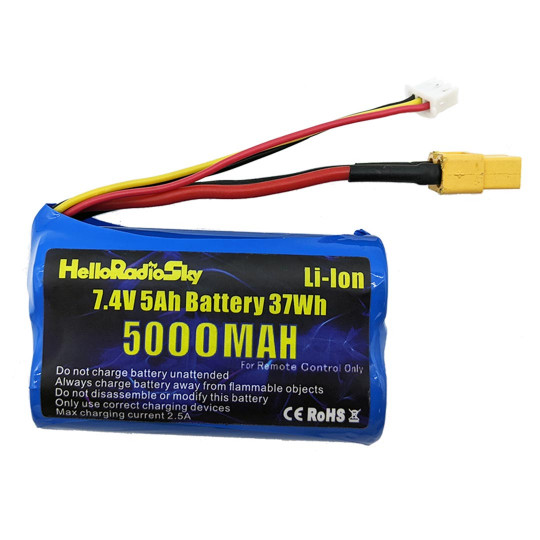
The V15 models offer a claimed operating time of up to 10 hours with an optional 5,000 mAh HELLORADIO battery, depending on settings.
For the V16 models, an indicative operating time of 10 to 30 hours is announced with a 5,000 mAh battery, depending particularly on the electronic configuration and radio module used.
These figures do not represent guaranteed battery life under all operating conditions.
The transmitters feature USB-C charging solutions and battery management systems.
A power supply compatible with the specifications of each model should be used.
For the V16 PRO and V16 MAX 4-in-1 references presented here, the battery and receiver must be purchased separately.
Trainer functions, simulators and flight training
HELLORADIO transmitters offer trainer functions that allow a master transmitter and a student transmitter to be used with a suitable connection.
This feature is useful when learning to fly RC aircraft, particularly when an instructor needs to be able to regain control quickly.
Depending on the version, the available functions allow certain channels to be assigned to the student and their operation to be adjusted.
USB-C connections intended for computer communication also allow the use of compatible flight simulators.
A simulator is particularly useful for learning control coordination, practising landing approaches and testing certain configurations before flying a real model.
HELLORADIO, Futaba or RadioMaster: how to choose your RC transmitter?
Beyond their advanced technical features, one of the main advantages of HELLORADIOSKY transmitters is their particularly competitive value for money: they offer many functions found on high-end RC transmitters from established brands such as Futaba, while generally being priced considerably lower than their Japanese and European counterparts.
RC enthusiasts looking for a high-end transmitter frequently compare HELLORADIO with brands such as Futaba, RadioMaster, Jeti, Spektrum and Graupner.
These manufacturers take different approaches to programming, protocols, ergonomics and receiver ecosystems.
HELLORADIO vs Futaba: open programming or a manufacturer-specific ecosystem
Futaba transmitters generally use programming systems and protocols specific to their product ranges.
HELLORADIO transmitters are based on EdgeTX, which provides open and customisable programming.
A HELLORADIO 4-in-1 transmitter may support certain compatible Futaba SFHSS receivers, but it cannot automatically replace a Futaba transmitter across all the manufacturer's protocols.
The choice depends particularly on existing receivers, required functions, the desired level of customisation and flying habits.
HELLORADIO vs RadioMaster: RC transmitters using EdgeTX
Both HELLORADIO and RadioMaster offer transmitters using EdgeTX and various transmission technologies, depending on the model.
Their differences should be assessed by comparing precise specifications: dimensions, switch layout, gimbal technology, integrated RF module, screen, battery and additional equipment.
The HRS TOOLS functions of the V15 models, the RDC90 sensors of the V15 ULTRA and the voice recognition capabilities of the V16 models are among the features worth considering.
It is preferable to compare two models with similar prices and configurations rather than draw a general conclusion about the manufacturers' entire ranges.
Frequently asked questions about HELLORADIO RC transmitters
Which HELLORADIO transmitter should I choose for an RC aircraft?
For an RC aircraft, the choice depends on the number of servos, the functions to be programmed and the receiver used.
A V15 ExpressLRS is suitable for an installation using this protocol, while a V16 4-in-1 may be useful for retaining compatible receivers already installed in existing models.
What is the difference between the HELLORADIO V15 Standard, MAX and ULTRA?
The V15 Standard uses Hall sensor gimbals.
The V15 MAX adds CNC aluminium gimbals mounted on ball bearings and programmable LED rings.
The V15 ULTRA uses RDC90 sensors and incorporates a voice-accessible AI assistant requiring an Internet connection.
What is the difference between the V16 PRO and V16 MAX?
The main announced difference between the two versions concerns the gimbals.
The V16 MAX features CNC-machined aluminium gimbals, while the V16 PRO uses Hall sensor gimbals mounted on ball bearings.
Both versions share EdgeTX and the main electronic functions of the range.
Are HELLORADIO transmitters compatible with Futaba receivers?
Certain 4-in-1 multiprotocol versions can operate with Futaba receivers using a supported protocol, particularly SFHSS.
This compatibility is not universal and must be checked for each receiver before use.
Do HELLORADIO transmitters support ExpressLRS?
Yes, the V15 models presented feature an integrated ExpressLRS Gemini Dual Band module.
Some V16 versions also use ExpressLRS.
However, a V16 sold in a 4-in-1 configuration does not necessarily include an integrated ELRS module: a compatible external module or a specific configuration may be required.
Can a HELLORADIO transmitter be used to fly a competition glider?
Yes, EdgeTX allows pilots to program flight modes, aileron and flap mixes, compensation settings and telemetry functions useful for a glider.
A receiver with the outputs and functions required by the installation must be selected.
Do I need programming knowledge to use EdgeTX?
Knowledge of a computer programming language is not required to create a basic configuration.
Menus and setup wizards make it possible to prepare common channels and controls.
However, more complex functions require an understanding of how inputs, mixes and outputs work.
Do HELLORADIO transmitters have voice commands?
The V16 PRO and V16 MAX offer voice recognition with commands in English.
The V15 models feature customisable voice announcements, while the V15 ULTRA also includes a voice-accessible AI assistant requiring an Internet connection. These are separate functions.
Which HELLORADIO transmitter should I choose to keep using my existing RC models?
For several models equipped with receivers from different brands, a 4-in-1 multiprotocol version may be useful.
However, the protocols and exact receiver references must be checked.
A V15 equipped with a compatible external 4-in-1 module may also provide a suitable solution.
Is a HELLORADIO transmitter suitable for beginners?
A motivated beginner can use a HELLORADIO transmitter by starting with a simple configuration.
However, the extensive capabilities of EdgeTX require some time to learn.
Trainer functions, simulators and model memories help pilots develop their skills.
Discover HELLORADIO RC transmitters at Scientific MHD
Scientific MHD offers HELLORADIO RC transmitters suited to different modelling activities, from recreational RC aircraft flying to more complex glider, helicopter and multi-channel model configurations.
The V15 range stands out particularly for ExpressLRS Gemini Dual Band, its 4.3-inch touchscreen and HRS TOOLS diagnostic functions.
The V16 PRO and MAX offer different radio transmission configurations, advanced EdgeTX programming and voice recognition features.
Before choosing your transmitter, compare supported protocols, gimbal technology, control mode, telemetry functions and the accessories required.
This will help you select a HELLORADIO transmitter suited to your current models and future RC modelling projects.
? What is the difference between a HELLORADIO transmitter and a Futaba?
HELLORADIO transmitters feature more powerful processors, wear-free Hall sensor gimbals, and the open-source EdgeTX software.
They offer open programming, instant startup, and an ultra-reliable ELRS link at a price far lower than Futaba.
? What is ELRS technology on HELLORADIO transmitters?
ELRS (ExpressLRS) is an ultra-fast, long-range radio transmission system designed by modelers for modelers.
It provides multi-kilometer range, half the latency, and increased safety through data redundancy. In its Gemini version (dual-band 868 MHz + 2.4 GHz), the risk of signal loss is virtually zero.
? Why choose a transmitter with EdgeTX software?
EdgeTX is an open-source, free and evolving system that allows total customization of the radio. Pilots can freely program their models, add complex mixes, enjoy free updates, and exchange with a large international community of users.
It’s a guarantee of durability and continuous innovation.
? Are HELLORADIO transmitters compatible with other receiver brands?
Yes. Thanks to the built-in MultiModule, HELLORADIO transmitters are compatible with major receivers on the market: Graupner, Multiplex, FrSky, FlySky, DSMX, Hott, etc.
You can therefore keep your existing receivers or switch to an ELRS setup without any constraint.
? Is the HELLORADIO voice command useful?
Yes, it’s a unique feature worldwide.
It allows you to activate certain controls (gear, flaps, trims…) simply by voice.
This improves flight safety and smoothness, especially during precision or competition flying.
? What is the price-performance ratio of HELLORADIO transmitters?
HELLO RADIO stands out for its unbeatable value for money:
high-quality components, total software openness, multi-brand compatibility, and a price 30 to 50 % lower than equivalent Futaba, Jeti or Graupner radios.