



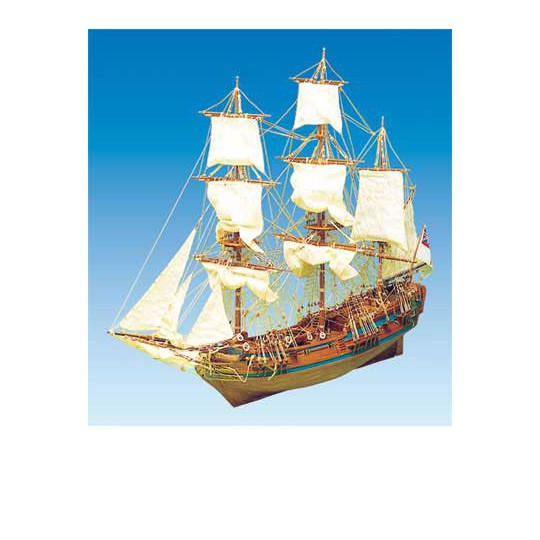
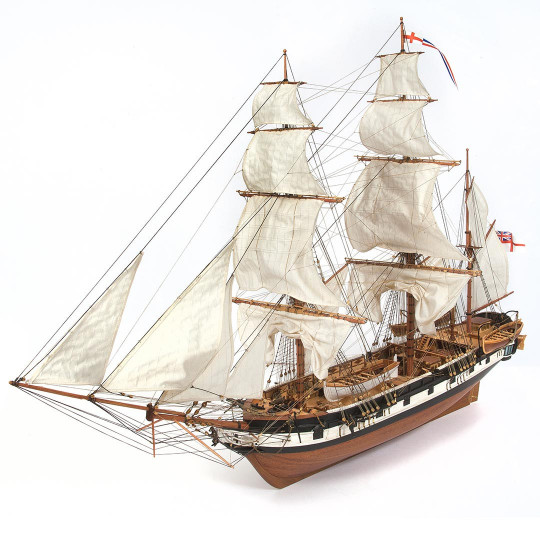


Build the Spanish frigate Diana, launched in 1792, with this wooden boat model at a scale of 1-85 offered by OcCre.
Comprising 4,542 pieces, this kit reproduces a Spanish navy warship that sailed in the Atlantic and participated in the fight against the privateers of the Caribbean.
Classified at the intermediate level, this wooden frigate model represents a naval modeling project estimated at 550 hours, combining hull assembly, detail realization, and rigging assembly.
Scale 1/85
Length 850 mm
Width 360 mm
Height 635 mm
Intermediate Level

Model of Spanish frigate Diana 1-85 - OcCre
Fast shipping
Via Chronopost 24H
Via DPD 24/48H
Colissimo 48/72H
329526 products in stock
Real-time stock displayed
Secure payment




Secure payment
In 3 or 4 installments

 4.6/5
4.6/5

Specialist since 1955
Fast shipping
Via Chronopost 24H
Via DPD 24/48H
Colissimo 48/72H
329526 products in stock
Real-time stock displayed
Secure payment
Secure payment
In 3 or 4 installments
4.6/5
Specialist since 1955
The Diana was launched on March 10, 1792 in the port of Mahón, on the island of Minorca.
It belonged to a series of six Spanish frigates nicknamed the "Mahonesas," in reference to their place of construction.
These ships were designed to improve their navigation qualities and speed.
During its trials, the Diana outperformed the Soledad, previously considered the best frigate in the Spanish navy.
Its performance led to the use of its plans for the construction of subsequent frigates.
It thus became a reference in the evolution of Spanish naval architecture in the late 18th century.
The frigate Diana took part in several military operations during its career.
It was notably involved in the war against France, off the Catalan coast, and stationed in Cadiz during the Spanish War of Independence.
Integrated into the Spanish naval forces based in Havana, it also participated in the fight against pirates in the Antilles.
Its missions led it to make several crossings of the Atlantic Ocean, connecting Spanish possessions in America to European ports.
After forty-one years of service, the Diana was dismantled in 1833 at the arsenal of Cartagena.
This maritime career is the historical context of the OcCre model, dedicated to a Spanish frigate that served on both sides of the Atlantic.
The Diana model allows for the reproduction of a military frigate from the late 18th century through a kit combining several naval modeling techniques.
The construction is based on a wooden structure complemented by metal and textile elements for the ship's various equipment.
The laser-cut planks facilitate the identification and fitting of the wooden pieces during assembly.
The photo-etched brass and molded zamak components allow for the reproduction of the ship's details, while cotton sails and threads of different thicknesses are used for rigging.
With over 4,500 components, this kit requires rigorous organization to follow the different construction stages and preserve the quality of the assemblies.
The Diana is aimed at enthusiasts of ancient frigates, military sailboats, and Spanish naval history.
It allows for the exploration of the architecture of a vessel designed for fast navigation and long-distance military missions.
This Spanish boat model can complement a collection dedicated to sail warships, 18th-century frigates, or historical vessels that participated in maritime operations in the Atlantic.
Brand: OcCreModel: DianaManufacturer reference: 14001Ship type: Spanish war frigateOriginal ship launch date: March 10, 1792Product type: wooden boat model kitScale: 1-85Number of pieces: 4,542Finished model length: 850 mm (85 cm)Finished model height: 635 mm (63.5 cm)Finished model width: 360 mm (36 cm)Difficulty level: intermediate (level 2 out of 4)Estimated assembly time: 550 hoursBox dimensions: 625 × 410 × 89 mm
With a length of 85 cm, a height of 63.5 cm, and a width of 36 cm, the Diana requires a workspace suitable for handling the hull and rigging installation.
These dimensions should also be considered when choosing a display case or exhibition location.
The manufacturer uses several materials to reproduce the different parts of the frigate:
Wood of different essences: components selected according to their function for the structure, coverings, and visible finishes.
Laser-cut planks allow for precise fitting of the pieces.
Photo-etched brass: engraved metal elements for fine details that cannot be reproduced with the same precision in wood.
Molded zamak: small metal pieces and accessories used to complete the ship's equipment.
Cotton: sails, threads of different thicknesses, and textile elements necessary for rigging and associated details.
The wooden components are FSC Mix Credit certified by OcCre, combining wood from FSC-certified forests and FSC-controlled wood.
OcCre classifies the Diana frigate at level 2 out of 4, corresponding to an intermediate difficulty.
This category is aimed at modelers who already have some construction experience and wish to undertake a project involving more parts and requiring more skill.
The construction of this ancient wooden boat model requires method to organize the 4,542 components and follow the order of operations.
Working on the hull, handling small metal parts, and assembling the rigging require precision and patience.
For a first experience in ship modeling, a beginner level 1 boat model will generally be more accessible.
The Diana is more suitable for a builder looking to deepen their techniques on a large historical ship.
The manufacturer estimates around 550 hours of construction.
This duration is indicative and may vary depending on the modeler's experience, work pace, and time dedicated to adjustments and finishes.
To facilitate progress, it is advisable to divide the assembly into several phases and check each assembly before proceeding.
Prior organization of the wooden parts, metal accessories, and textile elements also helps limit errors during construction.
OcCre provides downloadable assembly instructions for reference 14001.
These documents allow you to review the different construction stages and prepare the necessary operations before starting.
It is recommended to go through the instructions to identify the parts, locate the work phases, and organize the components according to their material.
This preparation is particularly useful for a kit combining laser-cut wooden planks, metal elements, and textile supplies.
The construction of this wooden boat model requires tools suitable for handling, adjusting, and assembling the different materials.
The wooden components, photo-etched brass parts, and rigging elements require specific working techniques.
Before starting, consult the OcCre instructions to determine the necessary tools, adhesives, paints, and finishing products.
To prepare for finishes, the choice of products should consider the surfaces to be treated.
The paints and varnishes for wood or metal must be compatible with the kit materials and the manufacturer's instructions.
The tools, accessories, and products needed for assembling and finishing the model are not included.
We have selected the main items useful for its construction.
For simplicity and cost savings, order them together with your model:
In metropolitan France, shipping is free for orders over €150.
Simply tick the boxes above for the items you wish to add to your order.
Once completed, the Diana can join a collection dedicated to ancient sailboat models, military frigates, or historical Spanish navy ships.
Its hull, equipment, and rigging are the main elements to highlight during the exhibition.
Given its dimensions, a suitable display case can be considered to protect the model from dust, especially on the sails and rigging lines.
The manufacturer's information does not specify if a presentation stand is included in the kit.
The frigate can also serve as a centerpiece for a diorama depicting the operations of the Spanish navy between the late 18th and early 19th centuries.
A maritime scene inspired by its crossings of the Atlantic or its missions against privateers in the Caribbean would place the ship in its historical context.
To maintain consistent proportions, the additional elements of the setting must be adapted to the 1:85 scale.
The choice of base and location should consider the dimensions of the assembled model. Diorama accessories are not mentioned in the kit contents.
The Diana is classified as intermediate level, 2 out of 4 on the OcCre difficulty scale.
It is suitable for modelers with some construction experience who wish to build a model with many parts and various materials.
At a 1:85 scale, the model measures 85 cm in length, 63.5 cm in height, and 36 cm in width. These dimensions correspond to the fully assembled frigate.
Yes. OcCre indicates the presence of cotton for the sails, as well as threads of different thicknesses and textile elements for rigging and ship details.
Yes. The model represents the Diana, a Spanish frigate launched on March 10, 1792 in Mahón.
It notably took part in military operations on the Catalan coast, made several crossings of the Atlantic, and fought privateers in the Caribbean before being dismantled in 1833.
The OcCre datasheet details the main construction materials, but does not confirm the presence of paints, glues, or tools.
It is recommended to consult the assembly instructions to identify the necessary supplies before starting.
Yes. OcCre offers downloadable construction instructions for reference 14001. They allow for preparing the assembly and following the different assembly steps.
OcCre announces a lifetime warranty on the parts of its kits.
The manufacturer offers a free replacement service for damaged or lost parts during construction, according to the conditions of its warranty.
The Diana is presented as a wooden ship model kit for static naval modeling.
It cannot be remote-controlled.