



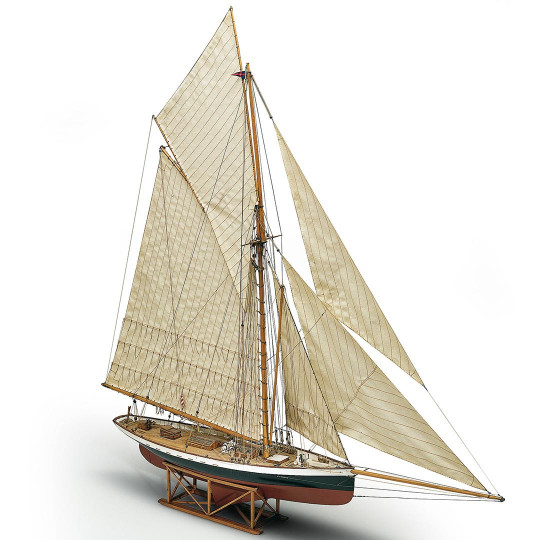


The Polaris 1/50 OcCre sailboat model is designed to discover naval modeling with a first wooden boat to assemble.
Its 1,226 pieces, its beginner level, and its estimated 120 hours of assembly allow you to gradually learn the techniques specific to wooden boat models. Detailed instructions and step-by-step video tutorials accompany you throughout the construction.
Scale 1/50
Length 580 mm
Width 124 mm
Height 446 mm
Beginner level

Model sailboat Polaris 1-50 - OcCre
Fast shipping
Via Chronopost 24H
Via DPD 24/48H
Colissimo 48/72H
329526 products in stock
Real-time stock displayed
Secure payment




Secure payment
In 3 or 4 installments

 4.6/5
4.6/5

Specialist since 1955
Fast shipping
Via Chronopost 24H
Via DPD 24/48H
Colissimo 48/72H
329526 products in stock
Real-time stock displayed
Secure payment
Secure payment
In 3 or 4 installments
4.6/5
Specialist since 1955
This OcCre model combines woodworking, detailed assembly, and rigging to familiarize you with the main steps of ship modeling.
• Beginner level, suitable for a first experience in miniature shipbuilding.
• 1,226 pieces and an estimated assembly time of around 120 hours.
• Wood of different essences, photo-etched brass parts, zamak elements, cotton sails, and threads.
The name Polaris refers to the North Star, used for centuries by navigators to locate the north and estimate their latitude.
Because it appears almost motionless in the sky, it was a valuable reference point for orienting at sea.
OcCre takes this idea to design an initiation sailboat that serves as a guide for beginner modelers.
The Polaris does not replicate a specific historical ship. Its goal is educational: to allow you to discover, step by step, the construction techniques used to create more complex ship models.
Assembly thus becomes a first concrete approach to the hull structure, deck finishes, and rigging setup.
Classified at the beginner level, the Polaris model allows you to approach the different operations without starting with a particularly complex model.
The laser-cut wooden elements facilitate their identification and adjustment.
The illustrated instructions and video tutorials help you follow the assembly order and understand the necessary gestures.
Plan around 120 hours to assemble the 1,226 pieces, depending on your pace and the time devoted to finishes.
Work on a stable and well-lit surface, organizing the small pieces as you go to avoid assembly errors.
To work with precision, consider having a modeling knife, fine sandpaper, precision tweezers, a small hammer, a hand drill, and wood-appropriate glue.
These tools allow you to prepare the parts, adjust the assemblies, and work on the boat's details.
The tools and glue are not included in the standard Polaris kit: check your equipment before starting.
The kit brings together several materials, each serving a function in the model's realization.
The different wood essences are used for the structure, hull planking, deck, and visible finishes.
The photo-etched brass parts provide fine details, while the cast zamak elements complete the fittings.
The sewn sails and cotton threads allow for rigging.
To achieve a neat result, take the time to lightly sand the surfaces when necessary and check the fit of the parts before gluing them.
The paint and choice of finishes depend on the desired outcome.
If you want to preserve the natural look of the wood, opt for a finish suitable for this material; for a painted presentation, apply the colors precisely while avoiding masking the details.
With dimensions of 580 × 124 × 446 mm, the Polaris model can be displayed on a shelf, in a showcase, or in a space dedicated to naval modeling.
Its sailboat profile lends itself to individual presentation, but you can also integrate it into a maritime diorama evoking a dock or coastal environment.
The decor is optional: the boat can also be displayed alone to highlight the hull, sails, and rigging.
The Polaris sailboat model by OcCre is mainly aimed at those who want to start in wooden boat construction, as well as modelers looking for a structured initiation project.
It allows you to acquire useful basics before moving on to more detailed ship models.
Thanks to step-by-step instructions and video tutorials, you can progress at your own pace and become familiar with essential naval modeling techniques.