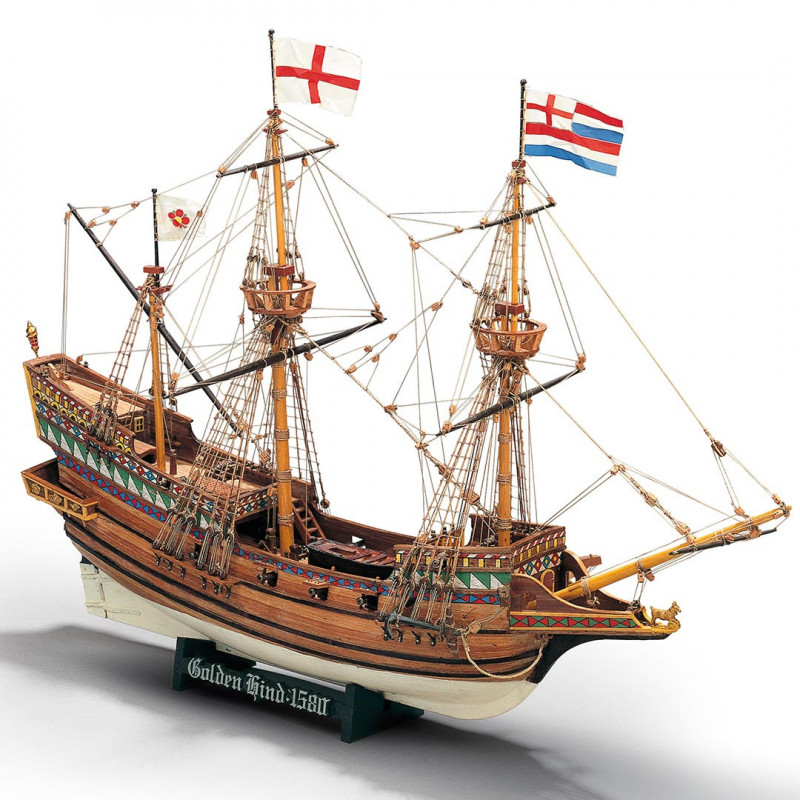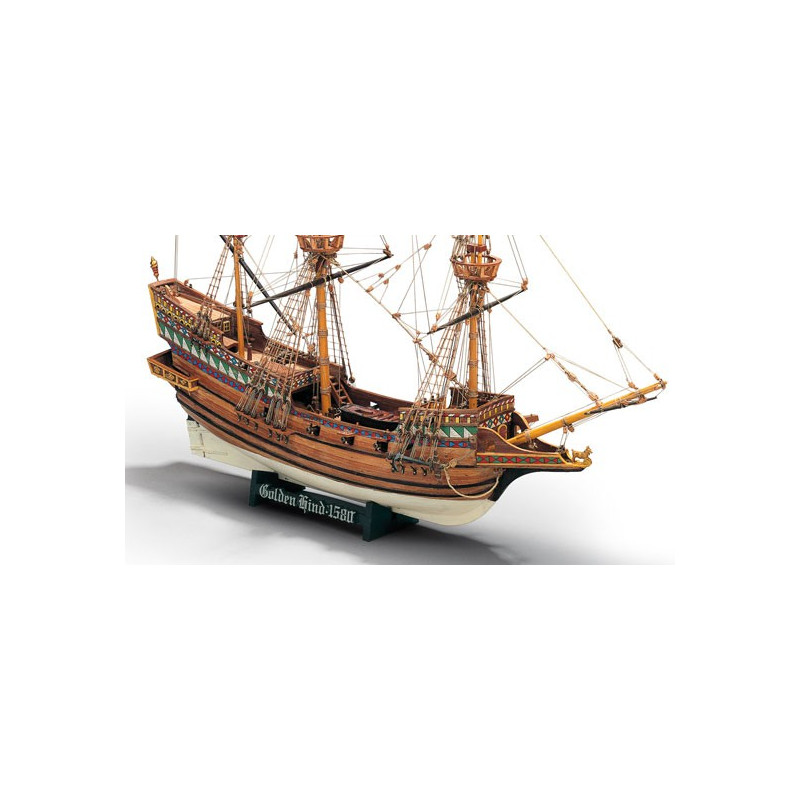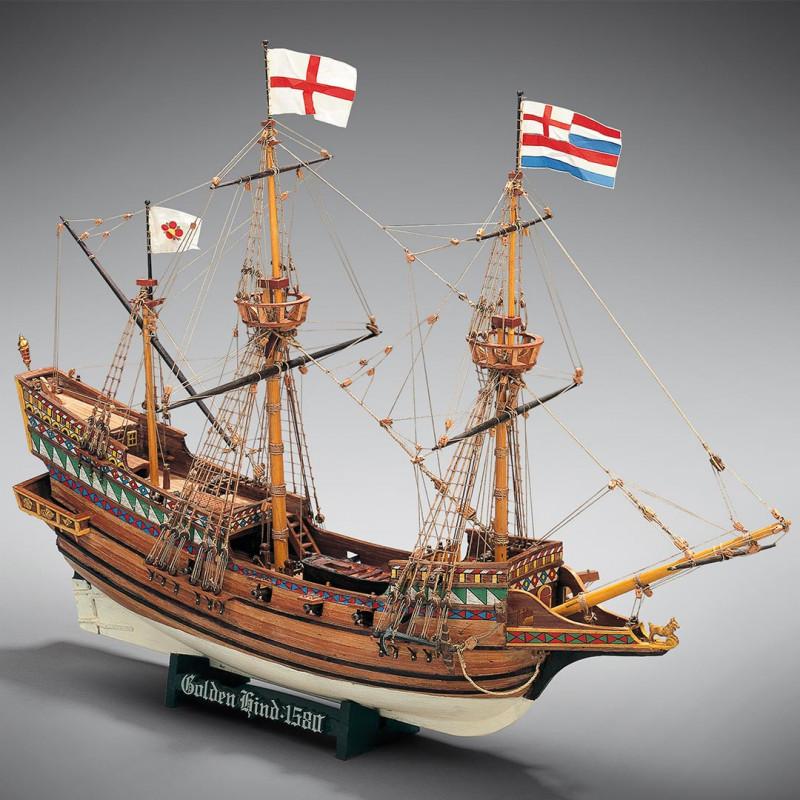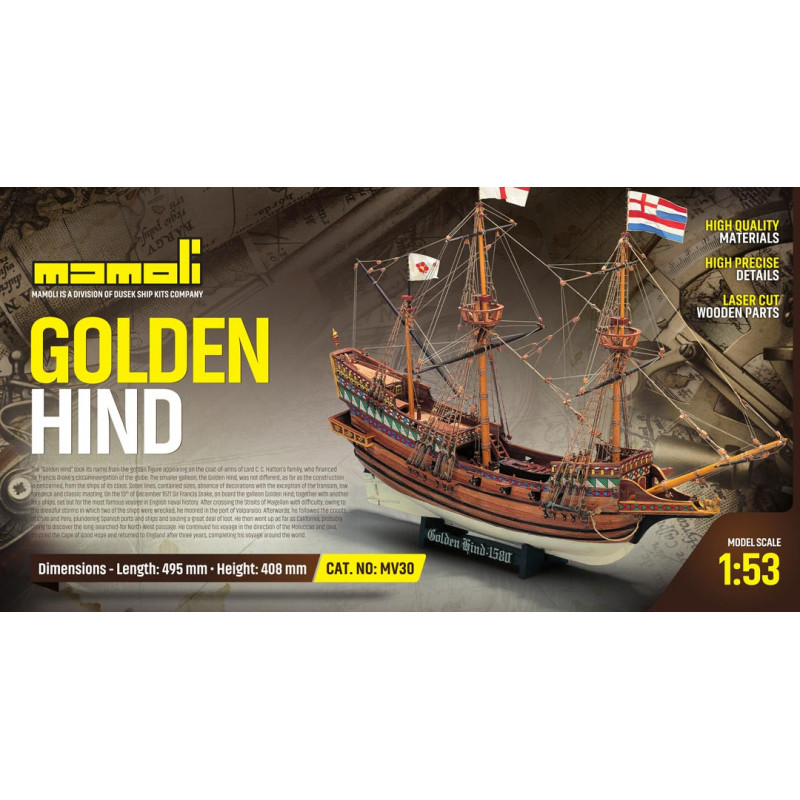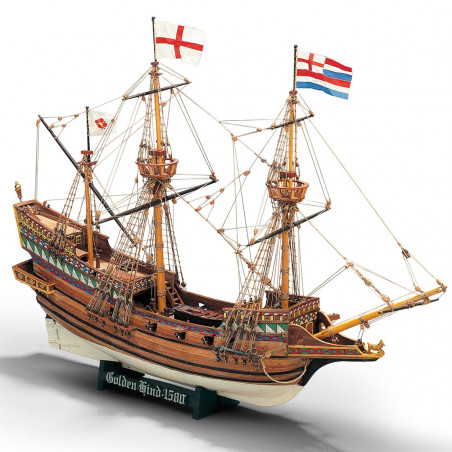
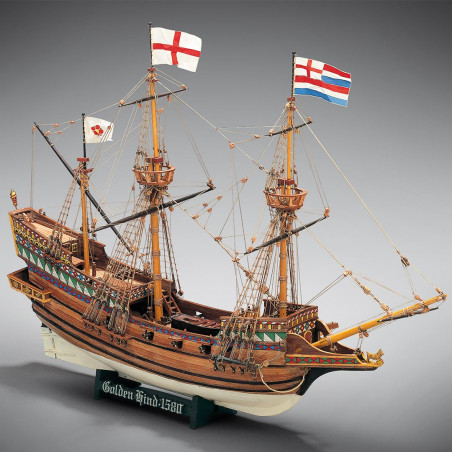
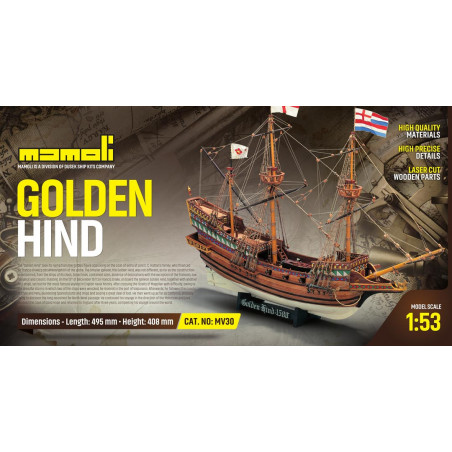
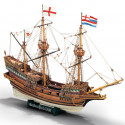

Relive one of the great maritime expeditions of the 16th century with the Golden Hind wooden ship model 1/53 by Mamoli, reference MV30 / Z49MV30.
This naval modeling kit reproduces the famous English galleon commanded by Francis Drake during his world tour between 1577 and 1580.
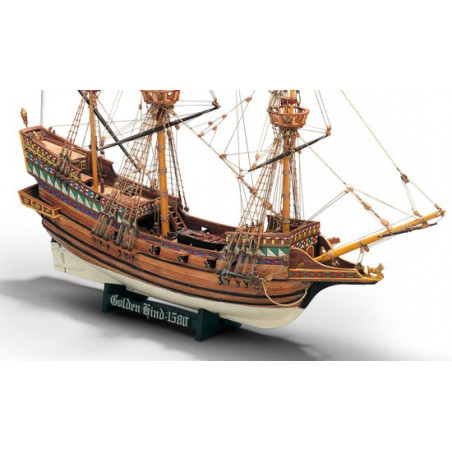
With its double-planked wooden hull, aft castle, colorful decorations, masts, and detailed rigging, this reproduction allows you to discover the architecture of an iconic ship from the Elizabethan era.
Measuring 49.5 cm in length and 40.8 cm in height once assembled, the Golden Hind Mamoli model combines a structure on laser-cut frames, beech and walnut strips, metallic rigging elements, and numerous ropes.
Its assembly constitutes an interesting project for wooden ship model enthusiasts wishing to deepen their knowledge of traditional construction techniques, planking, and the creation of ancient rigging.

Model boat Golden Hind in wood 1-53 - Mamoli
|
|
|
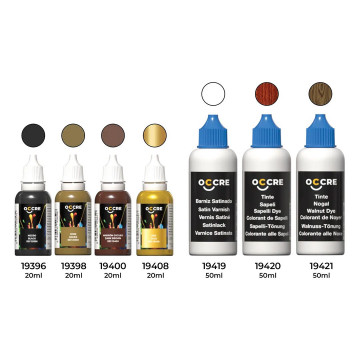
Pack Golden Hind Paints - 7 pots - OcCre€28.95 - ref. S06190512 |
|
|
|
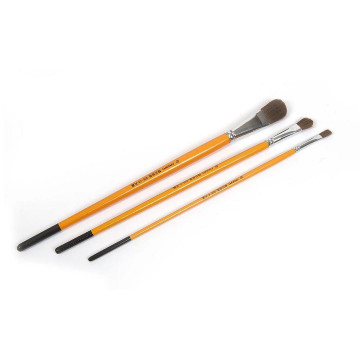
Set of 3 specific brushes for wooden boat model - OcCRE€5.95 - ref. S06110511 |
|
|

|
100 ml white glue for white glue model€8.80 - ref. S0681015 |
|
|

|
Wire cutter for boat rigging - Occre€3.95 - ref. S06110513 |
Fast shipping
Via Chronopost 24H
Via DPD 24/48H
Colissimo 48/72H
334721 products in stock
Real-time stock displayed
Secure payment




Secure payment
In 3 or 4 installments

 4.6/5

Specialist since 1955
Fast shipping
Via Chronopost 24H
Via DPD 24/48H
Colissimo 48/72H
334721 products in stock
Real-time stock displayed
Secure payment
Secure payment
In 3 or 4 installments
4.6/5
Specialist since 1955
The Golden Hind is a 16th-century English ship, made famous by the circumnavigation expedition led by navigator Francis Drake between 1577 and 1580.
Originally, the ship was named Pelican. It was later renamed Golden Hind, which means "golden hind," in reference to the heraldic emblem of Sir Christopher Hatton, one of the main financial and political supporters of the expedition.
The name change occurred during the voyage, in 1578, while Drake continued his navigation in the waters of South America.
The ship belongs to the family of English galleons from the second half of the 16th century.
Its relatively modest size, sturdy hull, and rigging allow it to undertake long ocean crossings.
Unlike the large, heavily decorated galleons, the Golden Hind is generally depicted with relatively simple lines, a low forecastle, and a more developed aft castle.
On December 13, 1577, Francis Drake left Plymouth at the head of an expedition comprising five ships, including his main vessel, then named Pelican.
The expedition pursued several maritime, commercial, and strategic objectives.
It took place in a context of rivalries between England and Spain for control of trade routes and overseas territories.
After crossing the Atlantic Ocean, the ships reached the coasts of South America and passed through the Strait of Magellan to reach the Pacific Ocean.
The navigation conditions were particularly difficult. Storms, loss of ships, and tensions within the expedition gradually reduced the fleet.
Francis Drake then continued his route northward, along the coasts of Chile and Peru, where he conducted several attacks against Spanish interests and seized important cargoes.
In 1579, the Golden Hind reached the western coast of North America. Drake then crossed the Pacific Ocean, passed through the regions of the Moluccas and Java, and then reached the Indian Ocean.
After rounding the Cape of Good Hope, the ship returned to England on September 26, 1580, completing the first world tour conducted under the command of an English navigator.
This expedition helped make the Golden Hind of Francis Drake one of the most famous ships in Elizabethan maritime history.
European galleons of the Renaissance gradually evolved into ships better suited for ocean navigation and sea battles.
The Golden Hind is characterized by an elongated hull, multi-level deck structures, an elevated aft castle, a bowsprit, and masts equipped with yards and sails.
The stern, geometric decorations, and rigging elements contribute to the visual identity of these ships from the second half of the 16th century.
The complete original construction plans of the Golden Hind have not been preserved, so current models are based on research and historical interpretations.
The Mamoli MV30 reproduction thus offers a representation of the famous English galleon, adapted to the construction techniques of miniature naval modeling.
The Golden Hind Mamoli MV30 model is a static wooden ship kit to build, manufactured under the Mamoli brand, integrated into Dušek Ship Kits.
Its 1/53 scale allows representing the main characteristics of the galleon while maintaining dimensions suitable for a showcase or a collection of historical naval models.
Manufacturer: Mamoli / Dušek Ship Kits
Manufacturer reference: MV30
Scientific-MHD reference: Z49MV30
Model: Golden Hind
Era represented: 16th century, 1577-1580
Type of ship: English galleon
Scale: 1/53
Assembled length: 495 mm (49.5 cm)
Assembled height: 408 mm (40.8 cm)
Construction: double-planked hull on frames
Structure: false keel and laser-cut frames
Planking materials: beech and walnut
Fittings: cast metal parts, walnut blocks and deadeyes
Type of model: static naval model to build
Recommended level: intermediate.
The kit reproduces the main architectural features of the Golden Hind, with its wooden hull, decks, decorative elements, masts, and rigging.
The construction of the Golden Hind Mamoli is based on a traditional naval modeling method: the planking on frames.
The kit includes a false keel and laser-cut wooden frames.
These pieces form the inner framework on which the strips forming the hull will be attached.
The assembly begins with the preparation and assembly of the structural elements. The frames are positioned on the false keel, respecting their order and orientation.
It is advisable to perform a dry fit before gluing to check the adjustments and verify the symmetry of the whole.
Precise alignment of the frames is essential to obtain a regular hull and facilitate the placement of the planking strips.
One of the main technical features of the Golden Hind wooden model Mamoli lies in its double planking construction.
This technique involves covering the ship's structure with two successive layers of wooden strips.
The first layer helps to form the general curves of the hull.
The strips are gradually adjusted and fixed on the frames to reproduce the lines of the galleon.
Once this first layer is completed, the modeler proceeds with sanding and preparing the surface to obtain a regular support.
The second planking layer provides the exterior finish of the hull. The kit notably uses beech and walnut strips, allowing for working with contrasts and the natural appearance of the materials.
The double planking is of particular interest to modelers wishing to deepen their understanding of traditional naval model construction techniques.
The rounded shapes of the hull require preparing the strips before their final attachment.
Depending on their thickness and type, some strips can be softened and then gradually bent to follow the curves of the bow, sides, and stern.
It is recommended to work evenly on both sides of the ship to limit structural deformations.
Sanding between planking operations helps to achieve a regular surface and prepare the finishes.
This step requires patience, but it plays an essential role in the final appearance of the model.
The stern is one of the most characteristic parts of the Golden Hind model.
The elevated stern castle, openings, and various decorative elements contribute to recreating the silhouette of Renaissance English galleons.
The Mamoli model notably reproduces colorful geometric patterns that highlight the lines of the hull and the structures of the stern castle.
The manufacturer describes the Golden Hind as a galleon with relatively simple shapes, whose most remarkable decorations are concentrated at the stern.
These elements provide an interesting contrast between the natural wood surfaces, metal pieces, and painted parts.
The assembly continues with the preparation of the decks and the installation of the various equipment of the galleon.
The small rigging pieces allow for reproducing the elements necessary for maneuvers, rope attachments, and the general organization of the ship.
The kit includes molded white metal components, as well as pulleys, deadeyes, and belaying pins in walnut.
The pulleys guide the ropes, while the deadeyes allow for reproducing the tension systems used on old sailing ships.
These small pieces require meticulous work to maintain the model's proportions and achieve a result consistent with the assembly plans.
The bow of the Golden Hind is extended by a bowsprit, a mast element inclined towards the front of the ship.
On old sailing ships, the bowsprit supports various rigging elements and the organization of the sails located towards the front.
The miniature reproduction requires respecting its inclination and attachment points to maintain the visual balance of the model.
The assembly of the bowsprit is also an important step before the final installation of certain ropes.
The Golden Hind Mamoli 1/53 model includes the elements necessary for the realization of its masts and rigging.
The various wooden pieces must be prepared and assembled according to the plans to reproduce the masts, yards, and attachment elements.
Controlling the alignments is particularly important to maintain the silhouette of the galleon and allow for the installation of the various ropes.
The construction of the rigging allows for the discovery of the operating principles of the large sailing ships from the late 16th century.
The rigging of the Golden Hind includes different categories of ropes, intended to reproduce the standing and running rigging of the ship.
The shrouds and stays help maintain the rigging, while the running rigging allows for the adjustment of the yards and sails.
The kit includes rigging threads, pulleys, and deadeyes necessary for the various installations planned by the manufacturer.
The placement of the ropes must follow the order indicated in the plans to maintain accessibility to the attachment points.
Regular tension of the threads helps maintain balanced rigging and prevents deformation of the wooden elements.
To achieve clean rigging, it is recommended to prepare the threads before installation.
Some ropes can be slightly treated with beeswax suitable for naval modeling to limit fraying and facilitate handling.
This treatment should remain moderate, especially on small diameter threads.
The knots and attachment points must be made according to the plans to respect the organization of the miniature rigging.
The Golden Hind Mamoli MV30 model is offered as a construction kit including the main components necessary for the realization of the static galleon.
The box notably includes:
The components allow for working on several naval modeling techniques, from hull construction to the creation of small parts and ropes.
Glue, paints, finishing products, and modeling tools must be provided separately.
Sets of pre-made sails are also offered by accessory manufacturers for the Golden Hind Mamoli 1/53. These accessories should not be considered included in the standard kit without prior verification of the packaging.
The Golden Hind MV30 is generally classified among the intermediate level naval models.
It is particularly suitable for modelers who already have some experience in building wooden models or wish to progress in creating more detailed historical models.
The assembly involves several operations requiring precision: preparation of the frames, installation of a double-planked hull, adjustment of deck elements, and creation of the rigging.
The construction of this galleon allows for the development of several skills:
Each step contributes to a better understanding of the construction principles of ancient sailing ships and the techniques used in traditional naval modeling.
With its 49.5 cm length, the Golden Hind Mamoli has more compact dimensions than some large galleon models.
Its 1/53 scale nevertheless allows for a detailed presentation of the hull, decks, and rigging.
This format may suit enthusiasts with limited display space while seeking a sufficiently detailed historical sailing ship model to constitute a complete assembly project.
The construction of this wooden model requires tools suitable for working with small parts.
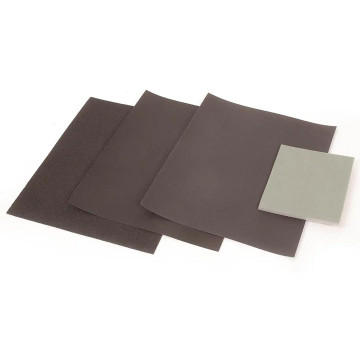
A precision cutter, abrasive paper, fine pliers, a ruler, a small saw, and holding tools are useful equipment for preparing hull elements and rigging components.
A bending tool can also facilitate shaping the strips intended for the curved parts of the planking.
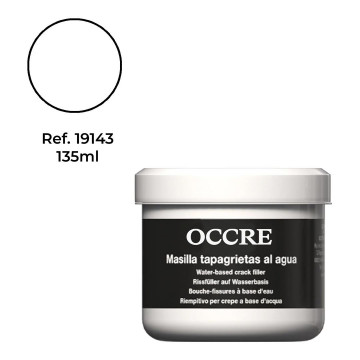
For wooden assemblies, a wood glue suitable for modeling is recommended. Metal parts may require an adhesive appropriate for the materials involved.
The wooden surfaces of the model can receive a natural finish or be painted according to the model's instructions and the modeler's preferences.
The decorations of the stern castle and the colorful motifs highlight the aesthetic features of the Golden Hind.
A varnish suitable for wood can be used to protect the surfaces, after checking its compatibility with the paints and stains used.
Before any final application, it is advisable to test the products on wood scraps to check the color rendering.
To achieve a regular hull, it is important to check the alignment of the frames before starting to lay the strips.
The first planking should be done gradually, adapting the strips to the curves of the structure.
Once this first layer is completed, the surfaces must be carefully prepared before installing the second wooden planking.
Fragile elements, decorations, and rigging must be installed following the different assembly steps to minimize the risk of damage.
Once assembled, the Golden Hind Mamoli galleon model is a collectible piece representative of 16th-century English maritime history.
Its wooden hull, decorated stern castle, flags, and detailed rigging allow the characteristic silhouette of Francis Drake's ship to be recognized.
The finished model can be presented on a suitable base or placed in a protective showcase large enough to preserve the masts, yards, and rigging.
Exposing it away from dust, excessive humidity, and direct sunlight will help preserve the materials and finishes.
Historical diorama enthusiasts can also consider a presentation of the Golden Hind inspired by its world voyage.
A port setting evoking Elizabethan England or a maritime scene can serve as a backdrop for this model.
To maintain a coherent representation, the decor elements must be adapted to the 1/53 scale.
Diorama accessories and additional display supports should be planned separately.
The Golden Hind Mamoli MV30 model is made at a 1/53 scale.
It reproduces the famous English galleon commanded by Francis Drake during his world expedition between 1577 and 1580.
Once assembled, the model measures 495 mm in length and 408 mm in height, which is 49.5 cm long and 40.8 cm high.
These dimensions correspond to the characteristics provided by the manufacturer Mamoli / Dušek Ship Kits.
The Golden Hind was commanded by the English navigator Francis Drake.
Between 1577 and 1580, he led an expedition that completed the first circumnavigation under English command, after crossing the Atlantic, Pacific, and Indian Oceans.
The ship was initially called Pelican. Francis Drake renamed it Golden Hind in 1578, in reference to the golden hind depicted on the coat of arms of Sir Christopher Hatton, one of the main supporters of the expedition.
The Golden Hind was a 16th-century English galleon.
It is associated with the maritime operations of Francis Drake, who attacked several Spanish ships and settlements during his expedition.
Drake is generally described as an English privateer, although his actions were considered piracy by his Spanish adversaries.
Yes. The Mamoli MV30 kit includes a double-planked hull on frames, made with beech and walnut strips.
This method involves assembling two successive layers of wood to form the hull and achieve the desired exterior finish.
This model is generally classified in the intermediate level kit category.
Some prior experience in wood construction is recommended, especially for double planking, preparing small fittings, and installing the rigging.
Yes. The model comes with plans and instructions to follow the different construction stages, from assembling the structure to completing the equipment and rigging.
The kit primarily uses wooden parts, including beech and walnut for the hull planking.
It also includes laser-cut plywood elements, cast metal components, and walnut accessories for the rigging.
The rigging and its main components are provided in the kit. H
owever, pre-made fabric sails are not included.
Compatible sail sets for the Golden Hind Mamoli 1/53 are available separately from specialized manufacturers.
No. Glue, paints, varnishes, and assembly tools must be provided separately.
It is advisable to choose products compatible with the wood and metal elements used in the kit.
The Golden Hind Mamoli MV30 is a 1/53 scale model measuring 495 mm in length, while the Golden Hind Dušek D017 is offered at a 1/72 scale with a length of 500 mm.
These are two different kits, with designs and features specific to each reference.
Yes. The Golden Hind Mamoli is a static naval model intended for display.
It can be placed in a showcase suitable for its dimensions to protect the masts, rigging, decorations, and other fragile parts.
The Golden Hind Mamoli MV30 model combines a famous historical subject with traditional wooden construction.
Its double planking, fittings, decorations, and rigging allow you to create a 16th-century English galleon while developing your naval modeling skills.