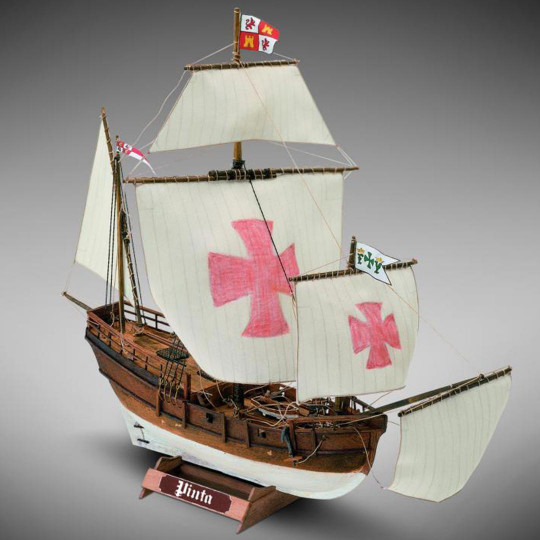
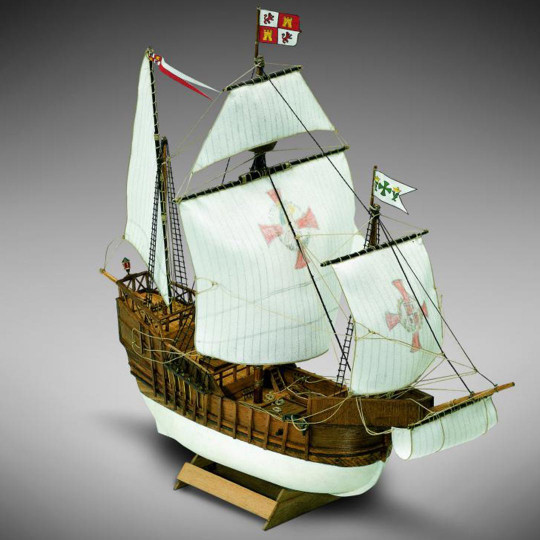
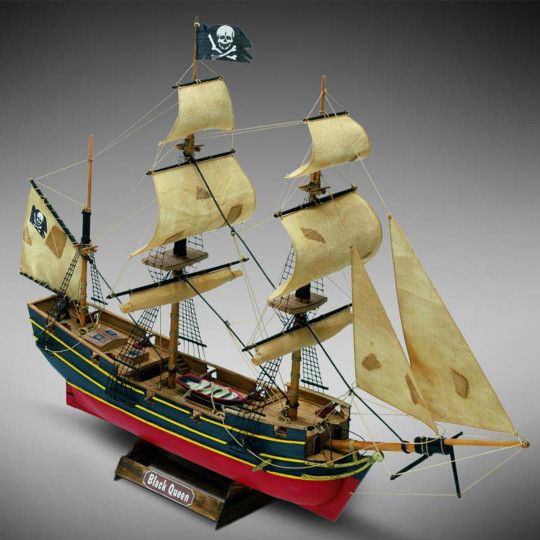
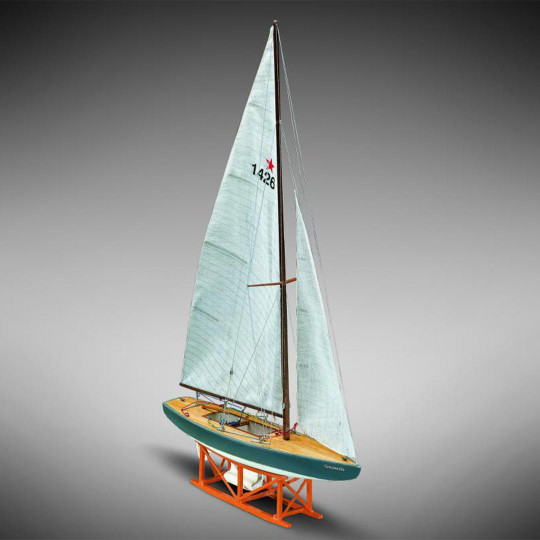
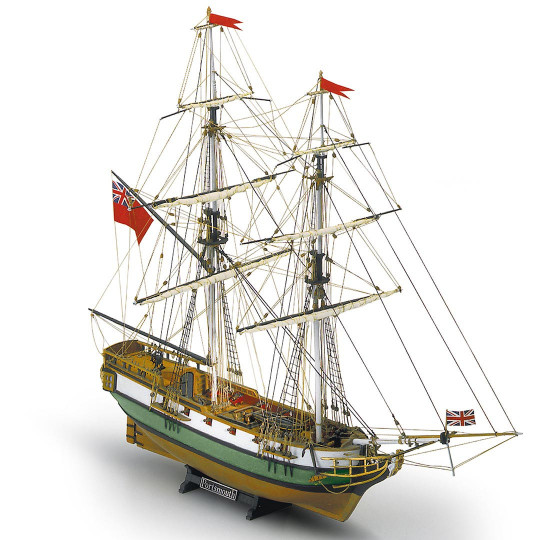
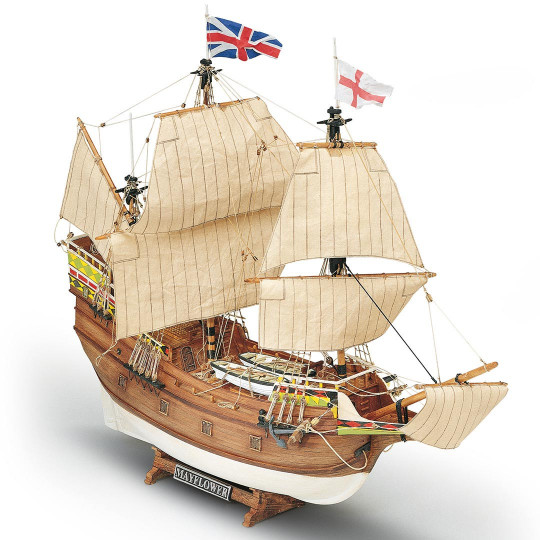
MAMOLI offers a range of wooden ship model kits to build, inspired by historic ships, galleons, sailing vessels and traditional boats.
Its model ship building kits combine bulkhead construction, wooden hull planking, detailed fittings and rigging, with several levels of difficulty.
Discover MAMOLI wooden ship model kits
Specialising in static ship...
MAMOLI: wooden ship model kits to build
MAMOLI offers a range of wooden ship model kits to build, inspired by historic ships, galleons, sailing vessels and traditional boats.
Its model ship building kits combine bulkhead construction, wooden hull planking, detailed fittings and rigging, with several levels of difficulty.
Discover MAMOLI wooden ship model kits
Specialising in static ship modelling, MAMOLI is a brand for enthusiasts who want to build their own miniature replicas of historic vessels.
Its catalogue includes wooden sailing ship models, frigates, exploration ships, historic galleons, racing yachts and traditional boats.
Unlike a ready-made ship model, a MAMOLI kit allows the modeller to take part in every stage of construction.
The modeller assembles the structural components, shapes the hull, installs the deck fittings and gradually builds the masts, sails and rigging.
The range includes models in various sizes and scales, allowing beginners to discover the basics of wooden ship model building while offering experienced modellers more complex projects.
Mini MAMOLI kits provide a simplified approach, while traditional MV references generally require more extensive work on the hull and rigging.
MAMOLI wooden ship model kits are designed for display once assembly is complete.
They offer an opportunity to explore the architectural characteristics of historic vessels while developing skills in cutting, gluing, sanding, painting and precision craftsmanship.
The history of MAMOLI, an Italian model ship manufacturer
MAMOLI is an Italian brand specialising in miniature ship building kits, founded by the Turconi brothers.
The company developed a catalogue covering different periods of maritime history, with reproductions of European and American vessels.
The brand became particularly well known for its historic wooden sailing ship models, built using traditional plank-on-bulkhead construction.
Several models are inspired by ships involved in maritime expeditions, naval conflicts or sailing competitions.
Following a fire that brought the Italian manufacturer's operations to a halt in 2015, the rights to the range were acquired by Dušek Ship Kits, a Czech company specialising in wooden ship model kits.
This acquisition allowed the gradual reintroduction of MAMOLI and Mini MAMOLI models.
The reissued kits retain the construction principles of the original historic models while benefiting from modern manufacturing techniques, particularly laser-cut wooden components.
Detailed plans and multilingual instructions guide modellers through the different stages of assembly.
Features of MAMOLI wooden ship building kits
Models in the MV series generally feature a structure consisting of a false keel and wooden bulkheads.
Wooden strips are then progressively attached to this framework to reproduce the shape of the hull. This technique, known as plank-on-bulkhead construction, is widely used in traditional wooden ship modelling.
Many models feature double hull planking.
The first layer of wooden strips forms the outer structure and allows minor irregularities to be corrected.
The second layer, often made from decorative finishing wood, provides a smoother and more uniform hull appearance.
Depending on the model, kits may include plywood components, wooden strips of various sizes, wooden or metal fittings, blocks, rigging thread and fabric sails.
Cannons, anchors, lifeboats, railings and decorative elements vary according to the vessel being reproduced.
The assembly plans explain the construction stages and indicate the position of the various components.
However, the exact contents of each kit should be checked on its product page, particularly regarding sails, display accessories and finishing materials.
Which MAMOLI wooden ship model kit should you choose for your skill level?
The level of difficulty is an important factor when choosing a wooden ship model kit to build.
Someone assembling their first kit will not necessarily have the same expectations as an experienced modeller who has already completed several three-masted sailing ships.
Difficulty does not depend solely on the number of parts or the overall dimensions of the vessel.
The shape of the hull, the number of wooden planks requiring bending, the complexity of the rigging and the size of the fittings all influence the work involved.
To help you choose, the MAMOLI models available from Scientific MHD are divided into four indicative skill levels: beginner, intermediate, advanced and expert.
This classification is a practical assessment of assembly complexity rather than an official rating issued by the manufacturer.
A careful modeller can naturally tackle a more demanding kit by taking the time to master each construction technique.
Comparison table of MAMOLI ship models by difficulty level
This table lists the MV references in the Scientific MHD range and helps identify models according to their assembly difficulty.
Mini MAMOLI kits, identified by their MM references, are grouped together on a single line.
Richly decorated historic vessel with numerous miniature components.
Level 1: Mini MAMOLI kits for beginners in model ship building
Mini MAMOLI kits are suitable for anyone who wants to start building a wooden ship model without extensive previous experience.
These kits generally feature a pre-shaped hull, eliminating the need to assemble a complete bulkhead structure and install several rows of wooden planking.
Assembly mainly involves preparing the hull, installing deck components, fitting the masts and completing simplified rigging.
The compact dimensions allow modellers to work in a limited space and gradually become familiar with the tools used in miniature ship construction.
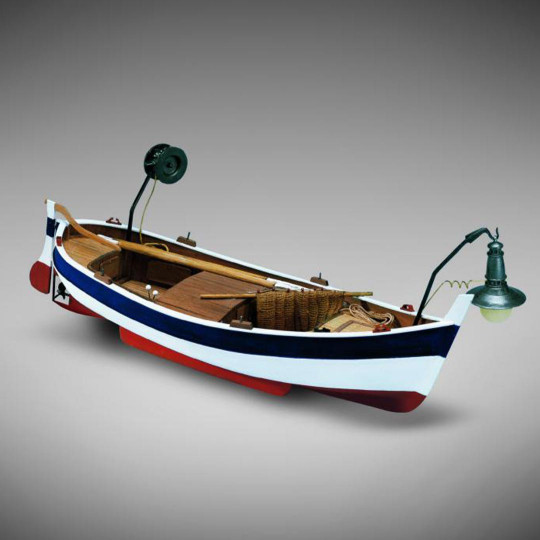
The collection includes replicas of historic sailing ships, fishing boats and famous vessels.
For adults looking for their first wooden ship model kit to build, this range provides a gradual introduction to gluing, sanding, painting and rigging installation.
However, handling the small components still requires patience.
Even with a pre-shaped hull, it is important to maintain correct alignment and follow the instructions to achieve a neat result.
Level 2: MAMOLI wooden ship kits for intermediate modellers
Intermediate-level models are intended for people who have already completed a simple kit or have good practical skills.
They introduce traditional wooden ship construction techniques, particularly the assembly of bulkheads and hull planking.
The Gretel MV33 is an example of a model that allows enthusiasts to develop their woodworking skills.
This historic yacht features a traditional structure and finishes suitable for learning.
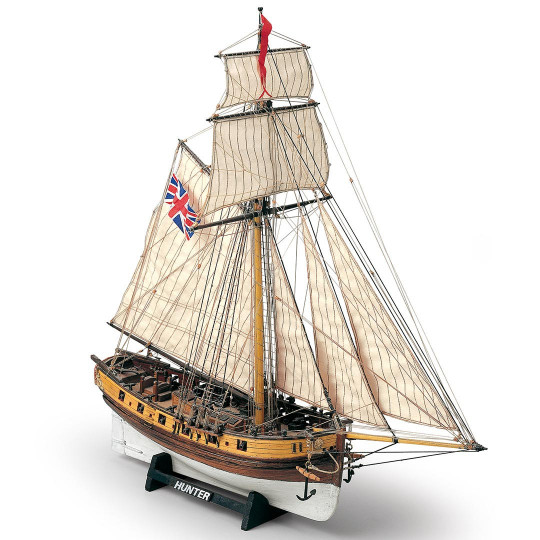
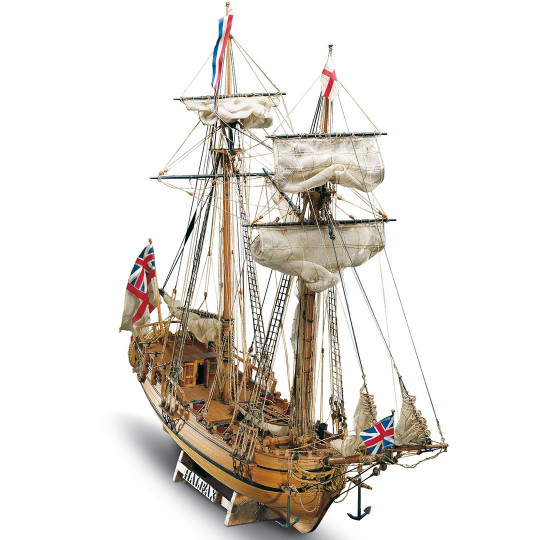
The Hunter MV35 and Halifax MV37 also provide opportunities to improve assembly techniques.
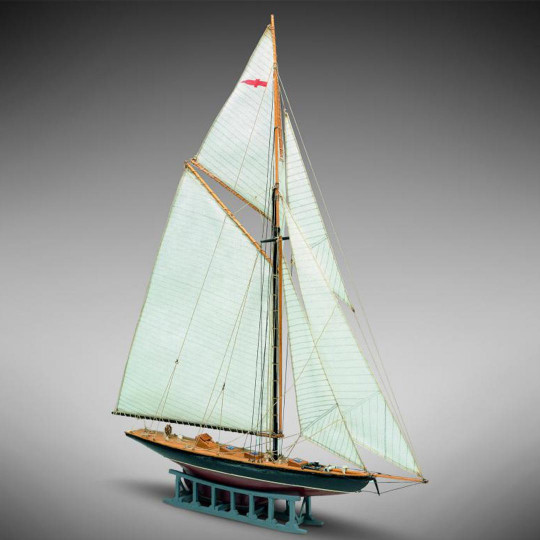
For anyone wishing to build a wooden sailing ship model with sails, the America MV26 and Jenny MV54 are interesting options.
They allow modellers to work on hull lines, masts and the distinctive features of racing yachts.
At this level, it becomes important to bend wooden strips without breaking them, hold components securely during gluing and sand surfaces without altering the hull shape.
Level 3: historic wooden ship model kits for advanced builders
Advanced-level models require greater experience with hull planking, fittings and rigging.
They generally contain more components and demand careful attention when installing deck equipment.
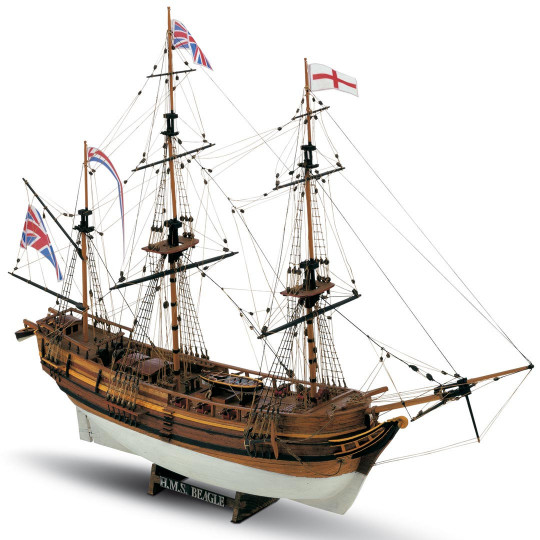
The HMS Beagle MV20 at 1/64 scale reproduces the British exploration ship associated with Charles Darwin's voyages. It features a double-planked hull and three-masted rigging.
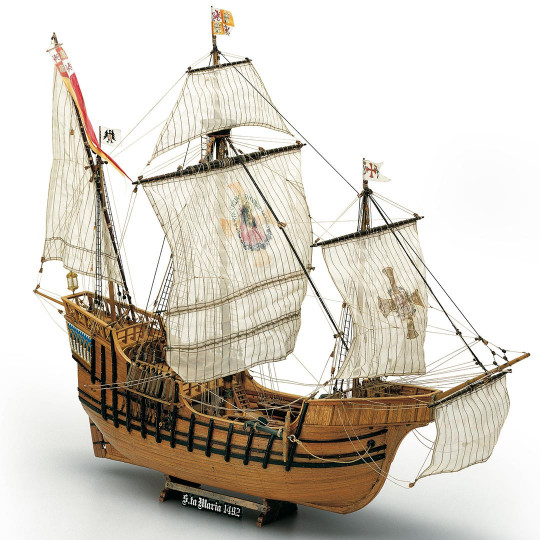
The Santa Maria MV42 at 1/50 scale is an interesting project for enthusiasts of historic wooden ship models.
Its completed length of 79 cm allows builders to reproduce the vessel's different structures, particularly the decks and masts.
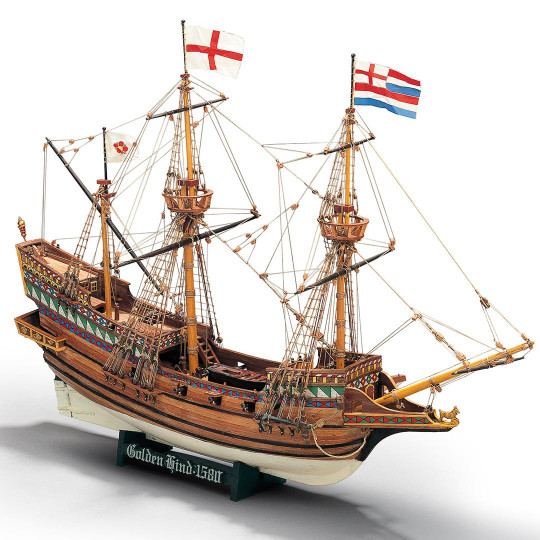
The Golden Hind MV30 at 1/53 scale is another model designed for enthusiasts of wooden galleon model kits.
Its stern structures, decorations and rigging require precise assembly.
These projects are suitable for modellers who can organise their construction over several weeks or months, depending on the time available and the desired level of finishing.
Level 4: large MAMOLI ship models for expert builders
Expert-level kits include models with a high density of details, elaborate hull structures or particularly complex rigging.
The HMS Victory MV27 at 1/90 scale, USS Constitution MV31 and Royal Louis MV40 are intended for enthusiasts of large historic warships.
Construction includes gun batteries, numerous fittings and demanding mast assemblies.
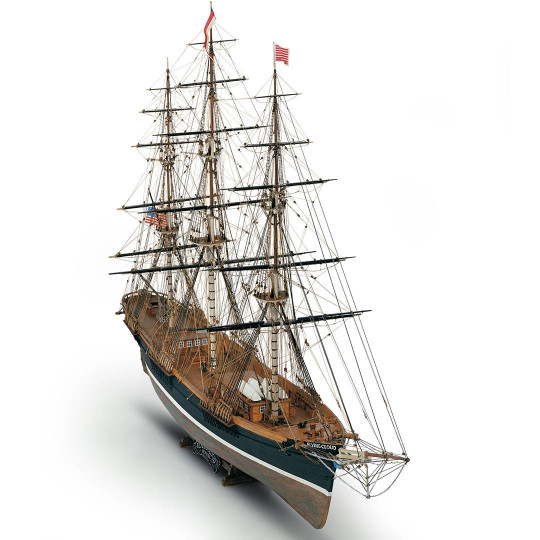
The Friesland MV24 stands out for its decorative carvings and armament, while the Flying Cloud MV41 requires extensive work on the rigging of a clipper.
The Amerigo Vespucci MV57 also requires considerable precision to reproduce its masts, yards and running rigging.
For these wooden ship model kits aimed at experienced adults, it is advisable to have a dedicated workbench and organise components according to each construction stage.
Assembly accuracy is more important than building speed.
What types of wooden ship model kits does MAMOLI offer?
Wooden galleon models and historic exploration ships
Galleons and exploration vessels occupy an important place in the MAMOLI catalogue.
These model kits reproduce ships that played significant roles in maritime history, particularly during the great voyages of exploration.
The Santa Maria MV42 is associated with Christopher Columbus's first voyage in 1492.
Its wooden reproduction allows modellers to explore the layout of ships from this period, including their raised decks, masts and rigging.
The Golden Hind MV30 represents the galleon used by Francis Drake during his voyage around the world in the 16th century.
The São Miguel MV21 is inspired by an Atlantic carrack, a type of vessel featuring a large hull and particularly prominent superstructures.
These wooden galleon model kits to build are suitable for anyone who wants to combine practical craftsmanship with an interest in historic ships.
The difficulty depends particularly on the shape of the stern castles, the amount of decoration and the number of rigging lines to install.
Wooden frigate and historic warship model kits
MAMOLI offers several reproductions of historic naval vessels.
Enthusiasts looking for wooden frigate model kits can consider the HMS Surprise MV58, USS Constitution MV31 or HMS Victory MV27.
These kits allow builders to discover the characteristic features of sailing warships, including gun batteries, gunports, working decks, forecastles and navigation equipment.
Construction requires careful organisation, as several components must be prepared and installed before certain sections of the hull are permanently closed.
On models featuring multiple gun decks, alignment must also be checked to maintain a consistent appearance.
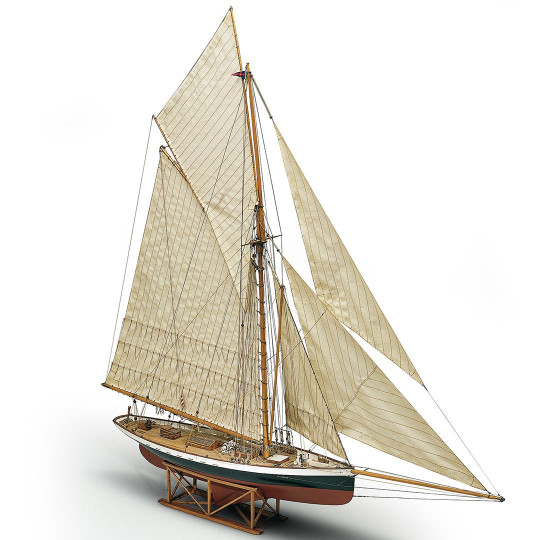
The range includes the America MV26, Puritan MV43, Britannia MV44 and Jenny MV54.
These yachts feature hull shapes and sail configurations that differ from those of military vessels.
Construction focuses particularly on the regularity of the hull planking, the lines of the boat and the arrangement of the masts.
The Jenny MV54 at 1/12 scale reproduces a Star-class sailing yacht.
Its kit features plank-on-bulkhead construction, double hull planking and fabric sails.
It is suitable for modellers who want to develop their skills with a racing yacht model kit.
The Flying Cloud MV41, meanwhile, represents a 19th-century clipper.
It is a more demanding project, particularly because of its extensive masts and the number of running lines required to reproduce its rigging.
Fishing boats and traditional wooden vessels
The MAMOLI catalogue is not limited to large historic ships.
It also includes reproductions of traditional vessels, such as Il Leudo MV29 and Catalina MV51.
These models provide an opportunity to discover construction methods and rigging arrangements specific to regional boats.
They are particularly interesting for modellers who prefer to reproduce a traditional wooden working boat rather than a military vessel or large sailing ship.
The hull shapes may appear simpler, but certain curves still require precision.
Natural wood finishes help highlight construction details and the different tones of the materials.
How to choose a wooden ship model kit to build
Choosing a model ship kit according to your experience
When choosing your first wooden ship model kit, start by assessing the techniques you already know.
If you have never installed hull planking, a Mini MAMOLI model or a relatively accessible MV kit will be more suitable than a large historic warship.
Someone who has already completed a plank-on-bulkhead ship model can consider a sailing vessel with more elaborate rigging.
Advanced modellers can then move on to models featuring several decks, numerous cannons or complex decorations.
A sensible progression involves learning to fit wooden components first, then mastering hull planking before concentrating on miniature fittings and multi-masted rigging.
Comparing model ship dimensions and scales
The scale indicates the ratio between the size of the real ship and that of its miniature reproduction.
A 1/50 scale model represents a vessel fifty times smaller than the original.
It is important not to confuse scale with the finished dimensions of the model.
A small vessel reproduced at 1/50 scale may take up less space than a large warship represented at 1/100 scale.
Before choosing a wooden boat model kit, check the length and height of the finished model.
You need to allow sufficient space for the hull, masts, yards and display stand.
A large ship model also requires more working space during assembly.
The rigging must be installed without accidentally catching delicate components.
Considering the construction time
The time required to complete a MAMOLI ship model depends on the number of components, the builder's experience and the desired level of finishing.
A Mini MAMOLI kit can be assembled over several sessions, while a large three-masted vessel may require several hundred hours of work.
Hull planking often involves several stages of gluing and drying.
Time must also be allowed for painting fittings, preparing rigging lines and making any necessary adjustments.
For a long-term model ship building project, it is preferable to choose a vessel that genuinely interests you.
Building a historic ship requires consistency, and each stage should be completed correctly before moving on to the next.
What tools and materials are needed to build a MAMOLI wooden ship model?
Essential tools for assembling a wooden ship model kit
Building a MAMOLI model requires several precision tools.
A modelling knife, small saw, files and abrasive paper are useful for preparing and adjusting wooden components.
A metal ruler, set square and holding clamps help maintain the correct alignment of the bulkheads.
Fine tweezers make small components easier to handle, while a manual pin vise allows holes to be drilled for installing certain fittings.
For plank-on-bulkhead models, a plank bending tool is particularly useful.
It allows wooden strips to be gradually curved to match the shape of the hull.
Fine cutters, small scissors and needles suitable for ship modelling can also make rigging work easier.
Tools should be selected according to the operations specified in the assembly instructions.
Which glue should you use for a wooden ship model?
White wood glue is suitable for most structural assemblies, particularly for attaching bulkheads, planking strips and various wooden fittings.
It provides enough working time to adjust the position of components before drying.
Cyanoacrylate glue can occasionally be used for certain metal fittings or small components requiring rapid attachment.
However, only a small quantity should be applied to avoid visible marks on surfaces.
Areas intended for staining or varnishing should be kept as clean as possible.
Glue residue can prevent finishing products from being absorbed evenly.
How to build a MAMOLI wooden ship model step by step
Assembling the false keel and bulkheads
On a traditional wooden ship model, the first stage involves installing the bulkheads onto the false keel.
These components form the framework of the vessel and determine the overall shape of the hull.
Before gluing, it is advisable to perform a dry fit to check that the components fit correctly.
Each bulkhead must be positioned correctly and perpendicular to the keel.
This preparation is essential because any distortion of the framework may make hull planking more difficult.
Planking the wooden ship model hull
Hull planking is a fundamental stage in building a wooden ship model.
It involves attaching wooden strips to the bulkheads to form the outer surface of the hull.
Each strip must be shaped to follow the curves of the vessel. Depending on the wood species and the required shape, bending may be necessary before installation.
This operation should be carried out gradually to avoid splitting the wood.
On double-planked MAMOLI kits, the first layer creates an even surface.
After sanding, the second layer provides the final exterior covering.
It is important to work symmetrically on both sides of the hull and check alignment regularly.
Careful, methodical installation reduces the risk of distortion and makes finishing easier.
Installing decks and ship fittings
Once the hull has been prepared, construction continues with the installation of the decks and their fittings.
Depending on the model, these may include railings, ladders, cannons, anchors, lifeboats, capstans or mooring bitts.
The smallest components often require cleaning and preparation before installation.
It may be preferable to paint them separately to ensure easy access to all surfaces.
Model ship fittings play an important role in the appearance of a historic ship model.
Correct alignment of the equipment and consistent finishing contribute to the overall accuracy of the model.
Building the masts and installing the yards
Masts are generally made from round wooden dowels or wooden components that need shaping.
They must be prepared according to the dimensions specified in the plans.
On large sailing ships, each mast consists of several sections.
Yards, tops and connecting components are then progressively added.
It is advisable to check the alignment of the masts before installing the rigging lines.
Incorrect positioning can cause uneven tension when the rigging is completed.
Rigging a miniature wooden sailing ship
Rigging is one of the most detailed stages involved in building a wooden sailing ship model.
It includes standing rigging, which supports the masts, and running rigging, which controls the sails.
Rigging lines must be installed according to the paths shown in the plans.
Blocks, deadeyes and attachment points reproduce the systems used on real sailing ships.
To avoid mistakes, it is advisable to proceed in small stages and keep different lengths of thread clearly identified.
The tension of the rigging should also be monitored to prevent the masts from bending or becoming distorted.
Completing the rigging can sometimes take longer than assembling the hull, particularly on frigates, clippers and large ships of the line.
Which paint and finish should you use for a MAMOLI wooden ship model?
Painting a wooden ship model
Painting allows modellers to reproduce the colours of historic ships and distinguish their different fittings.
Acrylic paints designed for model building can be applied to prepared surfaces, using a suitable primer when required by the material.
Before painting, it is advisable to sand the wooden components and carefully remove all dust.
Several thin coats generally produce a more even result than one thick coat.
For military vessels, colours can be selected according to historical documentation and the manufacturer's recommendations.
Cannons, anchors and certain metal decorations may require specific colours.
Precision masking tape makes it possible to create clean boundaries between colours, particularly along the waterline or between different sections of the hull.
Using varnish to preserve the natural appearance of wood
It is not necessary to paint an entire MAMOLI ship model.
Some reproductions can be displayed with a natural wood hull, highlighting the wooden planks and their different shades.
A transparent matt or satin finish can protect surfaces without completely hiding the texture of the wood.
The varnish must be compatible with the material and applied to a clean, dry surface.
It is advisable to test the product on a spare piece of wood, as some finishes can noticeably change the colour after drying.
How to achieve a realistic finish on a historic ship model
The realism of a historic ship model mainly depends on the accuracy of construction and the consistency of the finishing work.
A properly sanded hull, well-positioned fittings and carefully tensioned rigging contribute more to the final result than excessive decorative effects.
Slight variations in colour between certain wooden components can highlight the structure of the vessel.
Metal components can receive a subtle finish to avoid an overly shiny appearance.
For the sails, it is possible to retain the natural colour of the supplied fabric or apply a finish appropriate to the historical period represented.
Any modification should be tested on a sample before being applied permanently.
How to maintain and display a wooden ship model
Protecting the model from dust and moisture
A completed wooden ship model should be displayed in a stable environment, away from excessive humidity and significant temperature changes.
Wood can react to environmental changes, while rigging lines and sails may collect dust.
To maintain a miniature sailing ship, a soft brush can be used to gently clean the deck components.
Avoid applying pressure to the yards and rigging lines.
A display case is a practical solution for reducing dust accumulation and protecting delicate details.
It should be large enough to accommodate the model without the masts touching the sides.
Choosing a display stand suitable for the ship's dimensions
The choice of display stand is important, particularly for large historic ship models.
The hull should rest securely without placing excessive pressure on the keel or fragile components.
Before starting construction, it can be useful to decide where the completed model will be displayed.
The hull length alone is not enough to determine the required space: some yards extend significantly beyond the sides, while the bowsprit increases the overall length at the bow.
It is also advisable to avoid prolonged exposure to direct sunlight to limit colour changes in the wood, paint and fabrics.
Frequently asked questions about MAMOLI wooden ship model kits
What is the best MAMOLI wooden ship model kit for beginners?
For a first project, Mini MAMOLI kits are generally the most accessible thanks to their pre-shaped hulls and simplified assembly.
For those wishing to learn plank-on-bulkhead construction directly, the Gretel MV33 is an interesting option, provided they are prepared for a more technical build.
Are MAMOLI wooden ship model kits suitable for adult beginners?
Yes, several models are suitable for adults discovering model ship building.
A wooden ship model kit for adult beginners should be chosen according to practical skills, hull complexity and available time.
It is preferable to start with a simple kit before attempting to build a large galleon or a multi-masted frigate.
How long does it take to build a MAMOLI wooden ship model?
The construction time varies considerably depending on the model.
Small Mini MAMOLI kits generally require less time than traditional plank-on-bulkhead models.
A large historic ship model with detailed fittings can require several dozen or even several hundred hours of work.
The manufacturer does not always provide an official estimated assembly time.
Do MAMOLI kits include paint and glue?
Glue, paint, brushes and tools generally need to be purchased separately.
The kits mainly contain the components required to build the ship, together with the assembly documentation.
Do you need shipbuilding knowledge to build a MAMOLI model?
Extensive knowledge of shipbuilding is not necessary to start with a simple model.
The instructions explain the assembly stages, and the plans help identify the different components.
However, more complex models require an understanding of hull planking, ship fittings and rigging techniques.
Can you build a MAMOLI wooden ship model without painting it?
Yes, some models can be completed with a natural wood finish.
A transparent varnish can be applied to protect the surfaces.
It is also possible to combine exposed wood with painted components to achieve a finish consistent with the vessel being reproduced.
What is the difference between Mini MAMOLI and MV ship model kits?
Mini MAMOLI kits generally feature pre-shaped hulls and are designed for quicker assembly.
MV references usually require the builder to assemble the ship's structure and complete the hull planking.
They also involve more detailed work on the decks, fittings and rigging.
However, the level of difficulty varies from one MV model to another.
Can MAMOLI wooden ship models sail on water?
No, the MAMOLI models in this range are designed for static display.
They are not intended for sailing and do not include propulsion or radio-control equipment.
To operate a miniature boat on water, you should choose a kit specifically designed for radio-controlled model boats.
How do you choose between a wooden galleon model and a sailing ship model?
A wooden galleon model kit is suitable for enthusiasts interested in maritime history, historic deck structures, decorative details and traditional rigging.
A yacht or racing sailboat model allows builders to focus more on hull lines, precise mast construction and sail presentation.
The choice should also take into account the difficulty level indicated for each model.
Which MAMOLI ship model should you choose for a long-term project?
The HMS Victory MV27, Royal Louis MV40, Friesland MV24, Amerigo Vespucci MV57 and USS Constitution MV31 are suitable for experienced modellers looking for an extensive building project.
They require considerable work on the hull, fittings and rigging, with numerous stages demanding precision and patience.
Discover MAMOLI wooden ship model kits at Scientific MHD
Scientific MHD offers a selection of MAMOLI wooden ship models covering different periods of maritime history.
From small wooden boat kits for beginners to large reproductions of historic warships, the range caters for different levels of experience.
You can choose a wooden galleon model kit, a historic sailing ship, a racing yacht or a traditional wooden fishing boat model according to your preferences.
The MV references make it easy to compare models, their dimensions, scales and construction characteristics.
To select your next wooden ship model building kit, consider the difficulty of hull planking, the number of fittings, the complexity of the rigging and the space required for display.
Scientific MHD product pages provide the specific information for each MAMOLI ship model, helping you prepare your next model ship building project.