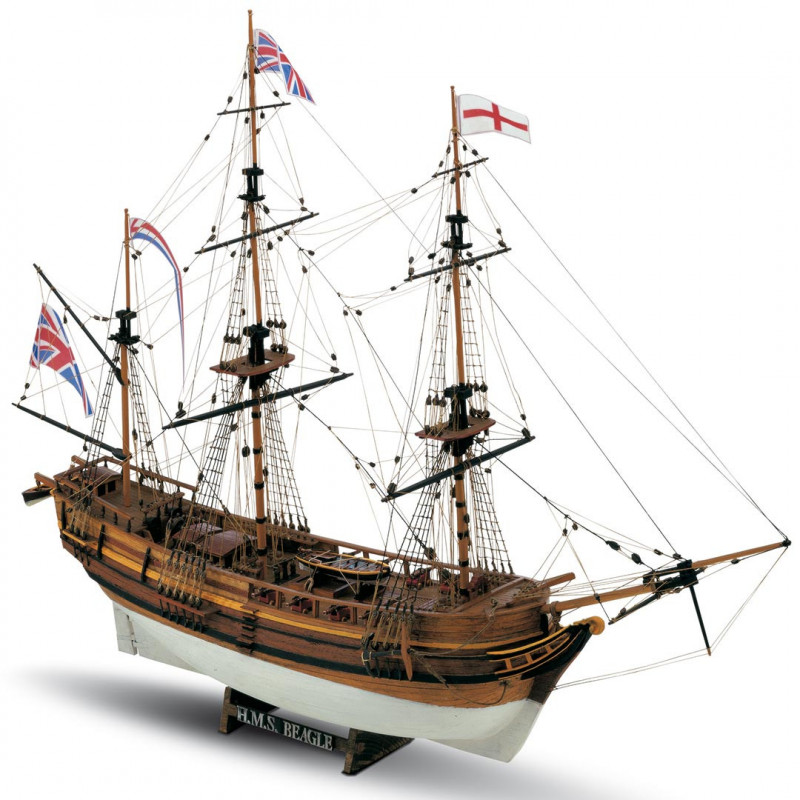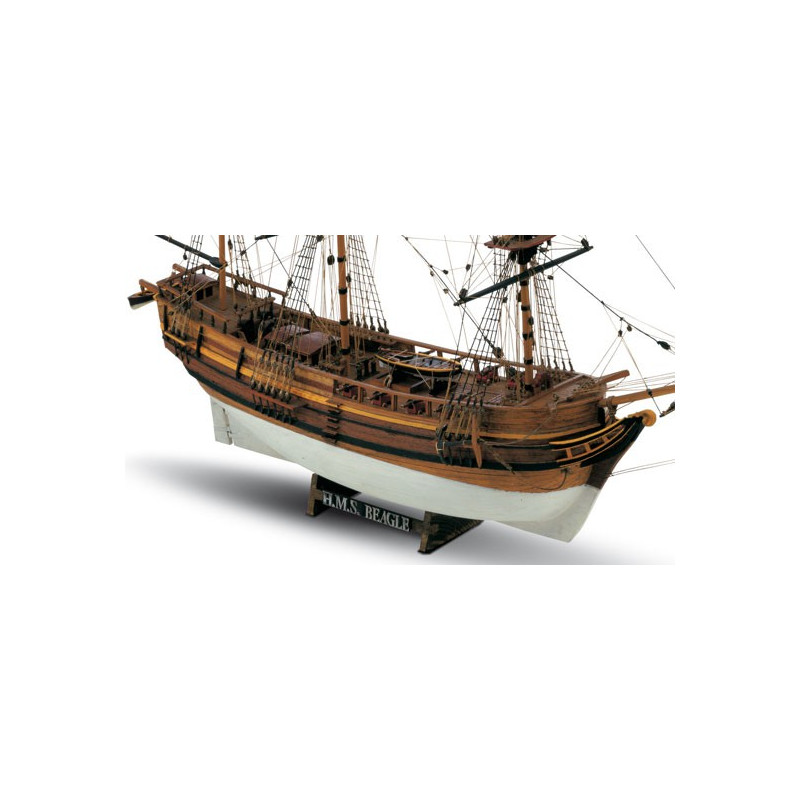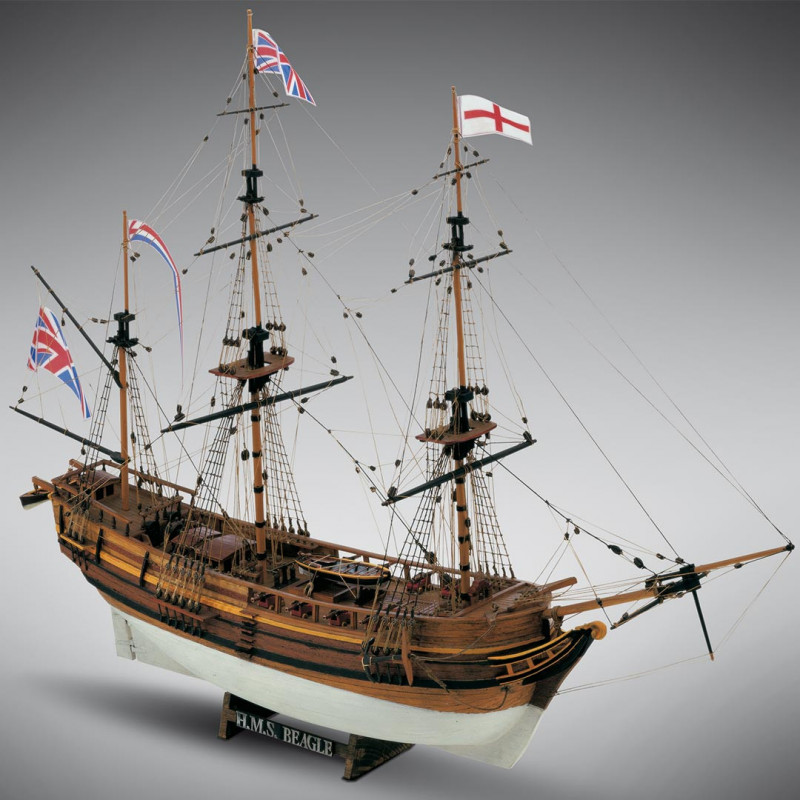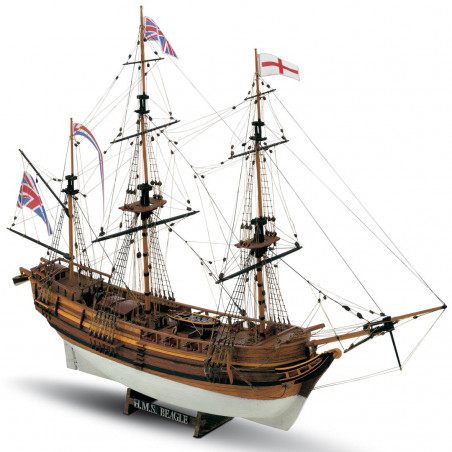
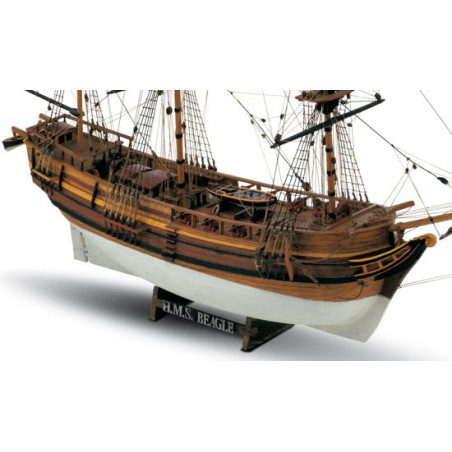
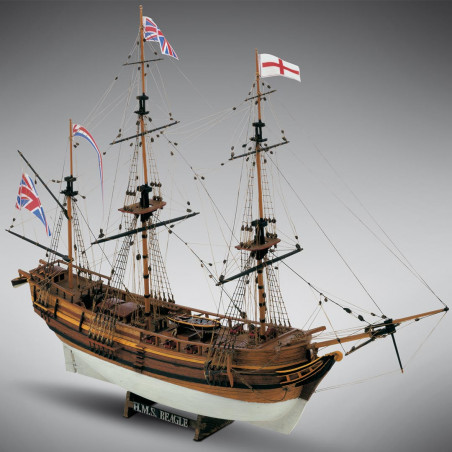
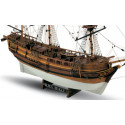
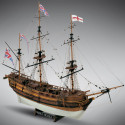
Relive one of the most famous scientific expeditions of the 19th century with the HMS Beagle wooden ship model 1/64 by Mamoli, reference MV20 / Z49MV20.
This naval modeling kit reproduces the British ship on which Charles Darwin embarked on his journey around the world between 1831 and 1836.
With its double-planked hull, three masts, fittings, and detailed rigging, this reproduction allows you to discover the characteristics of a historic sailing ship associated with great maritime explorations.
Measuring 64.5 cm in length and 47.8 cm in height once assembled, the HMS Beagle Mamoli model combines a wooden structure to be built on frames, planking strips, deck elements, and numerous small parts intended to reproduce the ship's equipment.
Its assembly constitutes a particularly interesting project for enthusiasts of wooden ship models wishing to deepen their construction, finishing, and rigging skills.

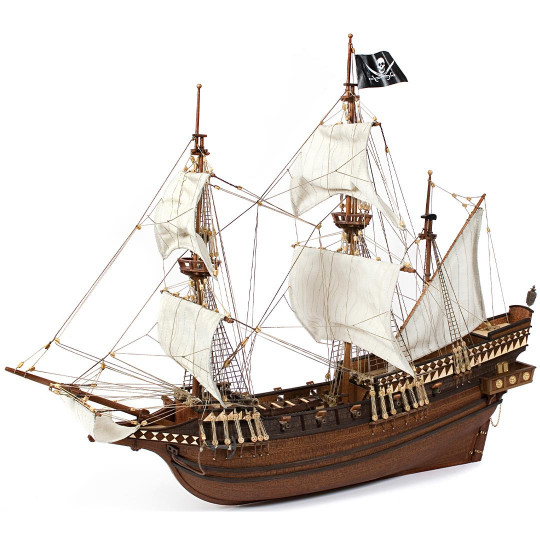
Static ship H.M.S. Beagle 1-64 - Mamoli MV20
|
|

|
HMS Beagle Paint Pack - 8 pots - OcCre€36.95 - ref. S06190514 |
|
|

|
Set of 3 specific brushes for wooden boat model - OcCRE€5.95 - ref. S06110511 |
|
|

|
100 ml white glue for white glue model€8.80 - ref. S0681015 |
|
|
|
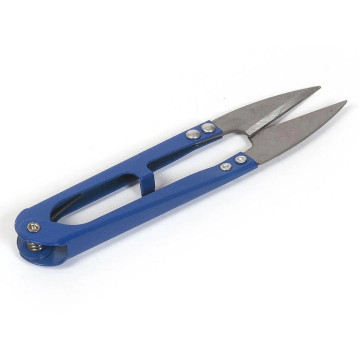
Wire cutter for boat rigging - Occre€3.95 - ref. S06110513 |
Fast shipping
Via Chronopost 24H
Via DPD 24/48H
Colissimo 48/72H
334680 products in stock
Real-time stock displayed
Secure payment




Secure payment
In 3 or 4 installments

 4.6/5

Specialist since 1955
Fast shipping
Via Chronopost 24H
Via DPD 24/48H
Colissimo 48/72H
334680 products in stock
Real-time stock displayed
Secure payment
Secure payment
In 3 or 4 installments
4.6/5
Specialist since 1955
The HMS Beagle is a Royal Navy ship launched on May 11, 1820, at the Woolwich shipyard on the Thames, in England.
It belongs to the Cherokee class, a series of British military ships designed for various navigation and maritime surveillance missions.
Initially built as a brig-sloop, the Beagle has a sturdy hull suitable for sea operations.
It then participates in several hydrographic expeditions, during which its crew is tasked with surveying the coasts, studying navigation conditions, and conducting cartographic work.
The ship undergoes various transformations to meet the needs of its scientific missions. Its rigging notably evolves into a three-masted barque configuration, with a third mast at the rear, called the mizzen mast.
This transformation facilitates the ship's handling and helps adapt its nautical qualities to long crossings and coastal reconnaissance work.
On December 27, 1831, the HMS Beagle leaves Plymouth, England, under the command of Captain Robert FitzRoy. The ship then embarks on an expedition primarily aimed at continuing the hydrographic surveys of the South American coasts.
Among those on board is the young British naturalist Charles Darwin, aged 22 at the start of the voyage. His mission includes observing landscapes, studying geology, collecting specimens, and documenting the animal and plant species encountered.
During this expedition, the Beagle crosses the Atlantic Ocean, skirts the coasts of Brazil, Argentina, and Chile, and explores several regions of the Pacific Ocean.
The ship notably stops at the Galápagos Islands in 1835, where Darwin studies the archipelago's fauna and flora. His observations contribute to a scientific reflection that will, several years later, lead to the development of his theory of evolution by natural selection.
The HMS Beagle returns to England on October 2, 1836, after nearly five years of navigation.
The voyage of the Beagle holds a major place in the history of natural sciences. The observations collected by Darwin concerning geology, fossils, and species distribution form an important basis for his later research.
In 1859, Charles Darwin publishes his work On the Origin of Species, in which he develops his theory of evolution by natural selection.
The HMS Beagle remains today one of the ships most closely associated with the history of scientific exploration. Its model reproduction allows for the rediscovery of the architecture of a 19th-century British ship while evoking an expedition that profoundly marked the history of biology.
The HMS Beagle Mamoli MV20 is a wooden ship model kit, reproducing the British exploration ship in its three-masted barque configuration.
Its 1/64 scale allows for detailed work on the hull, decks, rigging, and various fitting elements while maintaining dimensions suitable for display.
Manufacturer: Mamoli / Dušek Ship Kits
Manufacturer Reference: MV20
Scientific-MHD Reference: Z49MV20
Ship Name: HMS Beagle
Era Represented: 19th century
Ship Type: three-masted exploration barque
Scale: 1/64
Assembled Model Length: 645 mm (64.5 cm)
Assembled Model Height: 478 mm (47.8 cm)
Model Type: static wooden naval model
Construction: double-planked hull on frames
Materials: wood, metal, and rigging
Documentation: plans and assembly instructions, notably in French
Recommended Level: intermediate to advanced.
The model is intended to be assembled and then displayed. It is not presented as a radio-controlled boat or a ready-to-sail model.
The construction of the HMS Beagle Mamoli is based on a traditional naval modeling method: the plank-on-frame.
The assembly begins with the construction of the keel and the fifteen frames that make up the internal structure of the hull.
The various elements are positioned according to the plans to reproduce the general shape of the ship.
The official instructions recommend initially placing the frames without glue to check their fit and alignment.
This operation allows for the correction of any positional differences before final assembly.
The keel must remain perfectly straight during construction.
For this, it is recommended to use a stable mounting support to keep the structure in an upright position.
Once the frames are installed, the model maker continues with the deck elements, including the main deck, the foredeck, and the quarterdeck.
One of the technical features of the HMS Beagle wooden ship model lies in its double-planked hull.
This method involves covering the structure with two successive layers of wooden strips.
The first layer, made with softwood strips, forms the general curves of the hull. The strips are gradually adjusted, bent, and fixed onto the frames.
Once this first layer is completed, the model maker proceeds with the necessary correction and sanding operations to achieve a smooth surface.
The second layer uses thinner strips intended to form the visible outer coating.
It allows for working on the final appearance of the wood and integrating the wales, these longitudinal reinforcements that highlight the lines of the hull.
This double-planked construction offers a particularly interesting approach for enthusiasts wishing to master the traditional techniques of wooden ship modeling.
Bending the strips is an essential step in the planking process.
You can have at your disposal, to help bend the strips without breaking them, 2 tools manufactured by the company MANTUA: a pliers or a bending machine for the strips.
The shapes of the bow and stern require a progressive adaptation of the strips to respect the curves of the hull.
The Mamoli instructions particularly recommend softening certain strips with warm water before shaping them.
To avoid deformations, the planking must be done progressively by alternating operations on both sides of the ship.
After assembly, the surfaces are adjusted and then sanded to prepare for the finishes. The model maker can thus obtain a hull with regular lines, with a particularly neat appearance.
Once the hull is built, the assembly continues with the various deck fittings.
The Mamoli kit includes the construction of the main deck, the foredeck, and the quarterdeck. These structures accommodate the openings, navigation equipment, and elements necessary for the ship's various maneuvers.
The model maker must particularly prepare the hatches, stairs, and railings, respecting the dimensions and locations indicated in the plans.
The wooden strips used for the deck surfaces allow for reproducing the appearance of a historic sailboat's flooring.
The assembly instructions for the HMS Beagle Mamoli include several characteristic elements of a 19th-century ship's fittings.
The hatches allow for reproducing access to the lower spaces of the boat.
The skylights, placed on the decks, evoke the openings intended to bring light to the fittings located below the deck.
The kit also includes a reproduction of the rudder wheel, doors, stairs, and various deck equipment.
These small pieces require precision work to maintain the model's proportions and achieve a layout consistent with the plans.
The reproduction also includes rigging elements associated with the routine operations carried out on board.
The instructions particularly include the supports for the auxiliary boat, a pump, cleats, racks for maneuvers, and various elements for securing the ropes.
The installation of these accessories helps enrich the model's appearance and provides a better understanding of the organization of a British exploration ship's decks.
The components must be carefully prepared before their final installation, especially when several neighboring elements become difficult to access once assembled.
The HMS Beagle reproduced by Mamoli has three masts: the foremast, the mainmast, and the mizzenmast.
This arrangement corresponds to the barque three-masted configuration adopted by the ship during its hydrographic missions.
The assembly of the rigging includes the preparation of the different sections of the masts, yards, and pieces that allow their assembly.
The model maker must check the alignment of the masts and respect the positions indicated in the plans to maintain the ship's proportions.
The rigging of the HMS Beagle Mamoli MV20 is an important part of the construction.
The standing rigging includes shrouds and stays intended to support the masts.
The running rigging includes the various ropes used for maneuvering the yards and sails.
The Mamoli instructions show the paths of the ropes and the positions of the pulleys, attachment points, and other rigging equipment.
Installation requires careful organization to follow the assembly order and avoid making certain attachment points inaccessible.
The tension of the threads must also be controlled to maintain the masts without causing deformation.
The rigging materials include threads for maneuvers and fastening elements to be assembled according to the plans.
You can use the OcCRE thread cutter, specially designed for rigging wooden ship models.
Decorative flags are also part of the components described for the Mamoli MV20 kit.
The work on the ropes allows for the reproduction of the characteristic lines of a 19th-century British ship's rigging.
To limit the fraying of certain threads, a light treatment with beeswax suitable for modeling can be considered, after checking its compatibility with the materials used.
The HMS Beagle 1/64 model is offered as a construction kit containing the main materials needed to create the static model.
The kit includes:
Glue, paints, and modeling tools must be provided separately.
Fabric sails are not included and must be purchased separately.
The HMS Beagle Mamoli model is primarily aimed at naval modeling enthusiasts who already have some knowledge of wooden construction or wish to undertake a detailed assembly project.
Its level can be considered intermediate to advanced, due to the construction of a double-planked hull, the presence of numerous deck pieces, and the assembly of a three-masted rigging.
The construction allows for the development of various skills:
The kit includes technical plans and detailed construction instructions. A French version allows for following the different assembly steps.
The documentation describes the order of assembly for the hull elements, the position of the frames, planking operations, and the creation of deck equipment.
The plans also show the paths of the rigging ropes, the different mast pieces, and the attachment points necessary for their installation.
Before starting, it is recommended to study all the documents to identify the steps that require special preparations.
The construction of this wooden naval model requires modeling equipment suitable for small parts and the materials used.
The Mamoli instructions recommend sandpaper of different grains, a small hammer, pliers, a modeling knife, scissors, a mini-drill, and tools to facilitate the bending of strips.
White wood glue and instant glue suitable for the assemblies concerned can be useful for the various operations.
Holding clamps and a stable construction stand also facilitate the positioning of elements during gluing.
To build a regular hull, it is advisable to start by checking the position of all the frames.
The strips should then be gradually prepared, adapting their curvature to the shapes of the hull.
Gluing the strips alternately on both sides of the model helps to limit the risk of deformation during planking work.
Before starting the second layer of planking, it is advisable to check the regularity of the first and perform the necessary sanding operations.
Painting and finishing operations should be organized according to the assembly stages.
Some deck and rigging elements may become difficult to access after the installation of masts and ropes.
For wooden parts, it is recommended to conduct tests on scraps before applying paint, stain, or varnish to visible surfaces.
The handling of fine elements should remain gradual to avoid damaging the parts and misaligning already assembled accessories.
With a length of 64.5 cm, the HMS Beagle Mamoli model represents an interesting collectible for enthusiasts of historical sailing ships and scientific explorations.
Its wooden hull, three masts, and numerous ropes allow for the characteristic silhouette of a 19th-century British ship.
Once completed, the model can be installed on a suitable display stand or placed in a sufficiently large showcase to protect the rigging and fragile elements.
Diorama enthusiasts can also consider a presentation of the HMS Beagle inspired by one of the stages of its world voyage.
A setting evoking a 19th-century British port, the coasts of South America, or the Galápagos Islands can offer a historical context to the ship's reproduction.
It is then necessary to adapt the decor to the 1/64 scale and plan the complementary elements separately.
Such a presentation allows for the association of naval modeling with the history of great scientific expeditions and exploration voyages.
The HMS Beagle Mamoli MV20 model, reference Scientific-MHD Z49MV20, is made at a 1/64 scale.
It reproduces the famous British ship used for 19th-century hydrographic and scientific expeditions.
Once completed, the model measures 645 mm in length and 478 mm in height, or 64.5 cm long and 47.8 cm high.
These dimensions correspond to the official data from the manufacturer Mamoli / Dušek Ship Kits.
The HMS Beagle was built as a brig-sloop of the Royal Navy. It was later transformed and equipped with a third mast for its exploration missions.
The Mamoli model represents the ship in its three-masted barque configuration.
Yes. The Mamoli MV20 kit provides for a double-planked construction on frames.
The first layer forms the hull, while the second, made of finer strips, allows for the exterior cladding and its finish.
This model is mainly recommended for intermediate to advanced modelers.
Its construction requires mastering several precision operations, including hull planking, deck equipment assembly, and the creation of the three-masted rigging.
The kit mainly uses wooden parts and strips for the hull, decks, and masts. It also includes metal rigging elements and threads for the rigging.
Construction requires a precision cutter, pliers, sandpaper, a mini-drill, a small hammer, and strip bending tools. Wood glue and adhesives suitable for the materials used should also be provided.
No. Glues, paints, and modeling tools must be provided separately. It is advisable to choose products compatible with the kit's materials and the desired type of finish.
Both manufacturers offer wooden reproductions of Charles Darwin's exploration ship, but they are distinct kits.
The HMS Beagle Mamoli MV20 is at a 1/64 scale, with a length of 645 mm, while the OcCre 12005 version is announced at a 1/60 scale, with a length of 720 mm.
The contents and assembly methods should be compared from the sheets specific to each manufacturer.
Yes. This static model can be displayed in a showcase suitable for its dimensions. A transparent protection helps limit dust deposits on the decks, masts, rigging, and fittings.
The HMS Beagle Mamoli MV20 model combines the reproduction of a major historical ship with a wooden shipbuilding project.
Its double planking, deck equipment, and detailed rigging allow for deepening modeling techniques while rediscovering Charles Darwin's scientific expedition.
The manufacturers OcCre and Mamoli offer two wooden models of the HMS Beagle, the famous exploration ship of Charles Darwin, with different characteristics and assembly experiences.
The HMS Beagle OcCre 12005 model, at a 1/60 scale, measures 72 cm in length and 48 cm in height.
It includes 5,095 pieces, sails, a display stand, and benefits from detailed video tutorials, step-by-step photographs, and instructions available in five languages.
It is thus an interesting choice for modelers seeking visual support throughout the construction.
On the other hand, the HMS Beagle Mamoli MV20 model, at a 1/64 scale, measures 64.5 cm in length and 47.8 cm in height.
It stands out with a traditional double-planked hull construction on frames, detailed deck arrangements, and assembly plans accompanied by instructions in French.
It is particularly suitable for enthusiasts wishing to deepen their naval modeling techniques and work on the different construction stages of a historical sailing ship.
The choice between these two reproductions mainly depends on the desired scale, available display space, preferred assembly techniques, and the level of support desired.
Customers who bought this product also bought: